Video of the Divine Service is here. The sermon begins around the 25:45 mark.
In the Name of the Father and of the Son and of the Holy Spirit. Amen.
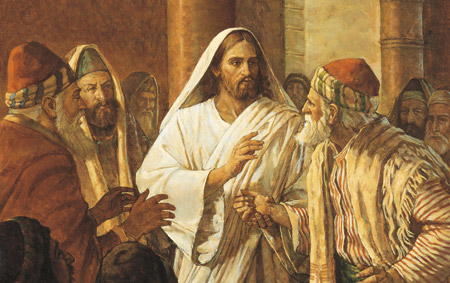
About those tassels on the robes of the Pharisees: According to God through Moses, the tassels on their robes were “to look at and remember the commandments of Yahweh, to do them, and not to follow after your own heart and your eyes, which you are inclined to whore after” (Numbers 15:39). In other words, the tassels on the robes were to point them to God’s Word. And that is true of everything that has ever existed in God’s creation. Adam and Eve were supposed to see the creation, and the Garden, and the Trees in the center, and each other, and their praise and thanksgiving was meant to rise to God, from whom all of this had come. We look at the tops of the mountains, but those mountains point to their Creator. We look at the breadth or the depth of the ocean, but those oceans are meant to direct our attention to their Maker. We look at other people, and we should consider the God who made them and redeemed them. We look at ourselves, and we should remember the God who made us, into whose Name we have been baptized, to whom we belong in body and soul. You are not your own! You were bought with a price. So glorify God with your body, not just your soul, or your mind (1 Corinthians 6:19-20).
But it’s so easy to stop at the creation, at ourselves and what we’re doing, or other people and what they’re doing. Let’s understand that the Pharisees are not the evil people we often think. If you call someone today a Pharisee, that’s not going to go over well. It’s a negative thing, almost a slur. But if you called someone a Pharisee in Jesus’ day, that would have been just about the best thing someone could be. The Pharisees are not the worst people; they’re the best. They’re the sort of people everyone looked up to; the ones everyone would want in their synagogues; people would have considered them the best examples of how to follow God’s law. But because of our modern use of the word “hypocrite,” we can be mislead by the English here, when it says they “preach but do not practice.” That’s too close to the sort of thing we say, “practice what you preach,” or “that person doesn’t practice what he preaches.” That is what we mean by “hypocrite,” but it’s not what Jesus means. Jesus says that the scribes and Pharisees sit on the seat of Moses, which presumably means something like they repeat what Moses says. Whenever they preach what Moses says, they are saying things that the disciples and the crowds are to do and keep. Whenever they preach what Moses said, they are in fact preaching Jesus, who is the fulfillment of the Law and the Prophets.
The problem is not that the Pharisees do not practice what they preach. In fact, they practice exactly what they preach: do these commandments so that you don’t break any of the commandments of God. What they’re not practicing is what God preaches. It is not that their works do not line up with their words, it’s that their works don’t line up with God’s words. Jesus describes their works: they put heavy burdens, hard to bear, on people’s shoulders, but they do nothing to assist the people who struggle under the weight of those burdens. They cannot lift the burden either of God’s Law or their commands. Their works are done so that people will see them and honor them. They wear their boxes of Scripture and make them big, either so that people can see how holy they are, or perhaps even as superstitious charms to keep them safe. They lengthen the tassels on their garments, but they don’t look at and remember the commandments of Yahweh; they point to themselves. Their works are to love sitting in the best seats at feasts, and the best seats in the synagogues; their works are to love greetings in the marketplaces, to be recognized as important teachers by the people. Their works are reveling in the honor given to them.
And these works of the Pharisees are not alien to us. Who doesn’t want to be honored and appreciated? Who doesn’t want to be seen as holy and good, maybe even as better than other people? Humility does not come naturally to sinners. But of course those actions are not the main problem; it’s the heart from which our works flow. And that’s how it is with God: people can only see outward works and judge people by those works, whether for good or bad. God, though, sees the heart, and it’s only the heart that matters. Sometimes when we talk about the heart, we mean someone’s motivation. So we think that if someone’s motivation is good, then we can judge the works good. If someone messes up, but we think the person’s motivation was good, we can excuse the mess that person makes. I meant well. It’s the thought that counts. Those are the sorts of things we say when we are trying to cover up the stupid, bad, or evil things we do.
When God looks at the heart, He’s not looking for a good motivation. In fact, if we’re honest with ourselves, I would guess that we do more good things out of bad motives than bad things out of good motives. But whether that’s true or not, God is not looking at your motivation. He doesn’t want a heart that means well, as if good intentions covered a multitude of sins. No, the heart that God wants is a heart that fears, loves, and trusts in Him above all things, and that loves your neighbor completely and wholly. And insofar as we are directing attention to ourselves—even hoping that attention will come our way—we are not trusting God completely or loving our neighbor fully. More than that, we might even be taking honor away from God by receiving it for ourselves. When we’re dealing with God’s word and God’s gifts, both for this life and for eternal life, the source of that word or those gifts cannot be anywhere else than in God Himself.
That’s what Jesus is getting at by comparing the works of the Pharisees with the Word of God. Their hypocrisy is that they command works that they think they and other people can do, but without right hearts that do not fear, love, and trust God alone. It is true that they are not fully keeping the Law, partly because they have softened the Law to make it doable by works, neglecting the heart of the one doing the works. But the real problem is not simply about what they’ve done and not done. It is, before anything else, that their eyes are directed at the Law and not at the one in whom the entire Law and all the Prophets and all the Psalms are fulfilled. To hear Moses rightly would be to believe Jesus, since Moses spoke of Him when he said that God would raise up a prophet like him from among the people of Israel. Their horizon only extends as far as the bare words, when it should extend to the Word of God made flesh, standing in their midst.
And how often do we identify Christianity by what people do or don’t do? How often do we make the keeping of God’s law a matter of moralistic demands, and make Jesus a new and better law-giver, or forget altogether that He is in our midst? If we stop there at the Law, and do not continue on to the One who instructs in the true meaning of the Law, then we are no different from the Pharisees and scribes. People might say we’re good people, like they would have said of the Pharisees. But that won’t get you anything beyond those nice words. Jesus does not repeat and explain the Law in terms that make it possible for us to rely on our keeping of it, even if everyone else thinks we’re nice and good and even holy. He gets right to the heart of the matter and to the evil root of our sinful actions.
The Pharisees lay heavy burdens of commandments on people. But Jesus lays the killing burden of the cross on us. They wanted everyone’s eyes directed at them, but Jesus becomes a servant and a criminal, unrecognized and dishonored. They could not lift those burdens, but Jesus takes the entire burden, both of the Law and of its breaking. He fulfills with a pure heart the heart of the Law and fully fears, loves, and trusts His heavenly Father. And then He bears that burden to the cross. This is how He can say what neither the Pharisees nor anyone else can say: “Come to Me all who are weary and heavy-laden, and I will give you rest. I am gentle and lowly in heart; learn from Me and you will find rest for your souls.” Neither the Pharisees nor anyone else is the true Instructor of the Word of God. But Jesus is. The only true Interpreter of God’s word is Jesus. The only true Source of everything is the Father through the Son. Every father, every teacher, every pastor has nothing to give, nothing to teach, nothing to do except what God gives in Jesus Christ.
We exalt ourselves, though we are the ones who should be humble. Jesus humbles Himself, though He is the only one who should be exalted. The greatest One becomes our servant, takes up the Law, fulfills it, and dies as if He were the only one who had broken it. And then He gives you the honor of sharing in His death and resurrection as if you had never broken the Law. Instead of tassels and phylacteries to point you to His Father, He gives you water, and words, and bread and wine, in which are His very body and blood, His voice, His salvation. Here is the One whom the Father sent as Instructor of the whole world, the Word that the Father has spoken so that every ear will be opened and every heart made new. To you He speaks, and to you He gives His living Words, to do and to keep forever, because His words alone give eternal life.
In the Name of the Father and of the Son and of the Holy Spirit. Amen. “And the peace of God, which surpasses all understanding, will guard your hearts and your minds in Christ Jesus” (Philippians 4:7, ESV). Amen.
– Pr. Timothy Winterstein, 11/1/23
 Bishop and Christian