Video of the Divine Service is here. The sermon begins around the 27:30 mark.
In the Name of the Father and of the Son and of the Holy Spirit. Amen.
This passage from Mark’s Gospel is full of doubles: words and phrases repeated. The whole thing forms a double, with the frame of Jairus and his daughter surrounding the account of the woman with the hemorrhage. The woman has been suffering for 12 years; we find out at the end that the girl is 12 years old. Jairus tells Jesus that his little daughter is at her end; and Jesus calls the woman “Daughter.” Jairus falls at Jesus’ feet and the woman does, as well. The woman is afraid, and Jesus tells her that her faith has healed her. Jesus tells Jairus not to be afraid, but to believe. Jesus asks, “Who touched Me?” and the disciples repeat, “You ask, ‘Who touched Me’?” There is a commotion and weeping at Jairus’ house, and Jesus says, “Why are you making a commotion and weeping? She is not dead; she’s only asleep.”
All these repetitions, these doubles, point to the fact that there is a double problem in this account, and it’s often where we locate our problems: in suffering and death. Those are the symptoms, those are the fruit; but the real problem is sin. Death is the wages of sin. Suffering is because of sin. There is not a one-to-one correspondence between sin and suffering. It is not as if you do this one bad thing and you suffer in this way. It is not because they were greater sinners that the tower of Siloam fell on those people. Job was not worse than everyone else because he suffered in those ways. But the ultimate root of all suffering and death is sin, which goes back to the Garden. In the day you eat of it, you shall die. In the day that you trust your desires, your will, your opinion, your judgment about what is good and right, over what God has said; you will die. As if there could be any distance between what God, our Creator has said, and what is good. As if we could somehow get behind or beyond God’s words and find out some good thing that He’s been keeping from us. That’s the root from which grows all the bitter fruit of suffering and death, the curse on this creation, and everything that goes along with it.
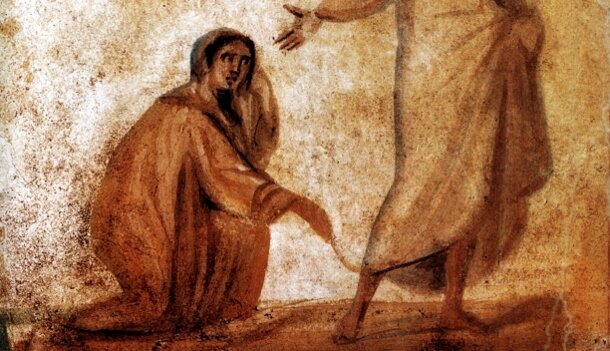
And yet, Jesus is confronted first with simply the suffering, simply the nearness of death. And He doesn’t say, as He does elsewhere, “your sins are forgiven.” We see the heart of God’s compassion in Jesus. He simply goes with Jairus to his house. While they are on the way, He is stopped by the touch of a woman. She has been suffering with this hemorrhage for 12 years. She’s spent everything. No one has helped her. She’s only gotten worse. Perhaps you know something similar. On top of that, this is probably a constant menstrual bleeding, which means she cannot go into the temple. This would explain why she tries to gain healing secretly. She is full of shame and fear. But Jesus brings her out into the open—not to expose her shame, but to bring her healing and His mercy into the open. To give her a word, and not just some power: Daughter! Your faith has healed you. Go in peace, and be healed of your affliction. That word for “disease” is a severe word. It can also be used of whips; it is torment and suffering, and she has been set free.
While this is happening, Jairus’ daughter has died. What can Jesus do now? Do not bother Him anymore. Do not be afraid, Jesus says; only believe. The mourners laugh at Jesus, as the unbelievers still do. But Jesus says in Aramaic, “Talitha cumi: little girl, get up!” And she does.
To this double problem, Jesus brings a double promise. He has appeared in this world to bring an end to suffering and death. But He doesn’t heal everyone in the same way He heals the woman. He doesn’t raise every dead body, the way He raises Jairus’ daughter. That is because neither of those things will bring suffering and death to an end. Both the healing and the raising will only be temporary for that woman and that girl. But He demonstrates who He is, and what He has come to do. This is the result of what He will do in His death and resurrection, when He removes sin by His own crucifixion and death. He hasn’t come just to put death off a little longer, or remove suffering for a little while. He’s come to do that permanently, and as long as this world is the way it is, as long as sinners remain sinners, suffering and death continue.
They continue for you. And He may indeed heal you temporarily. It’s good. Jesus does it. In fact, every time you recover from a sickness, that is God healing you temporarily. Every time a cut on your finger heals, He heals you temporarily. But the day is coming when you will not recover, when you will not be healed. The wages of sin is death. But those are wages you cannot fully pay, even with your own death. So Jesus dies to pay it fully, completely, forever; to bring sin, suffering, and death to an end, once and for all. And then He gives you that life in words of forgiveness, in the living and divine life of God in His body and blood. He gives you a double promise for your sin, sickness, suffering, and death: He is the resurrection and the life. If you have Him, then you have life, even if you die. This is the salvation of God, which is the word translated as “healing” in this passage. That is because we often think of salvation as something that happens to our souls. So we are “saved,” and our bodies die and stay here, while we go to heaven. But this word is not just about your soul being healed, as if that were the only thing that matters. No, salvation is not for souls; it’s for people, who are bodies and souls! You are meant to be healed as a person, in both soul and body. Sin and death are not unrelated problems: they are directly related, and people need to be healed of both of them. You have been healed of sin, and you will be healed of death. Your sin, suffering, and death will all come to their end. And the promise will be true for you: when Jesus appears, and the trumpet sounds, and the archangel shouts, then the dead in Christ will rise first. And then all those who are alive will be caught up together with Jesus in the air, and, as Paul declares elsewhere, your lowly body will be transformed to be like His glorious body. Your mortal body will put on His immortality. You will receive from the Lord’s hand double for all your sins (Isaiah 40:2).
Here is the double promise for your double problem: The steadfast love of Yahweh never ceases; His mercies never come to their end; they are new every morning; great is Your faithfulness, O Lord. In light of that promise, it is good to wait quietly for Yahweh, for His salvation. For the Lord will not cast off forever. Though He cause grief, He will have compassion according to the abundance of His steadfast love; He does not willingly afflict or grieve the children of men. But He does willingly save and heal. He does willingly enter flesh, and die. He does willingly give you forgiveness, and life, and salvation. He does willingly keep you until the day when you see His salvation face to face. And nothing in all creation can separate you from that love of God in Christ Jesus. Nothing can snatch you from His hand, from the love in which He has enfolded you. Do not be afraid; only believe Him. He is faithful. He will surely do it.
In the Name of the Father and of the Son and of the Holy Spirit. Amen. “And the peace of God, which surpasses all understanding, will guard your hearts and your minds in Christ Jesus” (Philippians 4:7, ESV). Amen.
– Pr. Timothy Winterstein, 6/28/24
 Bishop and Christian