Audio of the sermon is here:
In the Name of the Father and of the Son and of the Holy Spirit. Amen.
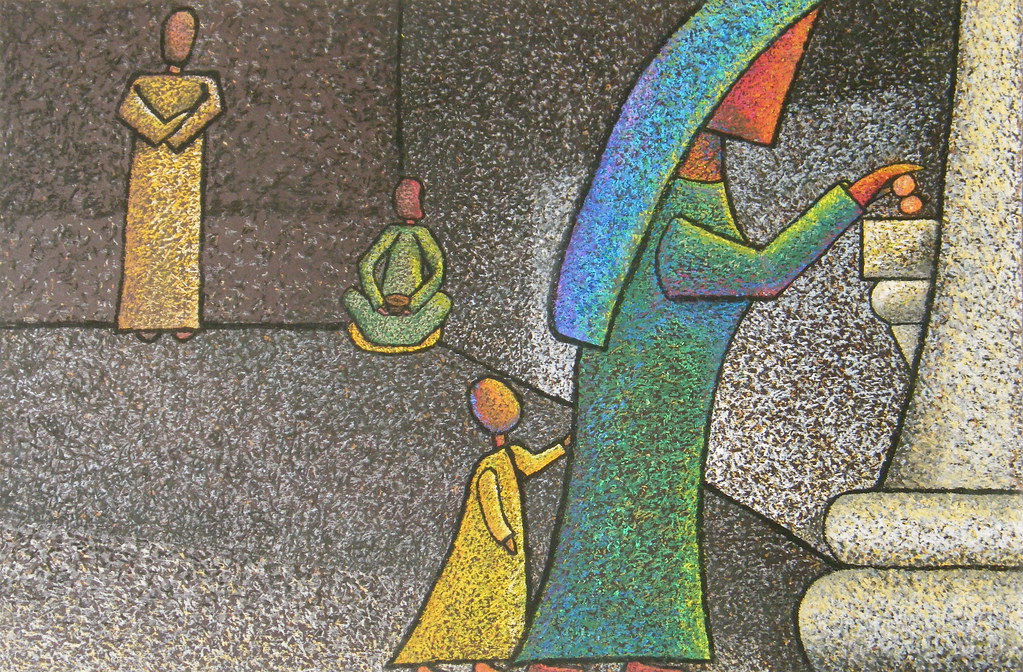
In the economy of God, everything is reversed. The rich go away sorrowful, and the poor rejoice in God’s blessing. Whoever would save his life will lose it, but whoever loses his life for the sake of Christ and the Gospel will save it. Little children and blind men and lowly servants—the last—are welcomed into the Kingdom ahead of those who would claim the first and honorable seats. A poor widow silently throws in two small, copper coins and so appears as the one who loves God with her whole life; the rich throw in many coins with a loud clatter, but they give much less than the widow. Jesus sits in the Temple watching this during the last week of His life on earth, and, for those who have eyes to see, He never stops drawing the picture of the Reign of God. He says that the leaders of the temple and synagogue had reversed God’s economy to their own advantage. They were acting in ways directly opposed to the ways God acts. The whole system had gone fundamentally wrong. And the illustration of this is the widow, in sharp contrast to the scribes—perhaps the very scribes who had devoured this widow’s house. So Jesus calls His disciples to Him, and teaches them, once again, what the Reign of God looks like. It looks like—well, like something that could easily be missed: a widow giving her last two pennies to the poor.
God’s Reign doesn’t work like the machinery of this world, well-oiled with wealth and power. It doesn’t come in with long robes, to be recognized and greeted in the marketplaces of this world; it doesn’t care about sitting where it can be seen; the Reign of God comes in on a donkey, welcoming widows and blind men and all the other spiritual and financial nobodies. It comes in carrying a cross to the place of crucifixion, forgiving those who do not even realize what they’re doing. It doesn’t need money or influence or even success. It doesn’t need to win votes by shaking hands and kissing babies and flashing gold-toothed smiles. It doesn’t even try. In the economy of God, everything is reversed.
In the economy of God, if you have a little you give a lot, and if you have a lot (and in this country, relative to the rest of the world, there are very few of us who don’t) you give more. Now, only Jesus and you know what percentage of your income you give away. Only Jesus and I know what I give away. But we all know, Jesus included, that we’re not very good at it. I worry whether I’ll have enough to cover my automatic bill pay. When I receive extra money, I’m not looking to give it to my neighbor who needs it, I’m looking at what I can buy. Oh, I might have good intentions some of the time, but what Jesus sees in the Temple shows me just how far I am from trusting Him to provide for me. Just how far I am from being selfless and the servant of all. Maybe I give 10%, but that still leaves 90% that I spend on myself, or to pay off what I’ve already spent on myself; 90% that that feeds my technological and material and consumptive addictions. And it’s not just money, of course. Besides my money, there’s my time and my energy, all spent in my economy. “And Jesus looked around and said to his disciples, ‘How difficult it will be for those who have wealth to enter the kingdom of God!’ And the disciples were amazed at his words. But Jesus said to them again, ‘Children, how difficult it is to enter the kingdom of God! It is easier for a camel to go through the eye of a needle than for a rich person to enter the kingdom of God’” (Mark 10:23-25). In fact, it is impossible for a rich person. It’s impossible for a poor person, for that matter. But not for God. All things are possible for God, even being born as a Man from the womb of a virgin; even the Creator serving the creatures as one of them; even God dying to give life to the poor, and the wretched, and the blind. Because everything is reversed in the economy of God: greatness in the eyes of people means nothing to God. God can destroy kings, presidents, governments, and economies in an instant. Cash, stocks, bonds, and 401(k)s mean nothing to God. He can take them away or give them as He chooses; all creation, including the wealth of nations, is His.
Which makes it all the more shocking, then, that the greatest, the One who actually did deserve to be greeted and welcomed and sit in the best places and to be heard—He appears as nothing, without a place to lay His head. He dies naked and without a single copper coin to His Name. And He did it so that the poor in spirit could be blessed with the richness of His mercy. He did it so that the rich might recognize their poverty before God and follow Him. He did it so that our money and everything else we own, every single cent of which He has given to us, would no longer have any hold on us. What do dead men have to do with money and wealth? And that is what you are. Dead to this world and its economy, and alive to God in Jesus Christ. Your flesh, which, if it is like mine, loves all the things money can buy, was crucified with Christ. Because of your baptism into Christ, it is daily drowned and dies with all sins and evil desires, including the evil desire to have more and give less.
The great reversal that we see at the heart of God’s economy in Jesus might explain why Jesus points out this widow to His disciples. This Gospel reading is not ultimately about how much “time, talent, and treasure” we should give, although we can certainly always do better at that. It is good for our neighbor if we make such a habit of giving that it becomes a practice, which will form the virtue of generosity, which will help to form our character in this world. It is only a person with a particular sort of character who can give her last two pennies to the poor. But God could tell us all that without Jesus, and even without the Bible. In the law written on our hearts, we know that it is right and good to give to those in need. Jesus points out the widow not because she is primarily an example for us, but because she is, above all, a picture of Him in the week before He goes to the cross. She does with her money what He does with His life. She has had her house devoured by the scribes and still she gives all her money for the poor. He is crucified and swallowed up by death. All the way to His last breath, He gave His life for your death, His righteousness for your sin. He gives now His Body and Blood into the hands of poor sinners—to everyone, whether rich or poor.
In the economy of humans, where you have to give in order to get, this is impossible. In the economy of God, where we do not choose Him but He chooses us, even this impossible mercy is not just possible, but finished. It still looks like nothing, these words, that water, that bread and wine. But it is still worth more than all the money in the world. It’s worth more than you have and more than you could ever give. And it’s free for the taking, free for you and me and everyone. Because that’s how the economy of God works. You have been bought out by the Son of God; He’s put His Name on you and He owns you and all you have. And to those on whom He has put His Name, He gives freely and generously. “Almighty and ever-living God, You have given exceedingly great and precious promises to those who trust in You” (Collect for Pentecost 25). This is our God, who gives freely to all His people through Jesus Christ, and who uses you and me and all His people to give freely to those in need. “Oh give thanks to [Yahweh], for he is good, for his steadfast love endures forever!” (Psalm 107:1).
In the Name of the Father and of the Son and of the Holy Spirit. Amen. “And the peace of God, which surpasses all understanding, will guard your hearts and your minds in Christ Jesus” (Philippians 4:7, ESV). Amen.
— Pr. Timothy Winterstein, 11/8/24
 Bishop and Christian