Audio of the sermon is here:
In the Name of the Father and of the Son and of the Holy Spirit. Amen.
Whenever there are major events in the world, things that the whole world is watching, it’s easy to connect those things to ultimate things. Just to pull one example out of the air, I don’t know, maybe a presidential election or something like that. People suddenly get very apocalyptic. Or maybe there is some catastrophic event, some disaster, natural or otherwise. Whatever it is, when we see these sorts of things happening, we try to make sense of them. How do these things fit with the story I’m telling myself about the world, the story by which I make sense of the world? Maybe this thing or this person means the end of the earth, the end of the world, or maybe just the end of my life as I know it. Christians are certainly not immune to that sort of thinking. We also want to know what this or that event means, related to what we know or believe or confess. We know the story of the Scriptures. How does this event fit into that story? Maybe this is connected to the end of the world, to the appearance of Jesus in glory.
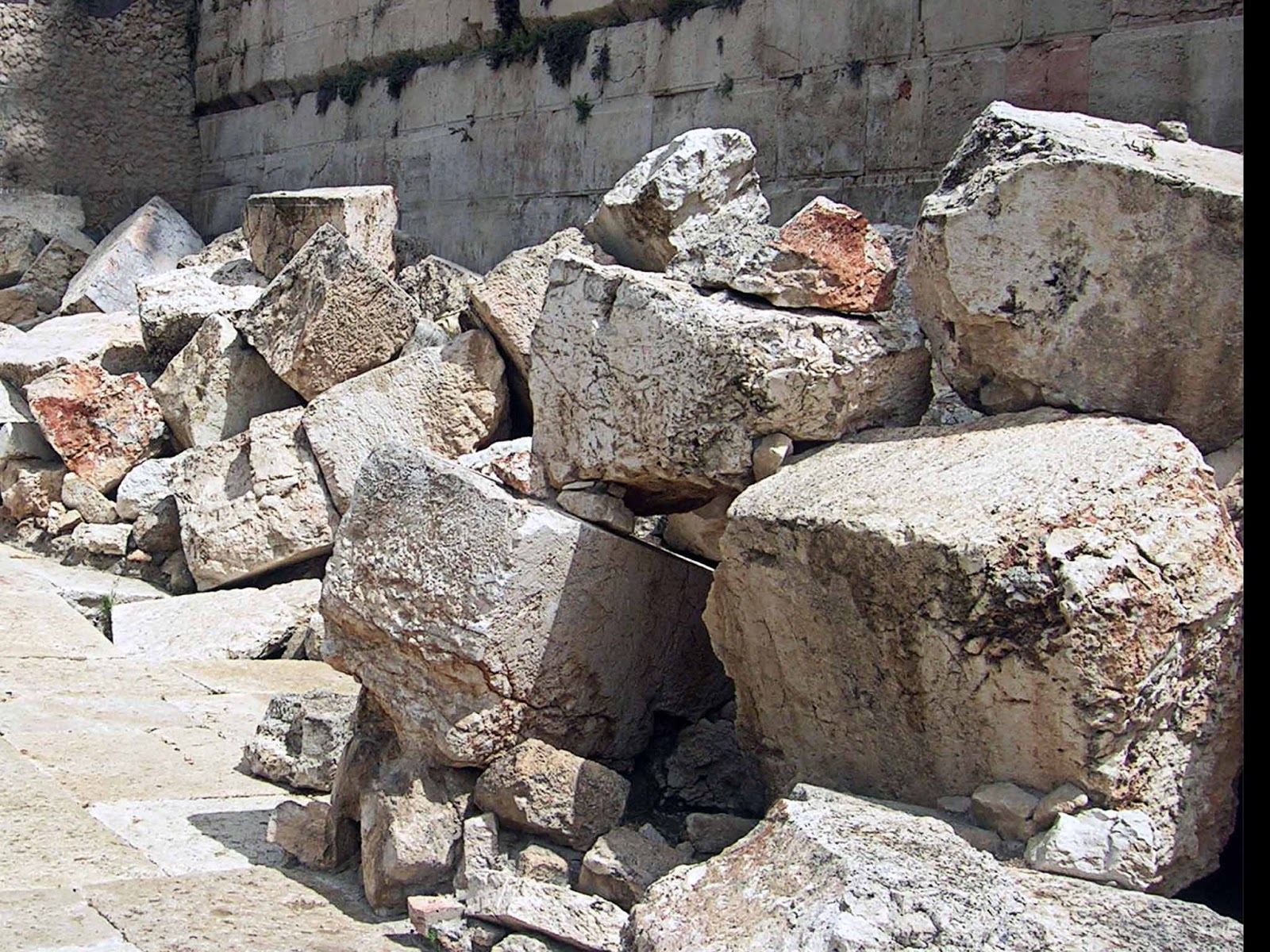
Jesus tells His disciples about an event like that. They are on their way out of the temple during what we call Holy Week, the last week of Jesus’ earthly life. The disciples are looking at the temple, and they say, “What sort of stones are these?” The Jewish historian Josephus describes the stones of the temple, and we can understand their astonishment. Some of the stones of the temple, according to Josephus, were like 67 feet long, 5 feet wide, and 6 feet long. Massive stones. So the disciples ask, what sort of stones are these? And Jesus tells them that there will not be a single one of those stones left on top of another. So, naturally, the disciples want to know, first, when these things will happen and, second, what will be the signs that all these things are about to be completed. Jesus does not directly answer the “when” question, although we know the answer. It happened in 70 AD, around 35 or 40 years after Jesus spoke these words. The Roman armies surrounded Jerusalem and besieged it. Josephus describes horrific things that happened during that siege. And finally the city and the temple were destroyed. And there has not been a temple in Jerusalem since that time.
Jesus does not tell them when, but He does give them some signs: wars, rumors of war, earthquakes, famine, discord within and between nations and kingdoms, betrayals and putting to death. And then, at the end of chapter 13, Jesus connects this event in 70 AD with the event of His appearance in glory. We might think that the destruction of Jerusalem doesn’t have much to do with us, and that may be, in large part, true. It doesn’t have much to do with us, except as a sign of Jesus’ final appearance; and for how Jesus tells His disciples that they should respond and react when they see all these things happening. Because the proper response of the disciples to things happening around them is also the proper response for us as Jesus’ disciples when things are happening around us.
Here in this section of Mark 13 that we heard this morning are four things that Jesus gives His disciples to do: first, they should not be led astray. It is easy, when everything is heightened, when everyone is on edge, when everything is at fever pitch, to be led astray. People are afraid, anxious, imagining the worst possible outcomes, weeping in public! We might be led into such a response to world events. Or, people are imagining the best possible outcomes, that everything is going to be the best it can be in this world. Paradise is on the horizon! Jesus says, do not be led astray. Many will come in My name, saying, “I am He,” and they will lead many astray. It happened before the destruction of Jerusalem, and it happens now.
Second, Jesus says, do not be afraid, ever. All these things are going to happen. Wars, reports of war, earthquakes, famine, nation against nation, and kingdom against kingdom. These things will happen, but do not be afraid, ever! Do not fear what can only kill your body, but not your soul. All these things were happening before the fall of Jerusalem, and they happen now. Do not be afraid because you do not belong to this world, with its upheaval, but to Jesus, who named you with His own name, and claimed you for His own. No one can remove you from His hand.
Third, be on your guard. These things may not be happening to us right now, although they’ve happened to Christians around the world. But they happened to the disciples in the Book of Acts. They were handed over, brought before the Sanhedrin, brought before leaders and kings and rulers. And they bore witness to them as the Spirit gave them the words. They testified of Jesus, who had died, but was risen from the dead. If it’s not happening to us—and it may or may not—then we should still be hearing the words of our Lord, by which the Spirit keeps us in the faith. We have the great blessing of the Scriptures in a book. We can read, mark, learn, and inwardly digest those words. We can hear and receive them, meditate on them. To have this book is not something that the vast majority of Christians have had.
Fourth, do not be anxious about what you will say if you are brought before the authorities and powers of this world. The apostles were not, and they spoke boldly and clearly of Jesus.
How could the disciples respond and react in these ways, when many around them were fearful, anxious, and being led astray, pulled away from Christ? Aren’t people fearful, anxious, and drifting from Christ around us? Not much has changed in that respect. How is it possible that we respond and react in these ways? Most people who are terrified about what is going to happen in the world, and most people who have put their hope in what will happen in this world, are looking to the future. They can let their imaginations run wild about what might or might not happen. The end of the world is still out there in the future. But not for you. Yes, Jesus will appear in glory to judge the living and the dead. But the end of the world has already come in Jesus. His death and resurrection are the end of this world as it is, the end of sin and death having any power over us. You have already died, Paul says. So you have that over and done with. You’re free to go about the work God has given you in this world, because the certainty of the future is tied to the certainty of what Jesus has already accomplished.
The end of the world is not tied to events around us, in front of us; what’s going to happen, whether good or bad. The end of the world is tied to Jesus’ crucifixion, resurrection, and ascension. That means that your response is not tied to what may or may not happen in this world before Jesus appears. Your response is also tied to the fact that you have already died, and your life is hidden with Christ in God. You know what will happen, because you belong to Jesus already. So we will hold fast to this confession of our hope, because we know that the one who has accomplished it and promised it to us is faithful. He will finish what He started, and bring it to its completion. He will keep you until the end, and this is why you can endure to the end and be saved. Endurance in Christ is not tied to simply keeping a stiff upper lip and bearing up under difficulties. Things are not easier for you because you are baptized. It doesn’t mean that bad things won’t happen to and around you. Endurance in Christ is tied to the fact of what He has done, not to your circumstances. Those change constantly. But your rest, your peace, your hope is only in Jesus. He has joined you to the new world, the new creation. He gives you His body and blood, in which He began the new creation. You have been joined to His death in baptism, and so you will certainly be joined to His resurrection. And so we continue to gather, not neglecting to meet together, as is the unfortunate habit of some; we gather in this place because we know that Jesus has promised to be with us where His word and sacraments are, and so we will be strengthened, forgiven, renewed to endure, no matter what comes. And we encourage one another, stirring each other up to love and good works, bearing one another’s burdens, reminding each other of our hope and life in Jesus. And all the more as we see that final Day approaching, when all that is faith will be made sight.
In the Name of the Father and of the Son and of the Holy Spirit. Amen. “And the peace of God, which surpasses all understanding, will guard your hearts and your minds in Christ Jesus,” (Philippians 4:7, ESV).
— Pr. Timothy Winterstein, 11/15/24
 Bishop and Christian