Audio of the sermon is here:
In the Name of the Father and of the Son and of the Holy Spirit. Amen.
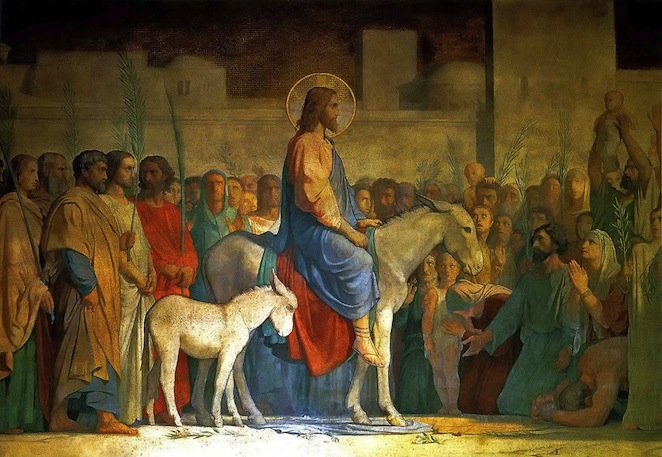
Even if you’ve been attending or been a member of a liturgical church, with a lectionary, for a long time, it can still be a little surprising, maybe even a little jarring, to come into the Lord’s house on the First Sunday in Advent, the beginning of a new church year, and hear this reading—today, from Luke 19. It’s a reading we associate with close to the end of the festival half of the church year, with Palm Sunday, Holy Week, the account of Jesus riding into Jerusalem on a donkey. This is probably my eighteenth Advent preaching, and it still kind of surprises me. It’s a little strange.
Or if it doesn’t strike you as strange, then maybe I can make it strange for you. Or if I can’t, maybe the world can make it strange for you. Because it’s certainly strange to the world. Not just the reading, but the entire fact of Advent. The world does not and cannot understand Advent. The closest the world can get, in the midst of all the shopping and buying, is that Advent must be the time of preparation for Christmas. So you can find Advent calendars, of a sort, in Kroger, but they all start on the first of December and end on the 25th—which is nice when Advent begins on the first of December. It works out well then. But Advent sometimes creeps into November, or a few days into December. Then we see that it doesn’t quite fit; something’s not quite right with Advent simply being preparation for Christmas.
Even in the Church, sometimes we start to think that way. And it makes sense, because that’s what we’re thinking about in our own lives. As soon as Thanksgiving’s over, we’re decorating, planning, buying; thinking about Christmas, preparing for Christmas. None of that is bad in itself, of course. But then you come in here, and it’s not quite what you expect. No Christmas hymns, no Christmas readings. We get Palm Sunday, John the Baptist, and nine months before Christmas.
But if we can understand what Advent is for, what it’s about, then we might be able to see why these are the readings; why the Church thinks this way, rather than another way. Why Advent is strange to the world, and why we might be strange to the world.
In the prophecy that is fulfilled in Luke 19, in Zechariah 9, God speaks through the prophet and says: Look! Your King is coming to you, righteous and having salvation; humble and riding on a donkey. You may know that “Advent” comes from a Latin word that means “coming.” Look, your King is coming to you. How does your King come to you? Certainly, He comes into this world in the flesh. We will celebrate His birth, but He was conceived by the Word of God in the womb of Mary nine months before that, which we celebrate at the end of March. He comes into the world as we all do. And then He comes into Jerusalem, to finish what He started in His conception. He rides in on a donkey in order to suffer, die, and rise from the dead. He does not come into the city on a war horse, with large armies, in order to overthrow governments and kingdoms, to conquer His enemies by force and power. He rides in humility to the cross. And then He rises and ascends to sit in the glory of the Father. And that same King, who came into the flesh, who came into Jerusalem, He will, as we confess, come again in glory to judge the living and the dead.
But that’s not all. How does your King come to you? He comes to you today, righteous and having salvation, humble and hidden, not riding on a donkey, but in bread and wine. He comes to you today with words of peace, words of forgiveness, words of comfort and consolation. Whatever you’re bringing in here with you today, whatever worries, burdens, sins, guilt, shame; He comes to you today, knowing it, and loving you. He comes to you today to give you His body and blood, to deliver to you the peace, and salvation, and hope that He finished on the cross. Look, your King comes to you, and it is the same King who was conceived, born, lived, suffered, died, rose, ascended; and the same King whom you will see, coming in the glory of God with all His holy angels.
This is the King who comes to you, but not everyone recognizes Him. Not everyone recognized Him when He was literally walking around on the earth, talking to them; when they could hear Him and touch Him and see Him. When He rides into Jerusalem, many shout His praise. His disciples get the donkey, put their cloaks on it, and on the road, and put Jesus on it. People shout, “Blessed is the King who comes in the Name of the Lord! Peace in heaven and glory in the highest!” But there were some who did not recognize the King when He came. They tell Jesus, “Teacher, rebuke Your disciples. Do not let them say such things about You.” But Jesus says, “If these were silent, if these closed their mouths, the stones would open their mouths. The stones would cry out.” And it may mean that the rocks would praise Him. The creation certainly praises its Lord and Creator. But in the context, with Jesus approaching Jerusalem, talking about the stones of the walls being torn down, it probably also means that if people do not acknowledge Jesus as God and King, then the stones will rebuke them for not doing so. It is not the people who praise Jesus who should be rebuked, but those who do not.
And Jesus weeps for them. He weeps for Jerusalem. He says, “If only you had known on this day the things that make for peace! But now it is hidden from your eyes.” It is not just peace in heaven, but Jesus has come to bring peace on earth, as the angels said. The stones of Jerusalem are going to be torn down, as we heard from Mark’s Gospel, because you did not know the day of your visitation. It is not just about His birthday, although we might think it would be easier for us if we were only celebrating something that happened a long time ago. If we could keep Jesus back there, and He wouldn’t interfere with our lives, except when we need some help. But today is the day of your visitation. You are here today because you know the things that make for peace, the things of Jesus. We are not just getting ready to celebrate His birth, although we will do that. But everyone is born. We are rejoicing in His presence with us now, and waiting and hoping and longing for the day when we will see Him face to face. His day is coming soon. He will appear, “not as of old a little child, to bear and fight and die; but crowned with glory like the sun that lights the morning sky” (“The King Will Come When Morning Dawns”). But it is not only on that day when you will have peace, when He will visit you. Today is the day He visits us with salvation; today we have peace.
God grant to you a strange Advent. And more than that, God make you strangers to this world, strangers to the ways the world thinks, strangers to the way the world acts. Because you are in Christ, you are as strange to the world as Advent. Because today your sins are forgiven. Today the Holy Spirit opens your eyes to the King who comes to you, righteous and bringing you His salvation.
In the Name of the Father and of the Son and of the Holy Spirit. Amen. “And the peace of God, which surpasses all understanding, will guard your hearts and your minds in Christ Jesus,” (Philippians 4:7, ESV).
— Pr. Timothy Winterstein, 12/1/24
 Bishop and Christian