Audio of the sermon is here:
In the Name of the Father and of the Son and of the Holy Spirit. Amen.
How many of you have read the same book more than once? Maybe you read it when you were a child, and then again when you were an adult. You may have liked the book for some reason when you were a child, but when you read it again later, the significance changed. You understood better, you saw more clearly, you noticed things that you did not notice before. It can happen with other things, too, of course. Children’s TV shows and movies are famous—and sometimes infamous—for including jokes that are aimed not at children but at the adults who bring them to the theater. Later, you understand the jokes you missed as a child. Or maybe you watched a movie when you were a child; you liked it, but you understood what was going on much more when you were an adult. Or maybe you thought a movie was boring when you were a child. When you watched it again, you appreciated or enjoyed it much more.
But I want to stick with reading for now, because that’s what Jesus does. He reads. He goes back home to the town in which He was raised, where people know Him and His family. They have a certain view of Him, certain expectations. It is sort of understood at the seminaries that pastors generally should not go to congregations where they have close relatives, because it can sometimes be hard to break out of a mold into which people want to fit you. Obviously, with Jesus, it’s not because He did crazy things in His youth, and now He has grown up. He was perfect as a human when He was a child, just as when He was an adult.
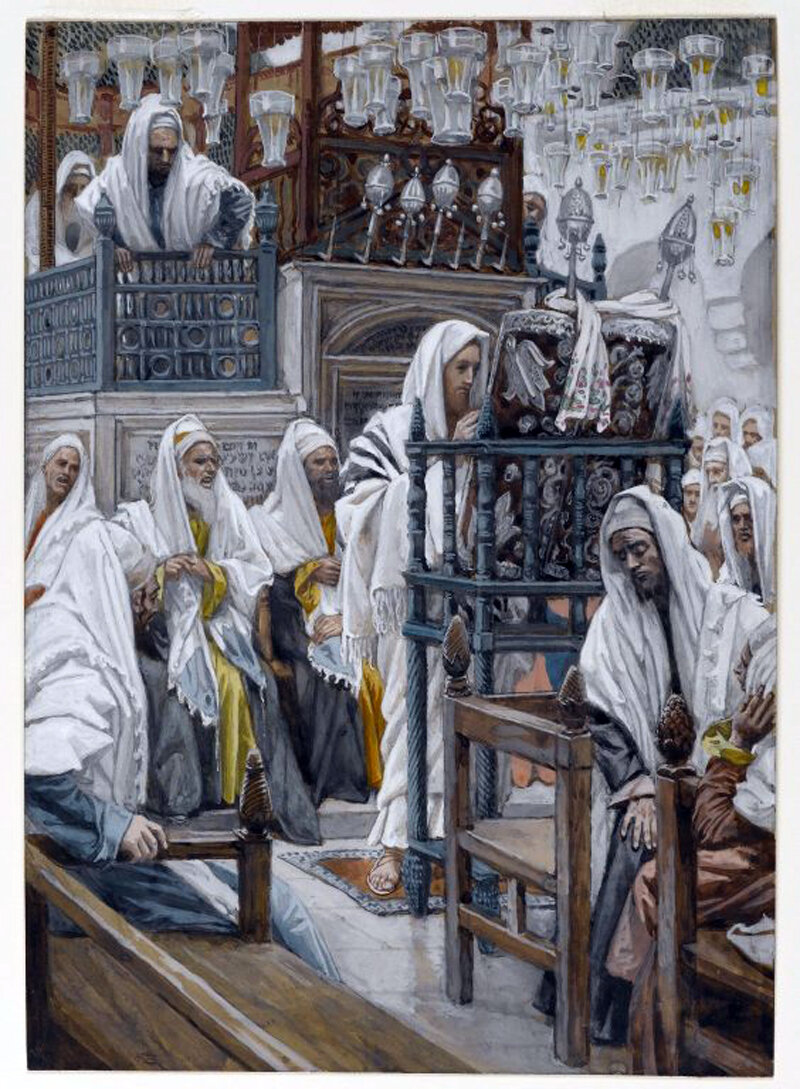
But He goes back home, and as was His custom, He went into the synagogue on the Sabbath day. It was the custom, but the people will not be accustomed to what is going to happen on this Sabbath day. The people probably want to hear from the home-town boy; find out what He learned in school; take pride in the famous rabbi who came from Nazareth. So He goes to the front and someone hands Him the scroll of Isaiah. They did not have chapter and verse divisions, but Jesus knows exactly where to turn, and He unrolls the scroll to the place we know as Isaiah 61, and He reads.
In that world, they did not do what we do, which is have a book in front of us and read so that everything is in their head. I don’t know if you liked silent reading time in elementary school, but I loved it. I would much rather read silently than listen to reading out loud! But maybe that’s just me. At any rate, they were not reading silently at Jesus’ time, and not only because they didn’t have shelves of books to read. “Reading” mostly meant “reading out loud.” So there are at least three things happening: comprehension of the words on the page, speaking of the words, and hearing the words. And that word for “reading” in Greek is literally “to know again.” That doesn’t always mean anything, as we know when we use words that if we used them literally, they would be nonsense or silliness. But here, it can help us to think of reading as “knowing again.” Jesus reads out loud the prophet Isaiah, and He means them to know again what they had probably heard many times. “The Spirit of Yahweh is upon, because He has anointed Me to proclaim good news to the poor. He has sent me to proclaim freedom to those in captivity, recovery of sight to the blind, and to set free the oppressed and the broken-down; to proclaim the favorable, or acceptable, year of Yahweh.”
Jesus reads this so that they will know again what the prophet is about, but in a way that sheds new light on something, that they will see more clearly, or understand more deeply, or see what they did not see before. So He sits down, as a teacher would, and He says, “Today, this Scripture has been fulfilled in your ears.” And they are amazed at the words of grace that flow out of His mouth, and go into their ears. Know this again: the prophet was not just talking about the return of the people from exile in Babylon. He was talking about the freedom of all the captives, all the blind, all the oppressed, and He was the one who was going to do it. The year of Yahweh’s favor is here in the flesh of Jesus. He was the anointed one in His baptism in the Jordan, when God publicly declared Him His beloved Son. He brings all of this in His own person.
But this reading, to know this again in this way, is not just something you get from reading again. This new knowing of something written has to be given. It doesn’t come naturally. First, Jesus reads the people: no doubt you will say things like this: Physician, heal your own! Do the things here in your hometown that you did in Capernaum. But people who have certain expectations, who want certain things, they do not simply snap out of their old reading, and their old patterns. So Jesus talks about two prophets who did not work in their hometowns among their own. Elijah and Elisha did their work among non-Israelites. But it wasn’t just because they felt like it. It was because they were rejected by their own, especially by the kings and queens of their people. Ahab and Jezebel, for example, didn’t want any prophets of Yahweh in Israel. So Elijah went elsewhere. A prophet, Jesus says, is not acceptable in his homeland. That word for acceptable is the same as the word for favor in the prophecy. It is dektos. This is the dektos year of Yahweh. But Elijah was not dektos. Elisha was not dektos. And Jesus is not dektos. The people don’t want to hear all of this from Jesus, so they take Him to the edge of the town and they’re going to throw Him off the cliff. Doesn’t matter. Once this acceptable year of the Lord has come, it cannot be stopped. He walks right through that angry mob, and apparently they are not even able to try to stop Him.
Jesus doesn’t always say what we expect Him to. He doesn’t always say what we want Him to. The Word that He brings, because He is the Word of God, does not confirm our prior assumptions about God. He alone brings the full and living Word of God. Because He is that Word, He reads us by that Word and Spirit. And that’s not comfortable. It is often unexpected. We think the Word is lying there, ready for us to read and understand according to our circumstances. And that sometimes happens: as we grow and mature and understand more, we do see things that we didn’t see before. But it is not just like any other thing that we read and know again. He knows us and reads us, even when we are reading. And that means He exposes in us things that we did not even understand about ourselves. He exposes things we don’t want known. He reads us and we know again our sin, our guilt, our shame, our disappointment, our frustration, our bitterness.
So Jesus may not tell us what we want, or what we like, or what we’re comfortable with. But He absolutely says what we need. We are here to know again what we need and what Jesus gives. He speaks to you of your sin, but only so He can forgive it. He speaks to you of your death, but only so He can make you alive. He speaks to you of your displacement, your captivities, your blindnesses, your brokenness and oppression, but only so He can put you right again, so He can free you, so He can give you true eyes, and release you from everything that binds, that bears down on you, that burdens you—everything that is not Him. Freedom, release, sight: these come when the year of the Lord’s favor appears. And it has. Because it has come, He has gathered you here. It is no accident. Here is His eternal life; here is His forgiveness; here is the crucified and resurrected Christ, the anointed one.
No matter what, nothing can stop this Word from going out. Not anger or hatred at what He says; not unbelief; not bad expectations; not assumptions that we have about what Jesus should say or do. His Word moves as easily in this world as it did through that angry mob. He simply moves on. But you are here, and He is reading you with His Word and Spirit, reading you into the story He is telling, so that you will know again today that His life and love are here for you. So keep reading, keep hearing. This living and active Word will continue to read you until the end of this story—which is actually the beginning. And you will know again, and fully, your Lord and your God.
In the Name of the Father and of the Son and of the Holy Spirit. Amen. “And the peace of God, which surpasses all understanding, will guard your hearts and your minds in Christ Jesus” (Philippians 4:7, ESV). Amen.
— Pr. Timothy Winterstein, 1/24/25
 Bishop and Christian