Audio of the sermon is here:
In the Name of the Father and of the Son and of the Holy Spirit. Amen.
What kind of God do you expect to meet, if you were to meet God? What kind of God is God? It may seem like an easy question, or at least a simple one, but take that question out onto the street here, or to your job, or classes, or friends, or roommates, and see what kinds of answers there are. It will suddenly get a lot more complicated. We tend to take it for granted that we all mean the same thing by those three letters, G-o-d. But do we? Do we mean the God who is Father, Son, and Holy Spirit? Or do we mean a generic God, in which any American ought to believe? The sort of God that goes in a phrase with “family and guns”? Do we mean God as an old, bearded guy in the sky? Or as a distant architect who set up everything and then just let it go? What God is it, anyway, in whom “we trust”?
Both Isaiah and Peter have a very clear expectation about the God whom they expect to meet, and you can see what that is by their very similar reactions when they actually do meet that God. Isaiah is in the temple, and suddenly, the veil that separates heaven and earth is pulled back, and Isaiah sees what was always the case: that God is not far distant, but that He is present in the temple with and for His people, as He promised. Normally you can’t see that God, but God reveals Himself to Isaiah. The thresholds and the foundation of the temple shake, and smoke fills the whole place, and Isaiah knows he’s met God. What does he do? He falls on his face and says, “Woe is me! I am undone. I am a man of unclean lips and I dwell in the midst of a people of unclean lips, and my eyes have seen the King, Yahweh of the heavenly armies!” Just as God had told Moses, no one can see Me and live. Isaiah knows what kind of God this is—the only God there actually is—and he knows what happens when sinners meet this God. Death. Woe. I am lost and undone.
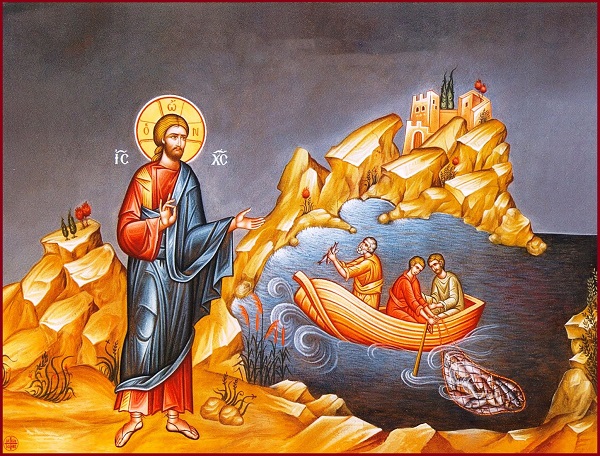
Peter also knows what happens when you meet God, but he doesn’t know at first that he’s met God. Jesus has been teaching on the shore, and He keeps getting pushed back further and further toward the water. So He gets into Peter’s boat and He teaches from there. When He’s done, He tells Peter to take the boat into the deep water and put down the nets for a catch. Peter may not think that Jesus knows much about fishing; after all, they—professional fishermen—have been fishing all night and haven’t caught anything. But because You say so, I will do it. When you go fishing with Jesus, you don’t go fishing, you go catching. The nets are so full that they have to call the other boat over to help, and then both boats are sinking, the nets are so full.
And then Peter realizes that he’s in the same situation as Isaiah in the temple, except this time God is not sitting on a throne in the temple, but standing in his boat. Go away from me, Lord. For I am a sinful man. Almost the same as Isaiah: I am a man of unclean lips and I dwell among a people of unclean lips. Go away from me.
So far, we might be on track with what some people think God is like: He wants to make sure you always do the right thing. He’s sitting up in heaven with His ledger, tallying up your good works and your bad works. He’s like a cosmic Ebenezer Scrooge, keeping track of every moral penny. And when He looks at you, He’s always disappointed. Woe is you! I will go away from you! Now, if you were to ask most people, they will probably say that they think the “good” column will outweigh the “bad” column. They’re not perfect, of course. But who is? Maybe God will end up grading on a curve, grading you relative to the bad people around you, rather than on your own behavior.
And it’s not that Isaiah and Peter are wrong in their expectations. God has a lot of commandments, a lot of requirements, and He says, “Do this, and you will live.” Which implies the opposite: Don’t do this, and you will not live. In the Law, there is absolutely no reason why Isaiah shouldn’t die; why Jesus should not go away from Peter—or from you, or from me. There’s no curve: it’s simply the Law for you and the Law for me. The Law says “do this,” and it is never done. We can’t even keep all our own obligations and responsibilities perfectly, let alone the entire Law of God. So Isaiah and Peter are right.
But their correct expectation is not the final word. There is another word that comes after, which is totally unexpected and surprising. Maybe we get too used to hearing this word, so it’s not surprising to us anymore. We sort of assume it. But there is nothing in God’s mercy to take for granted. There is nothing in any of us, or in this whole world, to which we might point as some reason for God to do what He does next. Isaiah and Peter are not play-acting. They’re not pretending. They’re not going through motions of sorrow and repentance. God is God and they are not. There is no excuse, no rationalization, no negotiation. Woe, death, separation are the only words that come to their mouths.
So we confess: I, a poor, miserable sinner. I deserve temporal and eternal punishment. Woe is me! I am undone! Go away from me, Lord, for I am a sinner. Those are the only words that can come rightly to our mouths. But those are not the only words that come to God’s mouth! Isaiah’s words are not last. Peter’s words are not last. God will have the last word. To Isaiah, He sends a burning angel, who takes a burning coal from the altar of heaven, and touches Isaiah’s unclean lips, purifying them. Can you imagine the voice of a burning angel? Look, this has touched your lips. Your guilt is taken away and your sin is atoned for. To Peter, He shows up Himself in flesh, the Message of God wrapped up in skin and bones. Jesus does not go away from Him; instead, He binds Peter even more closely to Himself. Follow Me. Do not be afraid. From now on you will be catching, not dead fish, but the gathering alive people into the Kingdom of God.
Your confession, though right, is not the last word. There is still the Word of God: I forgive you all your sins in the Name of the Father and of the Son and of the Holy Spirit, into whom you were baptized. Look, the burning coal of the Body of Jesus has touched your lips. It purifies you, because He has taken away your guilt and atoned for your sin. Do not be afraid. You are in the net of the Lord. He has caught you alive, and you are living sacrifices for the sake of those around you. Your lips have been purified to speak of Him. And He will do the work. Gather some people here into the net of Jesus, into the boat of the Church, and He will put His word into their ears. Even if you have worked and toiled and struggled, and it looks like nothing comes of it, do not be afraid. He will bring in the harvest. You know the surprising and unexpected God, whose mercy is totally unconnected to what you do or do not do. In this world, that is more than anyone expects from God. You know the God in whom you can find refuge. You know the God who speaks, who feeds, who renews, restores, gives, serves. There is no other God like this.
In the Name of the Father and of the Son and of the Holy Spirit. Amen. “And the peace of God, which surpasses all understanding, will guard your hearts and your minds in Christ Jesus” (Philippians 4:7, ESV). Amen.
– Pr. Timothy Winterstein, 2/7/25
 Bishop and Christian