Audio of the sermon is here:
In the Name of the Father and of the Son and of the Holy Spirit. Amen.
A little knowledge can be a dangerous thing. Has this ever happened to you? Maybe in a class you answer a question confidently, according to what you know, but you’re missing a key piece of the information. While it’s not technically wrong, you’re not quite right either, because there are things you don’t know. Or you’re having a discussion with someone about some hot topic, and all of a sudden they bring up something you had not even heard, which pulls you up short. And it’s hard, because there is so much information. We have more information available to us than anyone in the history of the world, but we find it hard to put it all together in a helpful way. Instead, we just read the headlines and think we’ve learned something. On a practical note, it’s always better to be humble because of what we may not know, then be confident and show ourselves to be foolish.
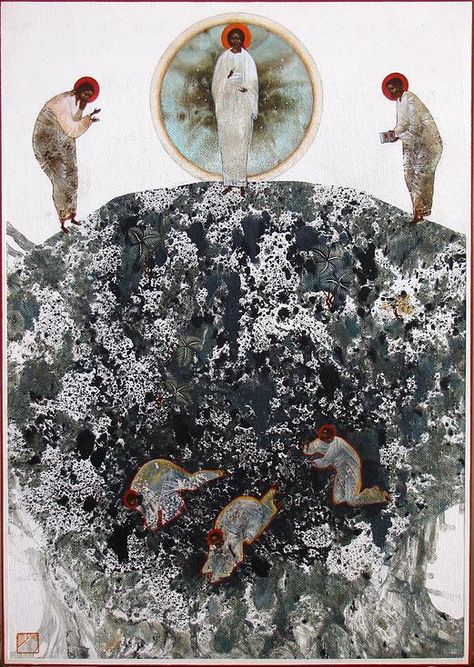
But Peter is one of those people who has some knowledge without the whole picture. So he’s not exactly wrong in what he says. He tells Jesus, it is good for us to be here. We should make three tents, one for You, one for Moses, and one for Elijah. Luke says that Peter did not know what he was saying. He didn’t know what he was saying because he doesn’t have all the information. He should have all the information. Six or seven verses before this, Jesus had told His disciples what was going to happen when they got to Jerusalem: He would suffer many things, be rejected, be crucified, die, and on the third day raised from the dead. But what Peter is focused on here is what he knows from the Scriptures. He knows that when God wanted to speak with the people of Israel, He met with Moses in a tent—the tent of meeting—and He told Moses stuff, and then Moses told the people what God had said. So it’s not some crazy, random thing that Peter says. He didn’t just come up with it out of nowhere. It’s in the Bible. But it’s not the whole picture.
Even then, way back in Deuteronomy, God had told Moses that He would raise up a prophet like him from among his brothers. God would put His words in this one’s mouth, and He would speak to the people, and the people would hear from Him. Staying with Moses and Elijah on the mountain is not enough.
Even so, Peter is willing to stop there, and stay there. He and James and John are “weighed down” with sleep; “burdened.” Have you ever been so weighed down, so burdened, that you just wanted to sleep? Of course, as much as you might need sleep, thinking about things can often keep you from sleeping. They are weighed down with sleep, just like Matthew and Mark say that they are in the Garden of Gethsemane, when Jesus tells them to watch and pray. Jesus says, Watch out that you are not burdened, weighed down, with dissipation—that’s wasting your life recklessly—drunkenness, and the anxieties of life (Luke 21:34). And Paul says in 2 Corinthians 2 that he and those with him were so weighed down, so burdened, and so far beyond their own strength and power, that they were close to despairing of life altogether (1:8).
And it can get that way, can’t it? That’s part of having so much information. Now we not only have to deal with the anxieties of our own lives and families, but we also find out about everyone else’s anxieties and worries. We have to deal with our own sin, and the sin of those around us; but now we have to deal with our knowledge of people’s sin everywhere around the world. It just gets to be too much, and sometimes you just want to sleep.
So it’s not surprising that Peter just wants to stay up there on the mountain. Forget the other nine disciples down in the valley. Let’s just stay up here. I can sympathize. Maybe you can, too. But that’s not enough of the story. Jesus is going to Jerusalem, and the disciples cannot share in the resurrection glory until after the cross. As John of Damascus put it a very long time ago, “Seek not bliss before its time, as Adam did to be made a God. The time shall come when thou shalt enjoy the sight without ceasing, and dwell together with Him who is light and life” (Catena Aurea, Luke 9:32-36). And isn’t that what we do? Seek the bliss before its time. We are burdened and weighed down, and we want to be released from that. As Paul says, “In this tent we groan, being burdened, being weighed down” (2 Corinthians 5:4). We groan with the whole creation, being subjected to the sin and death in this world, so we try to find relief. We seek pleasure and happiness in the things of this world. Almost anything will do. We buy stuff. We watch stuff. We eat or drink stuff. We seek pleasure and happiness in people and things and activities. But it is never going to last. We know it, but we keep pretending it’s not true, that maybe this thing, or this person, or this identity will last forever, and we will have bliss now.
But the Lenten valley teaches us that this is not true: that every single thing, every single person, every single life is burdened and weighted down with sin and death. It all goes away. And if we join ourselves to anything in this life as if it is eternal, we will go away with it. But Jesus shows His disciples and us something different from passing pleasures and mountain-top experiences. He goes down into all the mess and mud and pleasure-seeking and dying, and takes it all with Him to the cross. He finishes His road, which does not end on that mountain of transfiguration, but on the mountain of Calvary. He knows where the bliss is, and it’s not there in eternal tents on that mountain. It is in Him, the one who has taken flesh and tents among us, dwelling with us not on a mountain, but in the words and water and wine and bread by which He gives Himself to us. He gives us these moments, like He gave His disciples that moment, not so we will stay in some particular place in this world, but so we will be able to go all the way to the new world. It is good to be here. It is good to be here with you. But we all have to go out there, where the weight of this world presses down on us, sometimes beyond our strength, so, as for Paul, we almost despair of life itself. We groan, being burdened, but not so that we would be unclothed, floating around without our bodies, but so that we would be further clothed, so that our dying bodies would be swallowed up by the true life of Christ (2 Corinthians 5:4). On that day, which is coming as surely as Jesus is already raised from the dead, all the weight and burden of this world will be seen for what it is: a light, momentary affliction, which will be erased in the blink of a dying and rising eye, by the eternal weight of glory, beyond all imagining.
In the Name of the Father and of the Son and of the Holy Spirit. Amen. “And the peace of God, which surpasses all understanding, will guard your hearts and your minds in Christ Jesus” (Philippians 4:7, ESV). Amen.
– Pr. Timothy Winterstein, 2/28/25
 Bishop and Christian