Audio of the sermon is here:
In the Name of the Father and of the Son and of the Holy Spirit. Amen.
If you had never read or heard the Gospel according to St. John before, from the very beginning you would know that you were waiting for something. It starts in chapter 2, when Jesus was at a wedding in Cana. His mother tells him that the bridegroom’s family doesn’t have any more wine. And Jesus says to her, “Woman, what does that have to do with us? My hour has not yet come.” Something about changing water into wine, fixing the need or lack—of wine, of all things—something about His disciples believing in Him; this has some connection to His hour, whatever that is. And then in chapter 7, it happens again. The leaders of Israel are trying to get rid of Him, but they are unable to get Him arrested because His hour had not yet come. And again in chapter 8, they were trying to seize Him, but they could not because His hour had not yet come. We are set up in the Gospel to expect some hour, some moment, to come, and it has to do both with fixing what has gone wrong, what steals joy, and with Jesus’ arrest.
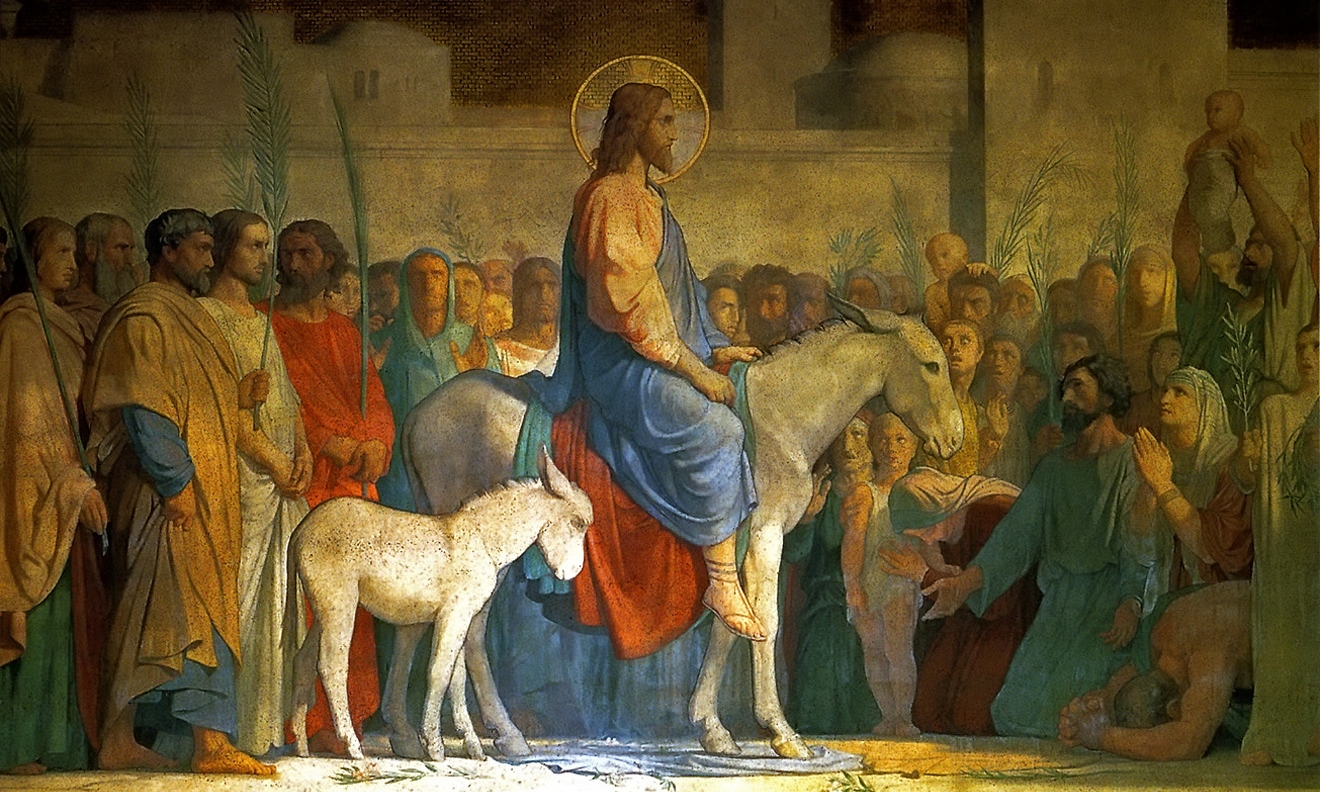
And then, finally in chapter 12, when Jesus is at Jerusalem for the feast of the Passover, after He rides into Jerusalem on a donkey to shouts of acclamation and the waving of palm branches—John, after all, is the only one who mentions palm branches—after all this, some Greeks come to the temple to worship, but they don’t make it to the temple. They find Philip and they say, “Sir, we want to see Jesus.” Philip tells Andrew, and they both tell Jesus, and then Jesus says, “The hour has come for the Son of Man to be glorified.” We have been waiting for something and Jesus says it is for Him to be glorified. But what is that and how will it happen?
Waiting is a difficult thing. If you don’t know what’s coming, if you don’t know whether it’s going to be good or bad, you might be filled with all sorts of conflicting emotions. I saw a short film last year called I Can’t Be Sorry, and that’s the sort of waiting that takes up the first half of the film. We see a woman, who’s maybe in her early 40s, as she goes into a diner and sits down. She tells the waitress that she’s waiting for someone, but no one ever shows up to take the place across from her. As she’s walking back to her car, she sees a pickup parked, idling at the edge of the parking lot. She walks over and the person inside rolls down the window. It’s a woman perhaps in her early 20s, and as they talk, we finally find out for whom the woman had been waiting. It’s her daughter, whom she gave up for adoption a long time ago. They talk for a bit, awkwardly, and it becomes clear that their waiting, over however many years, was filled with all sorts of emotions: anxiety, sadness, grief, bitterness, anger; but also joy and hope. Things are not yet right, but maybe they can be.
What kind of hour has Jesus been expecting? He says that His spirit—or His life—is troubled, distressed, stirred up. That’s from Psalm 6, where the psalmist prays for Yahweh to save him. His bones are troubled, His spirit or life is troubled. And He says, But You, Yahweh, how long? Or, until when? More waiting, more trouble, more mixed emotion: anxiety? Sadness? Joy? Hope? How long is the waiting? Until when? Jesus has come to this hour in order to glorify the Father and for the Father to glorify Him, but this is a very strange sort of glory. It is the glory of the Son lifted up—indicating what kind of death He was going to die—and of Himself as a single seed, put dead into the ground. But that same lifting up is a drawing of many to Himself, and that same death is the beginning of much fruit. Suffering, blood, and death are not really the kind of glory that we want. And this doesn’t look much like glory, this shameful lifting up on the cross. And Jesus is troubled.
Have you ever had that kind of waiting where your skin buzzes, like not enough blood is getting to your arms and legs, where your stomach is turning and moving? I imagine that at least for Jesus and the disciples, this first day of the week, with palms and pilgrims, must have been a little like that. Because this is not just another day. It is the beginning of the end of all the waiting. The hour has come, and we begin to see what, exactly, that means. Jesus’ hour means judgment for the world, because it is the casting out of the ruler of this world. That judgment is rendered not against the world under the power of the devil, but for it. Jesus’ hour means a vision of glory that still looks to unbelief like foolishness and weakness. It is incomprehensible outside this entire story, which John tells, he says, so that you will believe, and by believing have life in His name. In His hour, your hour has come as well. Any false hope that life might go on in just the same way, that you might save your life in this world, which is so clearly passing away, ends here and now. He dies alone so that your death will not isolate you from life forever. He dies so that He will not be the only living son of God. His resurrection is coming. No question about that. Life itself cannot stay dead. But He dies to bring you along with Him, to draw you to Himself, so that you will be forever where He is. He rises to be the firstborn of many brothers. You are the fruit of His dying life.
Once we belonged to this world. We were not only in the world, but of it. We thought its thoughts; we spoke its words; we did its evil deeds. The ruler of this world ruled over us, even if only for the short time between our birth into this world and our baptismal rebirth into the new creation of God. But we have a new King now. And His servants follow Him. We hate our lives in this world, because our sinful flesh cannot be separated from this world. We hate lives lived in constant struggle against sin and death and the devil. We hate our lives that are not yet conformed to the life of Christ. We hate our lives that do not yet look like eternal life.
But those who hate their life in this world will guard it until eternal life. And their cry is always, “We want to see Jesus.” The servant of Jesus follows Him and where He is, His servant will be. If anyone serves Jesus, the Father will honor that one. We want to see Jesus. And so we follow Jesus our King as He rides on in majesty, rides on in lowly pomp to die. His hour has come. He enters Jerusalem and it is but the beginning of His triumphs over captive death and conquered sin. He is enthroned in that Kingly glory, covered in the crimson garments of royalty.
And today our King keeps again His promise: the bread that He gave for the life of the whole world, He gives to each of us to eat. His flesh is that bread, and as we follow in the way of His suffering, dying, rising triumph, we see that this is our life in this world too. His hour has become our hour. Death’s doors are broken open, so we will walk through in the triumph of Jesus. Hell’s gates are broken down, so hell has no fury at all. When we die and Jesus raises us from the dead, we will finally see the glory that Jesus has prepared for us in His own glorification.
We want to see Jesus. So until that day, we continue to walk this road from the gates of Jerusalem with palms and hosannas, to the upper room where the glorious meal of Jesus’ flesh and blood is anticipated and given, to the cross where that new covenant is put into effect, and the victory is won, to the new Garden, where death is no more and tombs are empty. We want to see Jesus, so this week we continue to learn the hatred of our lives in this world. But we also learn again the victory and feasting and joy of which our eternal life will consist. Jesus reigns! He is King. This is His hour. The judgment of this world has come. The ruler of this world has been cast outside the new creation. And, eventually, the whole world will indeed go after Him, into her glorious restoration. And the waiting will finally be done: it will be like a woman who finally gives birth, and all the pain is over. Then there is only joy at new life. So it will be, when the fullness of this hour comes.
In the Name of the Father and of the Son and of the Holy Spirit. Amen. “And the peace of God, which surpasses all understanding, will guard your hearts and your minds in Christ Jesus” (Philippians 4:7, ESV). Amen.
— Pr. Timothy Winterstein, 4/12/25
 Bishop and Christian