Audio of the sermon is here:
In the Name of the Father and of the Son and of the Holy Spirit. Amen.
I think many people, if not all people, are looking for peace. But they don’t necessarily know where to find it. Maybe you’re looking for some peace and quiet at the end of this semester! And I don’t know what you think of when you think of “peace,” or what it looks like to you, but I think of being able to sit down, being able to take a breath, without anything that is immediately pressing on me, pressing in and down on me. But maybe that’s just because I own a house now. And yet, the Scriptures—especially the Old Testament—picture peace something like that. Peace—shalom—means that God has brought His people into the land, just as He promised. And when He does that, the people are able to build houses, to plant fields and vineyards, to eat the produce of the ground. And they are able to do it in peace: with no enemies constantly attacking, with no threats that force them to protect themselves, rather than live their lives under the blessing of God’s hand.
But the threats don’t come only from the outside. The deepest threat comes from inside here, in rebellious ears that would rather listen to words other than God’s; in rebellious hearts that go seeking anything and everything in which to put their trust, except the only trust-worthy one. This is the threat that takes the people into exile, away from the land and the promise. Israel longed for peace. And the disciples, too, need peace. They’re hiding in a room where the doors have been locked “on account of fear of the Jews.” That’s a strange phrase, but it appears three times in the Gospel of John. The first time is in chapter 7, where the crowds are arguing about whether Jesus is a good person, or one who is leading the people astray. But they don’t speak of Him openly, “on account of the fear of the Jews.” And then in chapter 19, it happens again, when Joseph of Arimathea asks Pilate for the body of Jesus, to bury it in his own tomb. John says that Joseph was also a disciple of Jesus, “but secretly, on account of fear of the Jews.” Joseph has these mixed reactions going on, where he did not approve of the condemnation of Jesus, but he doesn’t want to be known publicly as a disciple of Jesus. Same thing with Peter. And now, after Jesus’ death, the disciples are hiding behind locked doors, for fear of the Jews. Clearly, in all of these situations, the people who are doing this are themselves Jews. They are afraid of those Jewish leaders who are trying to get rid of Jesus, and who might do the same to those who associate publicly with Jesus.
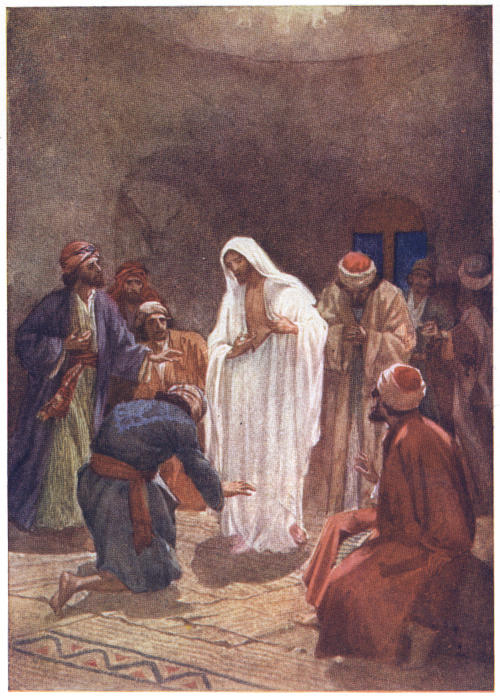
The disciples are hiding out, without any peace, in fear and anxiety and uncertainty, and Jesus “stands in the midst.” And the very first word He says to them—the very first word He says to them after the resurrection—is “Peace.” Peace to you. And then He shows them His hands and side. And then the disciples rejoiced, when they saw the marks that identified Him as the Lord who had died but was not dead anymore. And He says it again, “Peace to you. As the Father has sent Me, I am sending you. Whatever sins you forgive, they have been forgiven. Whatever sins you bind to a person, they have been bound to them.”
And then, you’re familiar with the story, Thomas shows up. Who knows where he had been the previous week? But what we do know is that he is not “doubting Thomas.” He is unbelieving Thomas. He doesn’t say, “You know, guys, I have some doubts about what you’ve told me.” He says, in as strongly negative terms as Greek has, “Unless I see His hands, and the print of the nails, and put my fingers in them, and put my hand in His side, I will never believe.” No doubt about it; I will never believe. But then Jesus shows up, in just the same way: He stands in the midst, and He says the same thing: “Peace to you.” Here, Thomas, put your fingers in My hands, and your hand in My side. Stop being an unbeliever, and become a believer.” And Thomas does. “My Lord and my God.”
They need peace. And if we were talking about giving them peace, how would we go about it? We might say that if we could get rid of the things that are causing them fear; if we could get rid of their fear of being associated with Jesus, or if we could get rid of all the circumstances around them that are causing them to lock their doors and hide out, then they would have peace. If only I could get rid of these difficult circumstances, this uncertainty about where I’m going or what I’m doing. If only I could get rid of these burdens, or I could be done with sin and death. Then I would have peace.
But Jesus says, “Peace I leave with you; My peace I give to you. I do not give to you as the world gives.” What Jesus does not do is change a single thing about their circumstances, or the things causing them fear, or the sources of their anxiety, outside the room or in their own hearts. It’s sort of like in the Book of Numbers, when the fiery serpents were biting the people and they were dying, and they cried out to God to save them. What God did not do was send a St. Patrick to drive out all the snakes. Instead, He stood something in their midst, a bronze serpent on a pole, and He said, believe My word and look at this symbol of your sin and death.
Here is the sign of your sin and death, right in the midst of you: the crucified Lord, marked with the wounds that make you whole, and the pierced hands and feet that remove your iniquity. Believe the Word and look at Him, in the flesh. As long as this world goes on, as long as you live in your flesh in this world, the circumstances may change, but the sin and death will not. You have a new heart, but it is right next to your old one. You have the Holy Spirit of God, but He is doing battle with your sinful flesh. Peace in this world does not come the way the world gives peace. It comes as Jesus stands in your midst. And it comes because He is risen from the dead. A dead Jesus cannot give you peace, or forgive your sins, or tell you to touch His hands and side. A dead Jesus cannot be your Lord and your God. But this living Jesus—the only Jesus there is—He stands in your midst, even today, and He speaks this word to you: Peace. What fear can be greater than the Jesus who has conquered death, and the world, and your sinful flesh? What anxiety can stop Him from being Lord? There is no enemy, no threat, no sin, and no death that can undo the peace He has made between you and God.
Peace to you. I forgive you all your sins, and they have been forgiven. The sins that were bound to you, He lifts up, takes away, removes, crucifies. You are released from them. You are free to bear witness to Christ openly, because what will anyone do to you? You have the Holy Spirit, as the apostles and all the Christians in Acts did, and they were no longer afraid to speak of Him openly, or to be His disciple, or to be associated with His Name. Because they knew He was alive, and they rejoiced. Peace to you. Look at what is all around the giving of Jesus’ body and blood to you. The whole thing is about peace: After the words of the living Jesus are joined to bread and wine, “The peace of the Lord be with you all.” Amen. And then, Lamb of God, grant us peace. You who have eaten and drunk, you have received the blessing of God: depart in peace. We sing with Simeon, “Lord, now You let Your servant go in peace.” And we do, with the blessing of Almighty God, who puts His Name on us: The Lord look upon you with favor and give you peace.” It is all about peace, because it’s all about the risen Jesus. Peace to you, here and now, as the living Jesus stands in your midst. Peace to you in all the days to come, whatever is in front of you. Peace to you, until you see your peace complete in the God who is your peace: when all the threats are gone, and your enemy sin has been destroyed; the devil has been removed from God’s new creation; and the last enemy, death, is destroyed. Peace to you.
In the Name of the Father and of the Son and of the Holy Spirit. Amen. “And the peace of God, which surpasses all understanding, will guard your hearts and your minds in Christ Jesus” (Philippians 4:7, ESV). Amen.
–Pr. Timothy Winterstein, 4/25/25
 Bishop and Christian