Audio of the sermon is here:
In the Name of the Father and of the Son and of the Holy Spirit. Amen.
Who was first: Abraham or Jesus? It seems like an obvious question. Obviously, Abraham was first. Abraham was around many, many generations, and thousands of years before Jesus appeared. That’s what the Pharisees know. “You are not greater than our father, Abraham, who died, are you? And the prophets died.” “You are not yet 50 years old, and you have seen Abraham?” Abraham and the prophets died, and Jesus is claiming to live forever, and to be able to give people eternal life. That one who keeps Jesus’ word, which is the word of the Father, will never taste death, even into eternity. Abraham lived and died a long time ago, and Jesus says that Abraham rejoiced to see His day, and, indeed, did see it. And the Pharisees say, “You’ve seen Abraham?”
As obvious as the answers to these questions seem, they get everything backwards. Whose story is this, anyway? Those questioning Jesus think it is Abraham’s story, and the prophets’ story, and their story. And isn’t that what we think, too? We think that this is our story. And it comes naturally to us to think so. We don’t even have to try. And because it’s our story, we decide what goes into it. What will I do? Where will I work? Whom will I marry? What will the story of my life look like? And that’s not wrong, in itself. It comes naturally to think of our lives as stories because we think of them having a beginning, middle, and end. Some people in the world think of their lives as cyclical, or as never-ending. Karma, reincarnation, nirvana, etc. But we mostly think of our lives as moving in a straight line from birth to death. Birth is the beginning, and death is the end. We call it “middle age” when we’re roughly halfway through, according to average life-spans.
When we think of our lives as stories, we have to ask, who’s the author of this story? And to us the answer is, once again, obvious: we are. We write our own stories. We decide how things go. This life is a choose-your-own adventure. Or so we think. Whose story is this, and who is the author? But if you’ve ever gotten tired of writing your own story; if you’ve ever felt the entire weight of self-creation on your shoulders; if you’ve ever realized that you’re maybe not as good at writing your own story as you think you are; if you’ve ever written a disappointing, bad, or broken chapter; this day of the Holy Trinity is for you. You have a story, but it is not the main story. You have a plot, but it is only a sub-plot to the primary narrative.
Up to this point, starting with Advent, we have heard the main story. It begins with the promise of the coming Savior—for us, His second coming, His appearance in glory. It moves through His birth, His revelation or epiphany; His suffering, death, and resurrection. And then the main plot concludes with the giving of the Holy Spirit, to create faith in Jesus, and to cause people to speak boldly about Jesus. As Peter preached on Pentecost: “Be baptized, each one of you in the Name of Jesus Christ for the forgiveness of your sins and you will receive the gift of the Holy Spirit. For this promise is for you and for your children” (Acts 2:38-39). When there was a baptism, the person being baptized was wrapped up in that story: given the Holy Spirit, granted faith, and given words to speak boldly. Baptism says, This God who made all things is your God now.
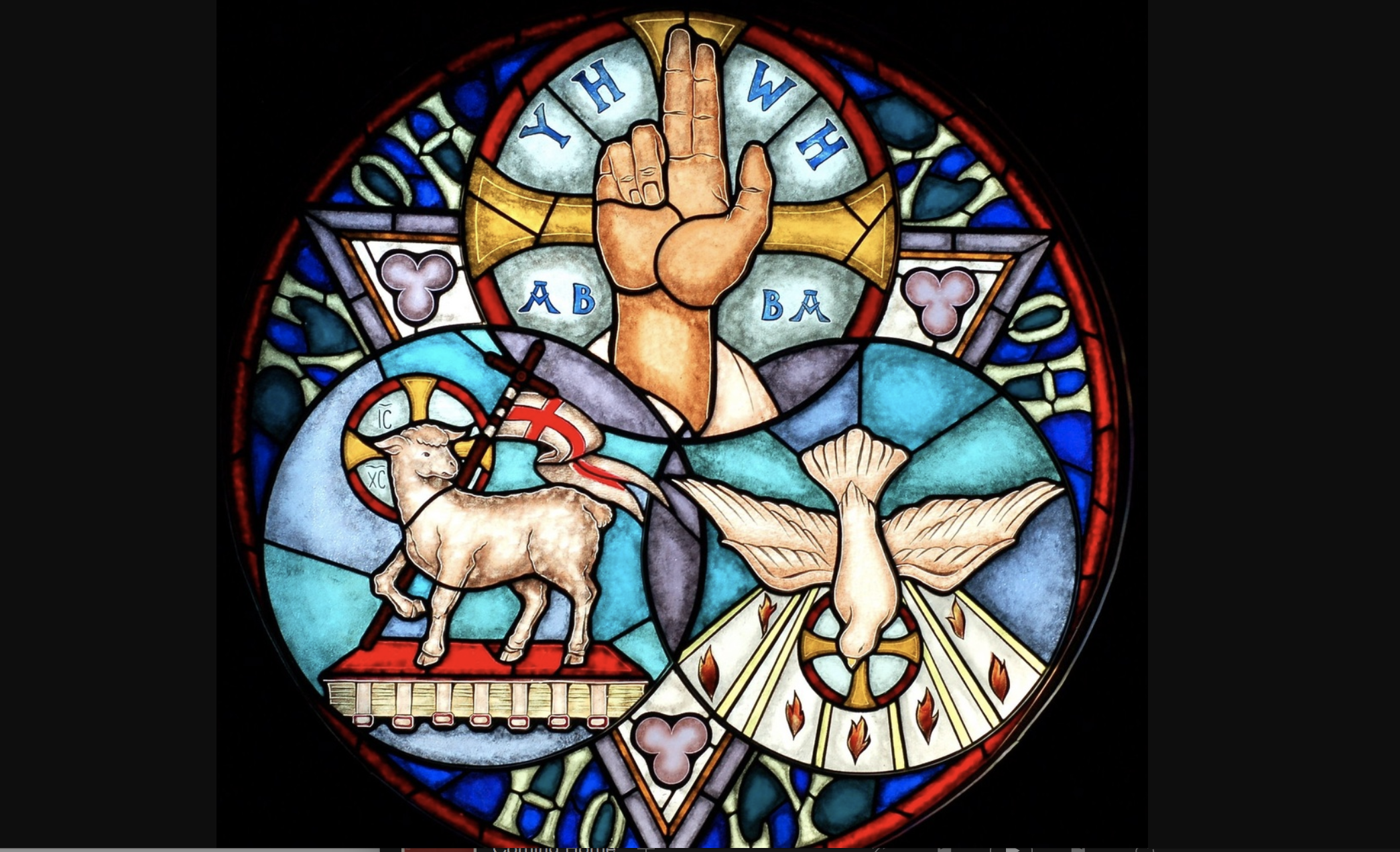
Baptism is how God wraps you up in His story, and so today is a good day to be reminded of the Name by which God has done that. We often think of the “Holy Trinity” as a sort of abstract doctrine thought up in the dry, dusty halls of academia by theologians who don’t have real lives. But the Trinity was not thought up as much of theology is today, by Ph.D.s who need to sell books. The teaching on the Trinity was proclaimed as the living revelation of God in this world. When Jesus appears, saying and doing things that only God can say or do (forgiving sins, healing the sick, casting out demons), when He says things like, “Before Abraham was, I am He,” people who confess one God have to figure out how this can be. So they simply confess what the Scriptures say: “There is one God, but God is Father and Son and Holy Spirit. And yet, there aren’t three Gods, and there aren’t three Fathers, Sons, or Spirits. One God, three Persons, and this is the God who has saved us and whom we worship in Trinity and Unity.”
Being baptized into that Name, and remembering our baptism, reminds us that the Holy Trinity is not a doctrine, not a symbol, not a piece of dusty theology, but a personal God who has acted and is acting for the salvation of His creation. The Father, the Son, and the Spirit are telling a story of their love for this whole creation, and they are writing into it as many people as possible. Baptism is the signature that the Trinity writes on those whom He has gathered into His story. And it is their entrance into His story, just as being born is the entrance into the story of this creation. Every day, and every week, we tell this story to ourselves when we mark ourselves with Christ’s cross and say, “In the Name of the Father and of the Son and of the Holy Spirit.” It is the story God tells us when He says, “I forgive you all your sins in the Name of the Father and of the Son and of the Holy Spirit.” It is a story that goes on as we go out from this place: The Lord bless you and keep you, the Lord make His face shine on you and be gracious to you, the Lord look upon you with favor and give you peace. This is His story of deliverance for you and for all your children: delivered from slavery to sin, death, and the devil, marked by the blood of the sacrificed Lamb, God’s wrath passing over you and being placed on His only Son. It is a story of death and resurrection, and baptism joins you to Jesus’ death and resurrection, instead of leaving you to your own eternal death.
But this is not the only story that is out there. This is not the only story you hear, and it’s probably not even the story you hear the most often. There are other stories, and you and I know them well. One of them goes like this: you have to get good grades so that you can get into a good school, so that you can get a good job, so that you can make enough money, so that you can live the life you want and be a success in this world. Or there’s this one: you need to do whatever it is that makes you happy. Until you do that, you’re not really living. If it makes you happy, do it. If it doesn’t, get rid of it, even if you made a promise. Your happiness is what matters. Those are some of the general stories, but there are also the more personal stories. The story that everyone knows about you, how they would sum you up: those actions, those words, those mistakes, those family situations, where you live, how you dress, what you think, how you vote. All of it becomes your story, some good, some bad, some horrible. And often, no matter how hard we try to keep those things from defining us, no matter how hard we try to justify our past, they remain our story. But those stories are not the story God’s telling. And if we remain in those stories, we will misunderstand God, Jesus, the Scriptures, and what we’re doing here on a Sunday morning.
So if the primary story in our lives is one of our success or our happiness, then we have to figure out how God fits into our stories. If He doesn’t contribute to my success or happiness, or at least make it easier, then all of this looks irrelevant. We have to figure out how to apply the Scriptures to our lives; we have to figure out how Jesus fits into our lives. We come here looking for some help for our lives, a little advice or a few practical steps to make Jesus relevant to us, when we have things exactly backwards. We have, like the Jews in John 8, thought that we must fit Jesus into our stories. They could not figure out how Jesus fit with their story of Abraham and themselves as His faithful descendents. They called Him a Samaritan to say that He was outside the promise and covenant of Abraham. But Jesus said they had it exactly backwards. He was not simply a descendent of Abraham, He was the Author of Abraham’s story. Before Abraham was, I am He. It is not Abraham’s story, but Mine. It wasn’t so much that I saw Abraham’s day, but that He saw Mine. It is not our story, but Jesus’. And that is why Abraham rejoiced, because He believed God’s promise to him, though he had it only by faith. But to have it by faith is really to have it. So Abraham rejoiced to see the Lord’s Day, even before it came. And so it is for every one who is baptized into the story of God in Jesus Christ: we rejoice that the Lord’s Day has come to us, that His death and resurrection have come to us, and that we really have them now by faith. All of our stories will end, by necessity, with death. That is the only place where the stories of sinners can end. But there is another story that takes up death into itself and makes it just one more event in eternal life. The story of Jesus, written on you by His Word means that you will never see or taste death. You have eternal life now, and there is no end to it, because this is the story of Jesus, and death no longer has any hold on Him. And you can be sure that the God who began this story, and who wrote you into it, will continue it into eternity.
In the Name of the Father and of the Son and of the Holy Spirit. Amen. “And the peace of God, which surpasses all understanding, will guard your hearts and your minds in Christ Jesus” (Philippians 4:7, ESV). Amen.
— Pr. Timothy Winterstein, 6/14/25
 Bishop and Christian