Audio of the sermon is here:
In the Name of the Father and of the Son and of the Holy Spirit. Amen.
Does it ever strike you as strange that people can read the same Bible and come to different conclusions about what it is saying? People can read the exact same passage and come to opposite interpretations. No doubt it’s happened to you in a discussion, or at least it’s bothered you, that anyone might come up with anything, supposedly based on the Bible. There is more than enough evidence on the internet that people can and do come up with anything.
One of the reasons—maybe the main reason—that happens is that people have different plots into which they put the Scriptures. Maybe you’ve seen one of those poems that reads one way from the beginning to the end, and then if you read it back from the end to the beginning it has an entirely different, even opposite, meaning. There’s a recent Honda commercial with a poem called “Unstoppable Dreams” that does exactly that. From the beginning, it’s about giving up; but from the end, it’s about never giving up. Depending on how you put the pieces together, you come up with completely different meanings.
People do that with the Bible as well. For example, you could read the Bible according to an acronym that you might know: BIBLE: “Basic Instructions Before Leaving Earth.” In other words, the primary meaning and purpose of the Bible is to tell you what you should do before you die and go to heaven. You could read it that way. I don’t recommend it, but you could. On the other hand, I prefer Jesus’ plot line. In Luke 24, Jesus lays out the plot from Moses through the Prophets to the disciples on the road to Emmaus: Foolish ones, and slow of heart to believe everything the prophets have written! Was it not necessary that the Christ should suffer these things and enter into His glory? And beginning with Moses and all the Prophets, He interpreted to them all the things concerning Himself. Then He does it again with all the apostles: This is what I said to you while I was still with you, that all the things written about Me in the Torah of Moses, the Psalms, and the Prophets should be fulfilled. Then He opened their minds to understand the Scriptures—by revealing the plot: Thus it is written that the Christ should suffer and rise from the dead on the third day, and repentance and the forgiveness of sins should be proclaimed in His Name to all nations (Luke 24:26-27; 44-47). Two different plots; two different readings; two different meanings to the entire Scriptures.
It happened in the fourth century, too. Arius had one plot: it had Jesus starting lower than the Father, with a beginning, and being elevated and glorified later. Athanasius had a different plot: the Son, eternal with the Father, was humbled in our flesh unto death, rose from the dead, and ascended, glorified in His flesh with the eternal glory of the Son. Two different plots, so that they read the very same Scriptures in two contradictory ways.
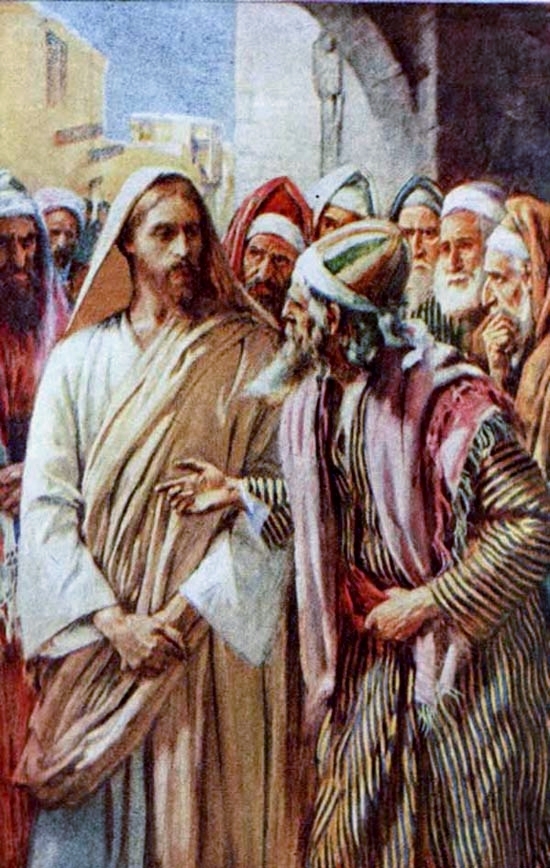
And it happens with the Sadducees in our passage from Luke. The Sadducees read the Scriptures according to one plot, which is that the Five Books of Moses determine everything, and that people will not rise from the dead. They seem to have believed that when your body dies, your soul dies. Because they read the Scriptures this way, they take a command from Deuteronomy 25, about a man marrying his dead brother’s widow, in order to produce a child who will be counted as the dead man’s child. They believe the Law, but they don’t believe the resurrection. So they come up with an absurd situation: what if there were seven brothers, and they all died without producing a child. Then, in the resurrection, whose wife will the woman be, since they all were married to her? Jesus, you believe in the resurrection, right? What will happen when these dead brothers and the one woman are raised from the dead? Doesn’t that show how ridiculous the idea of resurrection is?
But Jesus has a different plot, and it’s not one that ends with death. The sons of this age marry and are given in marriage. But those who are counted worthy of attaining the resurrection from the dead do not marry, nor are they given in marriage, because they cannot die. They are like angels in that way. They are sons of God, being sons of the resurrection. And since you cited Moses in Deuteronomy 25, what about Moses in Exodus 3, where he reveals to you what God said: I am the God of Abraham and the God of Isaac and the God of Jacob? He didn’t say he was their God, even though they had been dead for a long time. He is the God of the living, not the dead, for all are living to Him.
One thing the Sadducees forgot to mention in that passage from Deuteronomy: the reason for the law is explicit: so that the dead brother’s name (and line) is not blotted out of Israel; so that it doesn’t come to an end. Well, the only two times this law comes up in the whole Scriptures are with Tamar and Judah, and Boaz and Ruth. Neither matches the law exactly, but both make sure that a name and a line are not blotted out of Israel: the name and line of Jesus, Son of David. And that is the only plot that makes true sense of the Scriptures. This entire story is about Him, it’s about His Incarnation in flesh, the signs that He does to show that He brings a new creation in the kingdom of God, His suffering, death, resurrection, ascension, and revealing in glory at the end of this age. And because the Sadducees have a different plot, they don’t understand the Scriptures at all. As Jesus says in Matthew, “You are quite wrong.”
The plot you use for understanding the Scriptures determines how you see everything else, including marriage. How do the sons of this age see marriage? As a contract into which two consenting adults enter, for their own self-expression and fulfillment. Marriage is something the government can define and re-define. It’s something that you can make into whatever you want, and anybody, and any number of people can do it together. It’s a right, not a gift. But that’s because the sons of this age do not believe in the resurrection. Like the Sadducees, they think this is all we get, so make the most of it, however you can. But if there is no resurrection, there is no hope. It’s a disaster all around, and we’re living with all the consequences of that right now, in this age. But the sons of God, the sons of the resurrection, have a different plot. And it’s one that makes sense of marriage in an entirely different way. We know that marriage is for this creation and for this age. It was given by God before sin and death, and Paul talks about its fulfillment in the marriage of Christ and the Church. In the resurrection, when we all together are present as the Bride of Christ, there will be no marrying and giving in marriage.
But here the emphasis is on this age of death. And in an age of death, marriage is needed also. Marriage is needed, because children are needed. That’s the entire point of Deuteronomy 25: people die, and children are needed. And more than that: since people die, the name and line of Jesus is absolutely necessary. So there’s Judah and Tamar, and there’s Boaz and Ruth, and there’s David, and there’s Mary, and there’s Jesus. God will not let the genealogy of Jesus be blotted out from Israel. And that is because you and I die, and He does not want us erased from His eternal life. The plot of the Scriptures is exactly this: that Jesus appears to take all of Israel’s history, with all its sin and death, into Himself, in order to redeem and restore the whole, dying creation. He wrote you into that story. This isn’t your story, your plot, but His. He gives you an eternal Name and an eternal identity, that cannot be changed or take away, or blotted out or erased. You are baptized into that Name, into His death and resurrection, so that you have hope. And because you are sons of God, being sons of the resurrection, you can get married and you can have children. Both are images and confessions of faith and hope. Why would anyone still get married? Why would anyone bring children into this world? Only if you have a hope that death is not the end, and the resurrection is coming, and that God wants to mark your children with His holy Name as well, so that we will all be sons of God together in the resurrection.
The world has all sorts of narratives and plots, and it tries to write you into them, to see and read things differently. They’re everywhere, in politics, on social media, in your classes, with your friends, maybe in your families, in other churches. But there is one true plot that makes sense of the Scriptures, the narrative of Jesus. The Creeds keep you in that plot. The Book of Concord keeps you in that plot. The Church Year, by which you move through the life of Jesus every single year, keeps you in that plot. The liturgy keeps you in that plot. Because they all tell the same story: Jesus Christ, conceived and born into this age, crucified in this age, but raised from the dead to bring that age of resurrection into existence. To bring you into that plot and narrative that He began and that He will finish. You sons of God, sons of the resurrection, belong to this Lord, and He will bring you not to the end of the story, but to the day when you see its true beginning, gathered with all the other children of the resurrection into the age that does not end.
In the Name of the Father and of the Son and of the Holy Spirit. Amen. “And the peace of God, which surpasses all understanding, will guard your hearts and your minds in Christ Jesus” (Philippians 4:7, ESV). Amen.
— Pr. Timothy Winterstein, 11/7/25
 Bishop and Christian