Audio of the sermon is here:
In the Name of the Father and of the Son and of the Holy Spirit. Amen.
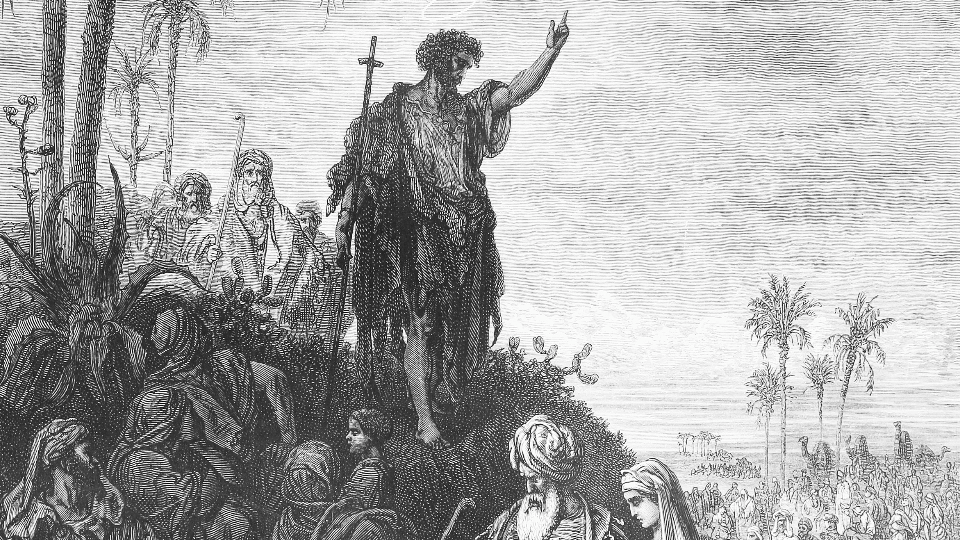
“In those days, John the Baptist appeared…” In those days. It would be easy to skip over those words, that opening phrase of our reading. And the divisions of the pericopes—the sections of the readings—and the chapter divisions encourage us to miss connections. So let’s pause here a moment, in those days. In those days, John the Baptist appeared. In what days? Though we’re skipping several years, in the days when Jesus went to live in Nazareth, so that the prophets’ word would be fulfilled: He shall be called a Nazarene. No one has ever pinpointed a particular word in the prophets that says such a thing, but no one expected the Messiah to be “from” Nazareth. Can anything good come from there? Yet, Jesus fulfills the prophets’ word that He would be despised and rejected and in Nazareth very specifically, He is.[1] So John appeared in the days when Jesus appeared, fulfilling the Scriptures, which are all about Him. In those days, when God began to reveal what He had promised for so long, John appeared. In those days, when God was turning everything upside-down and beginning to bring an end to this age, in order to restore all things—in those days, John appeared.
In those days, He appeared preaching and baptizing and calling to repentance, like Elijah in the days of the kings. In those days, people from everywhere around were going out to the wilderness, to the Jordan River, repenting and confessing and being baptized. These days, you could watch reels and stories about John over and over and over, but in those days, you actually had to go out there in the wilderness and hear and see him in person. And people did, and John’s preaching brought them to repentance, to changing their minds; from going one direction, away from God, and turning them to go in another direction, toward God. In those days, John said, the Kingdom of God, the reign and rule of God, is right here, standing near, at the very gates. I’m only the one who goes ahead of the King to say He’s coming. He is greater than me; I’m not worthy even to carry His sandals around. I’m doing this repentance-baptism, but He will do the Holy Spirit-and-fire baptism of the last day and the end of this age. He will do the Holy Spirit-salvation baptism and the fire-condemnation baptism. The axe is already there, and it’s ready to start chopping.
In those days, there were those who heard that word and believed it, and those who heard it and did not believe. It seems that there were indeed some Pharisees and Sadducees who went out to be baptized by John for repentance. But John calls them out: who warned you to flee from the wrath that is coming? Bear the fruit accompanying repentance, because fruitless trees will be cut down and burned. How do you flee from God’s wrath? You can’t outrun it. You can’t escape it by staying ahead of it. You can’t flee from it by taking refuge in being descendants of Abraham. God can make children of Abraham out of rocks, if He wants to. There were some who fled the wrath to repentance in preparation of its coming. There were others who took refuge in other things, and there is no refuge anywhere else.
In those days, people seemed to actually want to escape the wrath of God that is coming on the earth. But in these days, it has been so long since those days. Ever since, the gap between the coming of God on the earth and the fiery judgment and cleansing of the threshing floor has been growing wider and wider. John seemed to think that it would happen immediately, that as soon as Jesus appeared, wrath, axe, separation, and fire would commence. But if Jesus is the one who was fulfilling the Scriptures, and if John was sent to prepare the way for the coming of God on the earth in the flesh of Jesus, then it clearly was not immediate fire and condemnation and the end of all this sin and death and evil. In these days, we find this talk about wrath and fire to be a little uncomfortable. As soon as we hear fire-and-brimstone, the-end-is-near type preachers, we keep our distance, move to the other side of the street. In these days, it is so easy to come here, listen to some spiritual things, and then go out and live our lives in exactly the same way as we would have if we never came here. It is easy, with that gap of time, to keep all the spiritual, God-talk stuff here when we go out there into the “real world”; leave it all here, like John out in the wilderness.
I mean, is any of this relevant at all? So I understand the motivation to take the words of the Bible and figure out ways to make them relevant to people’s “real” lives in this modern world, so far removed from John and Pharisees and the Jordan River—and maybe from repentance and salvation too. When people need to make God’s Word and worship relevant to what’s going on out there, why does it so often mean making it look exactly like everything out there? It may be that by working toward relevance, all we’re really doing is making ourselves more like the unbelieving world than we already were. But if these words are irrelevant to us, there are only two options: either they are not the words of the living God, who speaks at all times to all people in all places; that they are dead words, like any other book, which we have to work to make relevant to us, because they are not, in themselves. Or these words are not the problem. Maybe the problem is not that God’s words are irrelevant to our lives, but that we’ve made ourselves irrelevant to God by our sin and unbelief and comfort in this world.
The work of conversion, repentance, confession is the work of making us relevant to this word, to become people who flee from the coming wrath and find refuge in the Rock of salvation, cleft for you, and streaming living water. I don’t know if we can become that kind of people for an hour a week, but nevertheless, in these days, the King is still near, standing close. The Kingdom of the heavens is still near, and the world still needs repentance. What happened in those days is also for these days. In those days, the Son of God took on flesh and was born from a virgin; in those days, He lived on the earth, suffered, died, and was raised from the dead. In those days, He ascended into heaven. In those days, He did not appear with glory and fire and condemnation, as John and others expected. Instead, He appeared weak, suffering, dying. And as He appeared in those days, so He appears in these days: weak, suffering, dying in His body the Church, humble in water, words, bread, and wine. Humble, but still the King, and still the King who brings salvation. These are not irrelevant words, but the words of the living God to you.
The day is coming when He will indeed baptize the whole earth with the Holy Spirit and with fire, with salvation for believers and condemnation for unbelievers. But before that day, when the Holy Spirit will raise up all the dead and give eternal life to all believers in Christ—before those days, in these days He continues to pour out His Pentecost Spirit on all flesh. People still repent, people still confess their sins, people are still converted, people are still baptized into the holy Name of God. And what Jesus did in those days, what He gives in these days, means your salvation in that coming day. It does not mean relevance the way the world wants it. I doubt very much that there was ever an age when John the Baptist was relevant in that way. In those days, when John appeared, camel hair, leather belts, and eating locusts and wild honey were no more relevant than they would be today. But the word of God that John proclaimed, the Word that was made flesh to whom he pointed, appeared and made this entire world relevant to Himself in repentance and faith. And you have been made, and you are being made, into the sort of people that is irrelevant to this world, to the ways of thinking, the ways of acting, the ways of being. You are not relevant to this world in the way the world wants you to be, because you have been related to God in Jesus Christ by His Holy Spirit. Instead, you are relevant in the way the world needed in the days of John, and in the way the world needs in these days: bearing witness to the coming one, who brings salvation in totally irrelevant ways, strange ways, unlikely ways—and, nevertheless, in ways that bring repentance and conversion in spite of all of it. Advent is not relevant to this world, but an Advent people of the coming Lord is just what this world needs, in those days, in these days, and in all the days until the Day of the Lord comes with the Holy Spirit and with fire.
In the Name of the Father and of the Son and of the Holy Spirit. Amen. “And the peace of God, which surpasses all understanding, will guard your hearts and your minds in Christ Jesus” (Philippians 4:7, ESV). Amen.
— Pr. Timothy Winterstein, 12/5/25
[1] I take this idea from Jeff Gibbs’ commentary on Matthew (Matthew 1:1-11:1 [Concordia, 2006], 133-134).
 Bishop and Christian