Audio of the sermon is here:
In the Name of the Father and of the Son and of the Holy Spirit. Amen.
There are two kinds of wisdom, Paul says: human wisdom, or the wisdom of the world; and God’s wisdom. Now we might be inclined to think that since we take it for granted that God’s wisdom is good, that means that human wisdom is bad. But that’s not the point. Human wisdom isn’t bad; it just belongs in its proper place. Human wisdom becomes bad when it tries to go outside of its bounds and enter places where it does not belong, like the salvation of people or God’s hidden will. Human wisdom is good in its place, for this world and all of the concerns we might have. How do we do things better? How do we serve our neighbor in the best way possible? What is the best way to do something?
But when human wisdom goes beyond this world, where it belongs, it can easily become something evil. Human wisdom is good in what we call the “hard” sciences. Many of the early scientists, in a modern sense, were Christians. They believed that God had created this world and they wanted to explore the world He created. So if you’re in the sciences, your work is good. You can use your reason and the wisdom that humans have accumulated to understand better how things work. As Christians, you want to understand how God’s world works. But human wisdom goes beyond its limits when it tries to declare how everything began. You can’t do an experiment on how things began, because you can’t recreate a beginning over and over to test it. You can assume that everything came into existence by accident, without any God, and that it is one giant cosmic chance that we are here, but if your first assumption is wrong, everything else will be also. Human wisdom is good when it stays in the realm where it belongs.
Human wisdom is good when it is uses scientific knowledge to make better things that help us live better lives in this world. That’s what technology is meant to be: practical tools like plows, or engines, or whatever—not just phones or computers. But in the 18th century, people began to think that humans had the ability with their technology to overcome every obstacle, subdue wild nature, and solve every problem that humans face, including death. And it’s gotten more sophisticated since then, but people still believe in that illusion. Human wisdom is good until it goes outside of its realm.
And especially when human wisdom encounters the Word of God, it ought to be enlightened by the Word, rather than claim enlightenment over the Word. Because of scientific and technological advances, human wisdom thought—and thinks—that we know what a perfect, divine book would be and so we compare the Bible with that idea and see how well it stacks up. Or we think, in our wisdom, that we know what the “real world” is, so we compare the Bible with the real world to see how it comes out. But human wisdom has gone beyond its bounds. It has exchanged the world of our own perception and observation for the world given by God. We think we can stand as objective observers outside of everything and render our judgments on what is good and right, and what is evil and wrong.
But we have never stood in that position and we never can. We simply repeat the sin of Adam and Eve over and over, which is not so much that they ate fruit from a tree (although that was the form the command took), but that they exchanged the gift of God for their own desiring, choosing, and deciding. Instead of receiving from God that they were made in His image and likeness, they decided it wasn’t enough, and that it would be better if they tried themselves to “be like God, knowing good and evil.” But the serpent lied. They were already “like” God; in their grabbing after that likeness, they lost it, and they turned everything upside-down.
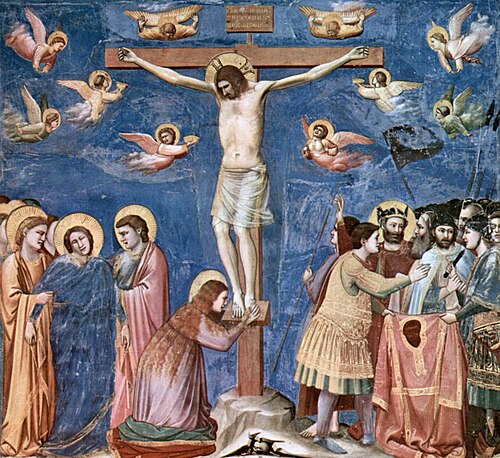
So here we are, upside down: right and wrong, good and evil reversed; human wisdom put where God’s wisdom should be and God’s wisdom ignored. So God let it be that way. He took what we had done and pushed it further and further, so that the human wisdom on which we relied would be reversed by the foolishness of God. Here’s what human wisdom does when it gets out of hand, beyond its limits: it exchanges the likeness and image of God for trying to be like God, and putting ourselves in God’s place. It rejects the perfectly good gifts of God in the creation for our own decisions about what is good and beneficial. It receives God with blows, and crucifies and kills Him. That’s what human wisdom will always do, because sin drives it out of its proper place in God’s creation and into heaven, where God alone reigns. So God brings human wisdom to its logical end at the cross. That’s where it ends when human beings want to be like God: they end up killing the true God. But the foolishness of God—where God appears foolish—is most apparent there, in God’s weakness and humiliation in the flesh of a dead man on a cross.
It is not because God knows that human wisdom will eventually find Him and He doesn’t want that. It is that human wisdom will continually seek for some god and never find the true God. Outside of its bounds, used by sinners, it only ends in trying to change places with God. Because people would never know God by wisdom, it pleased God, in His wisdom, to save people through foolishness. So God hides Himself in plain sight: in the man Jesus, the crucified one. To every unbeliever, this must be foolishness. The natural person, apart from the Spirit, Paul says, cannot and will not understand or know anything of this. It is all foolishness. It is all spiritually discerned and understood, by those who have the Spirit and the mind of Christ. But we have the mind of Christ. To all those who are perishing in unbelief, Christ and His cross are and remain foolishness. But to you, who are being saved by Him, the cross is the power of God. God does not give signs that people can figure out on their own, because signs can be interpreted in many ways. God does not give human wisdom, because outside its realm, it goes astray and makes its own gods. Instead, God gives Christ, to you and to the world, who is God’s power and God’s wisdom. He hides in plain sight, so that you, by the Spirit of God, may find Him where He has promised to be.
And then what? It will happen that the wisdom of the world, outside its proper place, will be foolish to you. And that you, with the wisdom and power of God in Christ will be seen as foolish to the world. But the weakness of God is stronger than human power and the foolishness of God is wiser than human wisdom. One example: in the 1986 film called The Mission, there are two men, one who is a Jesuit missionary, Father Gabriel, in South America, and one who is a slave-trader, Rodrigo Mendoza (no relation!) who becomes a Christian and a Jesuit priest. At the end of the film (sorry for the spoilers, but it’s been out for 40 years), the Portuguese army is taking over the territory, and they both stay behind with the native people. But while Mendoza fights with the people and dies, Gabriel celebrates the Mass and is processing with the people while carrying a monstrance (which is a golden thing that holds a communion Host). He also is shot down. The wisdom of this world might be able to celebrate Mendoza’s fighting, even though he and the people had no chance to win. But the wisdom of this world would never be able to understand Gabriel eating and drinking the Body and Blood, carrying that Body, and dying that way. Foolishness. But the fact is, despite the circumstances and the theology, they knew that Jesus, the crucified one, was there among them. They believed the resurrection. And that foolishness of peacefully walking with Jesus while they were shot and killed demonstrated the wisdom and power of God.
So it may be for you. The things you do, the things you say, the way you act, your coming here each week, all of this is being shaped and formed by the Mind of Christ and the Holy Spirit you have. Neither you nor I know exactly what we will do or say in every circumstance, but His wisdom and power are at work, now, here. Instead of doing anything and everything, you are here celebrating the presence of the crucified one among us; you are eating and drinking the Body and the Blood. And you might well face your death today; any one of us might. But whenever that comes, you know that you belong to the God who has hidden Himself in plain sight: in the crucified and risen Jesus who comes to you by means of water, bread and wine, words, who dwells among us, and who gives you the Spirit to discern and judge and act and live for your neighbor here and now. To you, who are being saved by Him, the crucified one is wisdom hidden in foolishness and power hidden in weakness. So it will always be until we see the full glory and power of God in the resurrection.
In the Name of the Father and of the Son and of the Holy Spirit. Amen. “And the peace of God, which surpasses all understanding, will guard your hearts and your minds in Christ Jesus” (Philippians 4:7, ESV). Amen.
– Pr. Timothy Winterstein, 1/31/26
 Bishop and Christian