Audio of the sermon is here:
In the Name of the Father and of the Son and of the Holy Spirit. Amen.
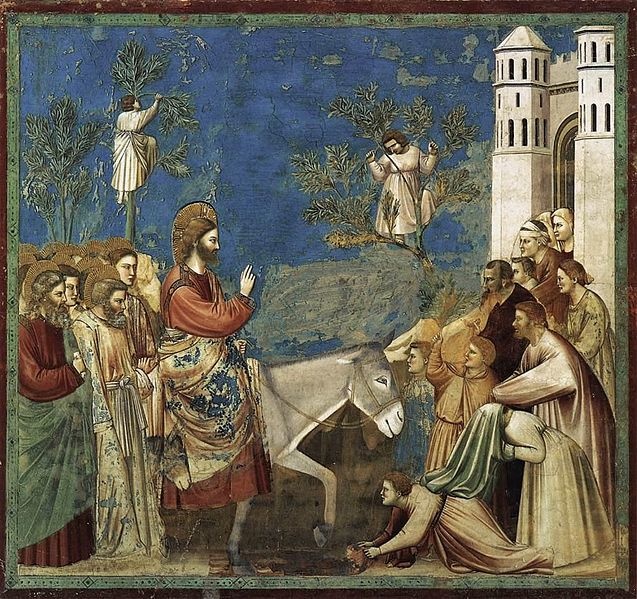
This is a day of stark contrasts. It’s built into the service itself. We start with all the joy and celebration and shouting and singing of the crowds: Hosanna—save us now! Hosanna to the son of David! Blessed is the one who comes in the Name of Yahweh! The Triumphal Entry, we sometimes call it. But then it moves very quickly to suffering and sorrow. They welcome Jesus into Jerusalem, but He comes riding on a donkey, which points to the contrast between what the people might be expecting and what they will get; between the joy and the sorrow; between the triumph and the defeat. The Son of God goes forth to war, but it is not the sort of war that is won by having more power, or a bigger army, or this world’s armor and weapons. This is a day of contrasts.
It’s built into the service itself, although the Church hasn’t always done it this way. In fact, your parents or grandparents may remember a time when Palm Sunday was just Palm Sunday. That’s because in the older calendars, The Sunday of the Passion came a week before Palm Sunday. People argue over which is better, but regardless of what anyone thinks, there is something fitting about bringing them together and making the contrast explicit: we cannot have the joy without the sorrow, the glory without the cross, not in this world. This is a day for contrasts.
It’s in the hymns, too. “Ride on, ride on in majesty; in lowly pomp ride on to die.” We don’t use that word “pomp” very much. Probably the only time you’ve heard it, if at all, is at graduations when they play “Pomp and Circumstance.” Pomp means a procession, a show, a splendid and ostentatious, maybe even a vain, spectacle. It’s about being impressive, extravagant, fantastic. But that means that “lowly pomp” is an oxymoron, a contradiction in terms. The contrast could not be clearer between the parades and processions of this world and the procession of Jesus on a donkey from the gates of the city to the cross. Ride on in lowly pomp to die. This is a day, and a week, of contrasts.
So some Greeks, who were in Jerusalem for the feast, say to Philip, “Sir, we desire to Jesus.” And Philip tells Andrew, and they go and tell Jesus. But Jesus doesn’t go see the Greeks. He says that His hour has come, and now if you want to see Jesus in this world—truly see Him—the only place where you can do that is on the cross. And I, when I am lifted up from the earth, will draw all people to Myself. He said this, John tells us, to indicate the kind of death He was going to die: being lifted up on the cross, as Moses lifted up the serpent in the wilderness, to be seen and believed. I don’t know about you, but if I were going to invent a god to worship, it wouldn’t be a crucified man. People talk about Christianity, along with all the other religions, as being invented by people to comfort themselves amid all the scary things in this world. But when the center of your religion is a man crucified by the Romans in the first century, the human invention of it looks ridiculous. No, this could only be the foolishness of God, not the wisdom of people.
But that is what this week is all about: the contrast between this and everything else in this world. The contrast between what we think we want to see, and what God gives us to see. More and more, what people want is for their side to obliterate the other side; that is, for their god to destroy the other gods, and however that gets done is fine with them. But when Jesus rides in on a donkey, His triumph is in the defeat. His glory is in the shame. His strength is in the weakness. And His salvation is in not being saved from death. The contrast is in the Sanctus. There is the “Holy, Holy, Holy” of the angels around the throne of God that Isaiah heard, and fell down on his face in fear of death. But when God appears in the world, He doesn’t appear in fiery, all-consuming glory. He appears in flesh and blood; He rides a donkey; He is crucified.
But exactly that is His glory. It’s not something different from the glory of God; it’s just the way the glory of God appears in the world. This is a world upside-down, where people claim wisdom and power and glory for what is foolish and weak and shameful in the sight of God; and so they, in return, view what God does as foolish and weak and shameful. Blood and suffering and death have no place in our ideas of glory. But Jesus is glorified when He is lifted up on the cross. His coronation is with thorns, and His royal robe is the blood He sheds. Because we have turned everything upside-down, and produced only sin and death, Jesus becomes sin and so He must die. He shows up in the likeness of sinful men and humbles Himself all the way down to death on a cross. He doesn’t exalt Himself and His virtues like everyone in this world does. Instead, He humbles Himself to serve and waits for God to exalt Him, as He promised to do.
Sir, we wish to see Jesus. Even if you don’t say the words, that is, or should be, your thought every time you come to the house of the Lord. We want to see Jesus. And He says, here I am to be seen. Like He says to the formerly blind man, do you believe in the Son of Man? Who is He, sir, that I may believe in Him? You have seen Him, and He is the one speaking to you. So also, you have seen Him; He is the one who speaks to you, whenever you hear the words of His prophets and apostles, whenever you hear that your sins are forgiven, today; whenever you hear, take and eat; take and drink; this is My body and blood, given and shed for you for the forgiveness of your sins. That is why we have that image of Jesus on the cross, to remind us that it is Him and no other that we receive in the Supper, in the Absolution, in the Baptism. You have seen Him; He is the one speaking to you.
And this whole world, though many do not know it, also want to see Jesus. They think they’re searching for what will make them happy down here, with their eyes on the earth, on what they can make or do; but the only happiness that endures past death is the joy of the Lord, and the joy in the Lord. He is your joy, and the joy of the whole world, if only they will look at Him and believe. Many will not, as Isaiah prophesied, but for those whom the Holy Spirit turns to hear and see, He turns and heals. You bear the Name of Jesus out into that world, and people may come to you, like they came to Philip and Andrew. They may say, We want to see Jesus, though it may be something like, Why do you believe in Him? Why do you go to that place? What is it about Jesus that you need? It is not that you will see or hear or get exactly what you think you want. Who wants a crucified God? But you will get in Him a life that begins now and that no one can take from you. You get a Word from God that no one can change or take away. You get the life of God that cannot be killed because Jesus was and He is alive.
We want to see Jesus. And this is, above all, the week to bring them to see Jesus. Every week is that, of course. Every Sunday is a little resurrection day. But this week, above all, we follow very closely the path of our salvation that Jesus creates: from the gates of Jerusalem to the Upper Room; to hear not only how our salvation is accomplished, but how it is given to us here and now; to follow from the Upper Room to Gethsemane; from Gethsemane to the prosecution of Jesus; from there to Pilate, and from Pilate on the road up to Calvary, where we stand with the women and see the crucified one and hear His words; and we follow as He is taken down from the cross and put into the tomb to rest after finishing all His work of new creation; all the way to the empty tomb and the angels and the fearful joy of a crucified God who could not stay dead, and the life He gives to you. It is a day and a week of contrasts. And all we want and need is to see Jesus.
In the Name of the Father and of the Son and of the Holy Spirit. Amen. “And the peace of God, which surpasses all understanding, will guard your hearts and your minds in Christ Jesus” (Philippians 4:7, ESV). Amen.
– Pr. Timothy Winterstein, 3/27/26
 Bishop and Christian