Audio of the sermon is here:
In the Name of the Father and of the Son and of the Holy Spirit. Amen.
You can’t get away from water in the Gospel of John. We heard last week about Nicodemus meeting with Jesus, and Jesus told him that he needed to be born from above by water and the Spirit in order to see and enter into the Kingdom of God. And the beginning of Jesus’ signs happened when He changed water into wine at a wedding celebration, more wine than they needed, better wine than they had. And here, Jesus sits down at a well (which, if you know the Old Testament, means that this is connected to the beginning of His signs at the wedding in Cana. But we’ll come back to that.)
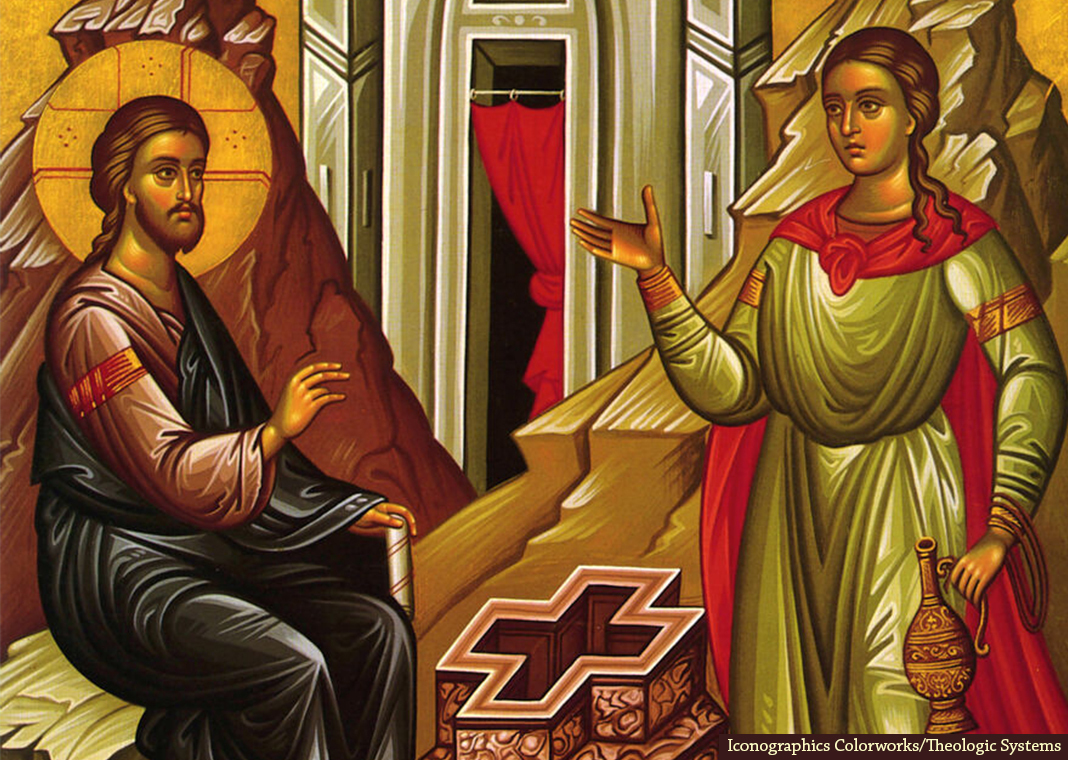
Jesus sits down at a well, and a Samaritan woman comes to the well to draw water. Jesus asks her for some water, and she says, Why are you, a Jewish man, talking to me, a Samaritan woman? Because Jews and Samaritans don’t have friendly relationships. That’s because the Samaritans are descended from the intermarriage of the nations that Assyria sent back to settle the land after the exile of the Northern Kingdom of Israel. So, she says, why are you talking to me and asking me for water? Jesus says, If you knew the gift of God and who it is who is asking you for water, you would ask Him and He would give you living water. She thinks, probably, that He is talking about running water. Where are you going to get this water? The well is deep and you don’t have anything to draw water with. You aren’t greater than our father, Jacob, are you? He gave us this well, and he drank from it himself. Look, Jesus says, you can drink all you want from this water, but you will be thirsty again. If anyone drinks from the water I give, he will not be thirsty and the water will become in him a spring of water welling up, bubbling over, into eternal life.
She says, please give me that water, so I am not thirsty and I don’t have to come here and draw water! And then Jesus throws a curveball, as He does to Nicodemus: Go call your husband and come here. She says, I don’t have a husband. He says, You have spoken well that you don’t have a husband. You have had five husbands and the one you have now is not your husband. You have spoken this truly. And then she says, Lord (or sir), I see that you are a prophet. Our fathers worshiped on this mountain, but you say that in Jerusalem is the place where it is necessary to worship. But wait a second. They were talking about water and wells, and now they’re talking about worship. What in the world does the talk about husbands have to do with this or that? It seems totally out of place. And it’s not helped by the mythology that we’ve created out of this. We imagine that in this small Samaritan village this woman has been married five times! And now she’s shacked up with another guy! And then we add to it by our speculation that this is why she’s out at the well by herself, because no one likes her or wants to be around her. And that’s why she says He’s a prophet, because He tells her something about her private life, her personal relationships, that she didn’t tell Him. So we hear “prophet” as someone who reads your mind, or who’s really good at reading people. But I challenge you to find a single place in the Bible where prophets do that. The closest anyone comes is Peter in the book of Acts with Ananias and Sapphira. But you can read all the Old Testament prophets, and that is not what they do. Why does she think He’s a prophet? Not because He knows her personal life. She barely blinks. She isn’t offended, or surprised, or ashamed, or embarrassed. I doubt people at that time even had something they considered their “private life.” She doesn’t tell Him, as people today would, that it’s none of His business. She just goes on talking about worship. What’s going on here?
Consider what prophets are doing in the Scriptures: they call out idolatry. They open their Bibles (in their minds) to Deuteronomy 28, and they talk about blessings for obedience and curses for disobedience, and they tell the people that they have done all the disobedience, and they should stop that before all the curses come upon them. Or they interpret all the bad things that are happening as the curses for idolatry. That is what a prophet does, and she knows it. That’s why she talks about worship. Because this is all about true and false worship. You can find it in 2 Kings 17. Why was the Northern Kingdom of Israel exiled to Assyria? Because they worshiped all the gods of the people around them. They would not listen to the prophets whom God sent, and they kept worshiping other gods and refused to hear or worship Yahweh (2 Kings 17:7-18). So Assyria came and captured most of the people and took them into exile. And then Assyria did what Assyria apparently always did: they sent other nations to settle the land and inter-marry with the people. I’ll give you one guess how many nations Assyria sent to resettle Samaria: five. Five nations, with their gods, resettled Samaria and intermarried with them. But God sent lions to devour the idolaters, so they said, Maybe this isn’t the best idea. The God of this place, Yahweh, doesn’t like these other gods. We should get a priest of Yahweh.
So the King of Assyria sent a priest of Yahweh and he tried to tell the people what Yahweh wanted and how to worship Him. But they just added Yahweh to their pantheon. They worshiped the gods of the five nations and they worshiped Yahweh. You have had five husbands, the gods of the nations; and the one you have now, Yahweh, is not your husband. It becomes apparent in the prophets, if we don’t bring in our own ideas about this woman. Yahweh your God is a jealous God. Do not have any other gods before His face. Idolatry is adultery, so the prophet Hosea has to marry a prostitute, who is repeatedly unfaithful to him. She doesn’t want to be married, and she keeps going back to her other lovers. And Hosea has to keep going after her. Adultery is idolatry. Ba’al, the Canaanite god, means (at least in Hebrew), “master” or “husband.” But Yahweh says, Ba’al will not be your husband; I will be your Husband (Hosea 2:16). “I will betroth you to Me forever. I will betroth you to Me in righteousness and in justice, in steadfast love and mercy. I will betroth you to Me in faithfulness. And you will know Yahweh” (Hosea 2:19-20).
God never divorces His people and lets them go to other gods, to other “husbands.” His bride, His people, are always looking for love in all the wrong places. They are continually putting their trust in other gods. They put their trust in money, or family, or government, or themselves. They pour their time, money, energy into the gods who never can save, because we’ve made them with our own hands; they are us. We trust ourselves, to pick ourselves up, to keep going, to make and remake ourselves. The Samaritans tried to worship their own gods along with Yahweh. The author of 2 Kings says that they did that up to the very day the words were written down. Sure, I’m a Christian. My Bible is around here somewhere. I keep Jesus around just in case I really need Him. But idolatry is adultery. And the only true God is jealous on your behalf. He will kill off all the other suitors to gain His bride.
So He comes and sits down next to a well. As I said, this is connected to the beginning of His signs at the wedding in Cana. Because, if you know the Old Testament, you know that the best way to find a bride is sit down by a well. If you’re looking for a nice girl—just saying, it’s an option. Abraham’s servant does it for Isaac, Jacob does it, Moses does it. You want a bride, you go to a well. And Jesus begins His search in Samaria, among the gods of the nations, with this woman. She does not have a husband; she has spoken well and truly. But now the hour has come for her and all her people to put away the idols. That’s like trying to find some water in a broken well. It’s looking for running water and all you find is a stagnant pool. You keep drinking, thinking you’re going to quench your thirst, but it’s only drinking salt water. Now the hour has come for true and living water, from the source of life Himself. I know that the Messiah is coming, she says, and He will proclaim all things to us. I am, Jesus says; the one who is speaking to you. Later, on the last and great day of the feast, Jesus will stand up and say it even more loudly: If anyone is thirsty, let that believing one come and drink from Me! The Scripture says, Out of His belly will flow rivers of living water. And the soldier pierced His side and blood and water flowed. I am, the one speaking to you. It is not about where you worship, here or in Jerusalem; it is only about whom you worship. And I am the location of God’s presence, not the temple; not Mt. Gerizim. Jesus is. The hour is coming and is now here when the true worshipers will worship in the Spirit and in the Truth. The Father is seeking such worshipers. He is seeking you. Put all that filthy, poisoned water aside. Have living water; have the water of God’s own life, which Jesus gives you. Put aside all the created things in which you trust. They cannot save you. But Jesus can and does. If anyone is thirsty, dried out from all the false water of this world, let that one, believing in Him, come and drink. It will never run out. He will never fail you. Come, drink, and live. The one who speaks to you in forgiveness and mercy and body and blood, is He.
In the Name of the Father and of the Son and of the Holy Spirit. Amen. “And the peace of God, which surpasses all understanding, will guard your hearts and your minds in Christ Jesus” (Philippians 4:7, ESV). Amen.
– Pr. Timothy Winterstein, 3/6/26
 Bishop and Christian