Bible Study Summary, 9/13/15
[We are using Pr. Matt Richard‘s helpful study, “How Do We View Christianity?” which sums up two ways of looking at the various aspects of human beings, sin, free will, salvation, and more.]
Today we discussed the Sacraments, starting on p. 8 of the study guide. We looked at Matthew 26:27-28; 1 Peter 3:20-22; and Acts 2:38-39, as well as Titus 3.
The question running through the different positions on the Sacraments is: which direction does the activity go between God and us? If we think of God above and us below, are the Sacraments my action up toward God, or are they God’s action in Christ down toward us? Are they my obedience and commitment toward God (the things I do in response to the salvation God has given me)? Or are they God’s saving action in Christ given to me in concrete ways? Are they powerless signs of something that happens apart from the Sacraments within me? Or are they powerful signs of Christ’s saving presence that come to me from outside myself?
The difference between these two positions is everything. If they are signs of my obedience and commitment, what if my obedience and commitment seems to flag and wane? Then the only place for me to turn is to an increased effort on my part to demonstrate my commitment and obedience. There is no Gospel that way; only despair. On the other hand, if the Sacraments are God’s action toward and for me, flowing from and based in Christ’s death and resurrection, then it is exactly to the promises contained in the Sacraments that I should turn. There I can know that I have a gracious God, because He has said it, and He continues to distribute His mercy–unlimited and eternal.
We talked briefly about how these questions highlight the fundamental differences between traditions in the Christian Church. This is not for the purpose of tearing down others, but of being honest about where those differences lie. If we can’t agree on where the disagreement is, we’re never going to agree on the substance of what is at stake.
Our discussion will continue next Sunday on whether unity is achieved or whether it is demonstrated by sharing the Lord’s Supper. We had great participation today, with numerous questions and comments, and we hope you will join us next week to share your contribution as we study God’s Word together.
Bible Study Summary, 9/6/15
[We are using Pr. Matt Richard‘s helpful study, “How Do We View Christianity?” which sums up two ways of looking at the various aspects of human beings, sin, free will, salvation, and more.]
Our discussion on Sunday revolved around where Justification (being right with God) is located (p. 7 in the study guide): is it something that happens individually, within each person? Is the primary meaning of justification my internal transformation: that justification is something that happens within my heart? Or is it something that happens outside me, in Christ, because of His death and resurrection? We might be tempted to go with the first option, since that seems to make it more personal. But our discussion of the location of our assurance of salvation made it clear that if justification happens inside us, then we are going to look for the assurance of our justification also within ourselves. But to look within for assurance is always uncertain and changing, since our emotions, circumstances, and experiences are always changing. In the midst of a changing world and changing circumstances, we needs a certain word and an unchanging promise–which can only be found outside us in Christ, who is the same yesterday, today, and forever. “On Christ, the solid rock, I stand; all other ground is sinking sand.”
Away With the Atheists
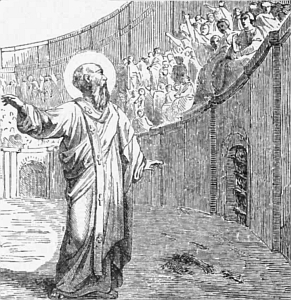
Bishop and Christian*, September 2015
“In many and various ways long ago God spoke to the fathers by the prophets; in the last of these days He spoke to us by the Son” (Hebrews 1:1). How does God tell us what He wants us to know? How does He make known to us His will? How do we discern what really is God’s word to us, especially when all sorts of people are running around telling us that God has said this or God has said that?
Continue reading
The Funeral for Virtus “Stub” Welch

Heart of Hearts
Bible Study Summary, 8/30/15
[We are using Pr. Matt Richard‘s helpful study, “How Do We View Christianity?” which sums up two ways of looking at the various aspects of human beings, sin, free will, salvation, and more.]
On Sunday we discussed questions on p. 6-7 in the study guide. We talked about what difference it makes in how we present the Gospel if (A) we believe that faith is a person’s decision to accept God’s grace, or (B) we believe that faith itself is a gift from God by which we receive the Gospel. If faith is an individual’s decision, then you would present the Gospel so as to make the case for the Gospel, about which the other person would have to decide. But if the Scriptures show us that individuals apart from the Holy Spirit are deaf, blind, and dead in their sin, then they cannot make a decision about the Gospel, and will always choose the opposite of the Gospel. On the other hand, if that’s true about people, then our sole responsibility is for the Gospel and for telling it to people. The Holy Spirit does the entire work, when and where He wills, of converting, enlightening, and granting faith in that Gospel.
We also talked about the Bible, and whether it contains the Word of God, or whether it is the Word of God. Someone made the point that throughout, “Plan A” in the study puts the individual person in control, whereas “Plan B” makes God the subject of the verbs. In this question, the same is true. If the Bible only contains the Word of God (i.e., some things in the Bible are not the Word of God, but solely the words of men), who decides which words are God’s and which words are merely human? The reader of the Scriptures is put over the Scriptures, rather than the Scriptures over the person. We also made the point that this belief in the Scriptures as wholly the Word of God is only true because Jesus is the Word of God. If the words of the Scriptures are all true, it is because Jesus is the Truth. If the words of the Scriptures show us the way, it is because Jesus is the Way. If the Scriptures shine a light for us to walk by, it is because Jesus is the Light of the World. All the words of the Scriptures are true because they all testify of Him.
The Memorial Service for Pamela (Hof) Loomis

Bible Study Summary, 8/23/15
[We are using Pr. Matt Richard‘s helpful study, “How Do We View Christianity?” which sums up two ways of looking at the various aspects of human beings, sin, free will, salvation, and more.]
This past week we discussed the first two questions on p. 6: Is the Gospel an announcement of good advice to be applied, or an announcement of good news to be believed? And: Is the Word of Christ information upon which I have to act, or is that Word something that acts upon me?
Both of these questions get to the heart of how we treat the Scriptures. Is the Bible an inert book, that waits for us to read the words, figure out how they apply to our lives, and then apply them? Or are the Scriptures–as Hebrews says–a living and active word, which the Holy Spirit applies to us in order to do something to us, to give us the Truth (Christ) to believe, and to sustain our faith in the midst of all the things over which we have no control?
This led us into a discussion about how we use the Bible as individuals. We recalled that for most of Church history, individuals never had a Bible which they could open in the privacy of their own homes and read silently. They heard the Scriptures of Jesus proclaimed to them, they believed them, and the Holy Spirit brought them into the story that God is telling in the Scriptures.
We also talked about how individuals understand what they are reading. With Acts 8:31 in mind, we wrestled with how individual Christians ought to read the Bible. I made the distinction between reading the Bible as an individual member of the Body of Christ and reading the Bible as an individual isolated from the Body of Christ. It is helpful to keep in mind what is the greater danger in our particular time and place. Is it that Christians will not be able to hear the Scriptures in their own language because “the Church” is controlling the Bible and simply telling people what it says and what they ought to believe (as it was, at least in part, prior to the Reformation)? Or is it (as I believe) that individual Christians, cut off from the history of the Holy Spirit’s work in the Body of Christ, will read individual passages of Scripture out of context and figure out how the words apply and fit into their lives, as if our lives were the main story, rather than the Scriptural story?
The topic gets complicated! It is wound up with the history of how the Scriptures came to be, the challenges to the primacy of Christ in various ways, the history of interpreting the Scriptures, and many other things.
We agreed that that sort of information is probably not where we’re going to start when discussing the Gospel or the Scriptures with unbelievers! And yet, if it is in the Scriptures–all the words that testify of Jesus–then we can’t ignore the words or stop trying to increase in our understanding of them.
Join us next week as we continue our discussion!
 Bishop and Christian