Video of the Divine Service is here. The sermon begins around the 27:20 mark.
In the Name of the Father and of the Son and of the Holy Spirit. Amen.
There are so many variables when it comes to growing something good and strong. Think about a plant, or bush, or tree that you want to plant and you want to grow and you want to thrive. Are you in the right growing zone for it? Will it get enough rain, or too much? Will it get enough sun, or too much? Enough shade, or too much? What is the soil like? Enough of the right nutrients, or too many of the wrong ones?
To switch images suddenly, what if you want to build a building? Is the foundation good? Are the walls straight? Will the roof leak, or is it solid? How’s the wiring? There are also a lot of variables that go into building a strong and lasting building.
It is interesting to me that these are two of the most common images of the Church: a plant and a building. They are not really the same kind of thing: one is organic; one is inanimate. But both images are common in the Scriptures. Think of Jesus: I am the vine, you are the branches. Jesus the sower of the seeds of His word in various places. The mustard plant in which many birds can nest. The tree of life, from which the healing of the nations will come. And then there’s the house built on a rock. And Paul speaks of the Church as a holy temple, built on a foundation of apostles and prophets, with Christ as the cornerstone. Peter also calls Jesus the cornerstone, and speaks of the Church as made up of living stones, of which you are one.
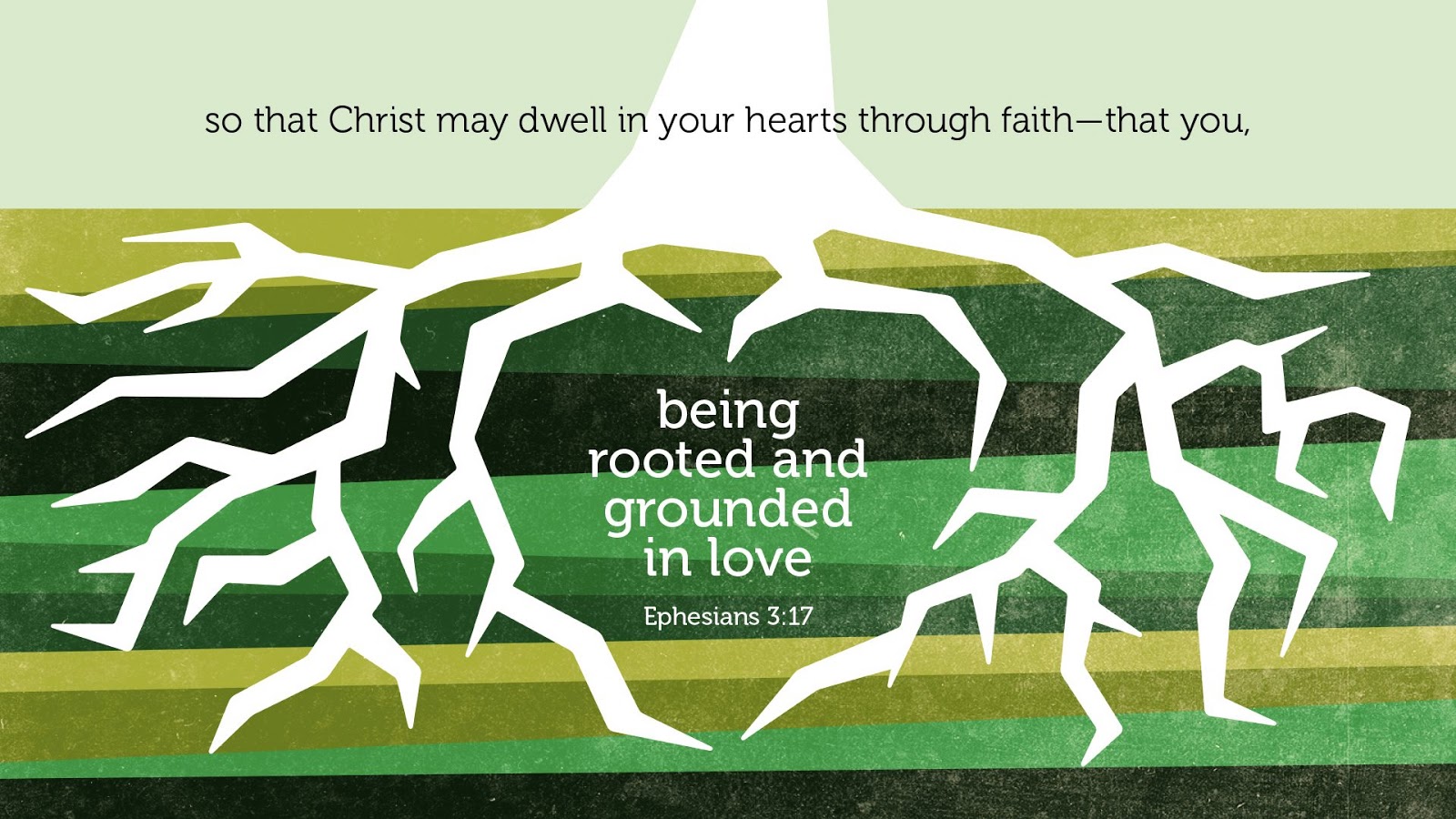
Those images are also here in Ephesians 3, although they’re a little harder to see: having been rooted and having been founded, or established. One is a plant image and one is a building image. In Colossians 2, Paul uses the same words: rooted and built up in him and established in the faith (2:7). But as different as plants are from buildings, these images tell us the same thing: in order to grow strong and well, plants need to be well rooted; in order to be built well and lasting, buildings need a good foundation.
These words are the heart of what Paul hopes for the Christians in Ephesus. If they were not well-rooted and well-grounded, the other things he hopes for them would be hard to come by. But Paul spent three years with the Ephesians. He knows them. But more importantly, he knows the words and gifts of God to them.
In this letter he repeats to them the heart of the Gospel, and the fruit of that Gospel in their lives: for it is by grace that you have been saved through faith. This is not from you, but it is a gift of God to you; it is not from works, so that no one may boast. For we are His work, being created in Christ Jesus for good works, which God prepared beforehand, that we might walk around in them. We used to be dead in sins and trespasses, walking around in them. But He has freely chosen to remake and recreate us, and those who are alive in Christ walk around in His good works.
Paul also reminds them that Christ has given gifts: apostles, prophets, evangelists, pastors, teachers, and they are to equip the saints for their vocations; they are to do the work of the ministry given to them; and they are to build up the body of Christ by His means, until we all together attain to the full unity of the faith, to the full knowledge of the Son of God. We are, Paul says, to be children no longer, tossed around as if we were on a stormy ocean, carried this way and that by waves of various doctrines. There is only one body with one Spirit; there is one hope to which we were all called; one Lord, one faith, one baptism, one God and Father of all, who is over all and through all and in all.
The roots of those Christians in Ephesus are in the God from whom every family is named, through the Spirit, in Christ. Their foundation, and the Church’s only foundation, is Jesus Christ, her Lord. Outside of Christ, and the word He gives through apostles and prophets, there is no Church. But Christ has established His Church, His dear bride, in His own body, and so she has eternal life.
And you have those good roots. You have that good foundation. I have known you over these ten years. But more important are the words and gifts of God for you. You are rooted and established in His own body. You, together, are His own dear bride in this place. These are not things that you have to do or make or create. These are passive words. That means that the things that are being done are happening to you, not being done by you. These words mean that you were rooted and you still are; you were established on a good foundation, and you still are.
But there are a lot of variables in the Church of God in a particular place, aren’t there? Just as with plants and buildings, we might be unsure on how to grow or build a healthy congregation. We might look at the garden next door, or the building in the next town over. We might remember when the plant seemed to have a lot more fruit every year, or when the building was brand new. And once we start looking, the church algorithm is going to feed us all the ads for all those who promise to help you grow and build more quickly than ever before, if you only do this, and don’t do that. Sometimes we just can’t wrap our heads around the variables, which can paralyze us and keep us from working in the field, in the temple, where He has put us. At the same time, especially when things are not going the way we want them to go, our fear grows and we get desperate, and we start grabbing at any rocks to fill in the gaps, and start pouring random chemicals on the plants to make them grow.
But this is not our plant, and this is not our building, except as we are part of it. Things can only go wrong when we get our jobs and God’s job mixed up. Because there is work for us to do. Pastors can’t say, “Well, I don’t need to preach; I don’t need to administer the sacrament; I don’t need to visit; I don’t need to continually pray or read the Scriptures; I don’t need to teach that Word; I don’t need to deliver forgiveness to sinners all the time; I don’t need to worry about who might need the Law and who might need the Gospel; because God grows and builds His Church.” And people in congregations can’t say, “Well, I don’t need to welcome visitors; I don’t need to invite unbelievers; I don’t need to bear witness to Christ as I go about my vocation in my job and my family; I don’t need to ensure my children are baptized and come to the Sacrament of the Altar; I don’t need to give to make sure the Word and Sacraments are available in this place; I don’t need to hear, or read, or study, or memorize the Scriptures; because God grows and builds His Church.” That’s confusing our jobs for God’s.
But it goes the other way, too. We can easily confuse God’s job for ours. When we, pastors or congregation members, think that if we only do this or that, or copy some other place that seems to have a lot of people, then we will “grow” the church; if we soften or change all the things that people don’t like, or stop using such old words, then we could fill up the pews; if we could just get with the times and stop holding so tightly to God’s order for marriage, and children, and life; or if we could get on board and help work toward the latest utopian vision of a just and perfect society, then we could appeal to more people; if the pastor would only do this or that, or be more like this, or less like that; then we could definitely succeed!
The problem is, there never has been, and there never will be a one-to-one correspondence between what we do and what God is doing to plant and build His Church. One of my favorite reminders of this comes from Dietrich Bonhoeffer, who said in a sermon:
Yet it is not we who are tobuild
, but God. No human beingbuilds
thechurch
, but Christ alone. Anyone who proposes tobuild
thechurch
is certainly already on the way to destroying it, because itwill
turn out to be a temple of idolatry, though the builder does not intend that or know it. We are to confess, while Godbuilds
. We are to preach, while Godbuilds
. We are to pray to God, while Godbuilds
. We do not know God’s plan. We cannot see whether God isbuilding
up or taking down. It could be that the times that human beings judge to be times for knocking down structures would be, for God, times to do a lot ofbuilding
, or that the great moments of thechurch
from a human viewpoint are, for God, times for pulling it down. It is a great comfort that Christ gives to thechurch
: “You confess, preach, bear witness to me, butI
alonewill
do thebuilding
, whereverI
am pleased to do so. Don’t interfere withmy
orders.Church
, if you do your own part right, then that is enough. But make sure you do it right. Don’t look for anyone’s opinion; don’t ask them what they think. Don’t keep calculating; don’t look around for support from others. Not only mustchurch
remainchurch
, but you,mychurch
, confess, confess, confess” … Christ alone is your Lord; by his grace alone you live, just as you are. Christ isbuilding.
And when Christ builds, and when we hear, and believe, and eat and drink, and confess the Christ who builds, the Church is what He says she is. He roots you in Himself; He is your foundation; so that you will be strong enough to grasp what is the breadth and length and height and depth, to know the love of Christ; that is, the love that goes beyond all knowledge.
This is Paul’s prayer for the Ephesians, and it is my prayer for you: that you will revel and rejoice in the riches of God’s grace for sinners such as we are; and as He continues to make those riches known to you in abundance, in His Word and in His sacraments, He will strengthen you with the power of the Spirit, who holds you close to Jesus, who dwells in you through faith. Rooted and established, whatever happens, you know that the love of Jesus for you never fails; and if it never fails for you, then you do not have to be worried that it will fail those whom you bring to hear Jesus. You will not fear the changes and uncertainties of this world, because Jesus is Lord. You will not fear sinners, because you know the One whose blood and death and resurrection is enough to cover them, just as it has covered you. You will not be stingy with forgiveness, because you know just how much you have been forgiven. Your mercy and love can only come from the mercy and love of Jesus for you. Anything else is a sham mercy and a false love. This is beyond all human knowledge, but as long as His Word is present, and people are being baptized, and people are being absolved, and people are eating and drinking Christ’s Body and Blood, He will plant, and He will nourish, and He will grow, and He will build, and He will finish what He starts. These are the ways that you are filled with the fullness of God in Jesus Christ. That full love and mercy and the power of His Spirit will push out all the sin and death in you, until they are no more.
Paul’s prayer for the Ephesians is the same as my prayer for you. We are members of the same family, baptized believers in Christ, our brother, who took on flesh to bring us back to the Father. Jesus suffered and died and rose so that you would be planted by baptism in His death and resurrection, as living branches of the living Vine. God strengthen you with the power of His Spirit; Christ dwell in your hearts by faith; having been rooted and grounded in His love, you will have the strength to grasp more and more just how broad and wide and high and deep is His love for you and this world; God keep you under one Lord, in one faith, in one baptism, with the one God and Father of all; that you would be eager to keep the unity of His Spirit in the bond of peace, patient, humble, and bearing with one another in love and forgiveness; until He brings you into the fullness of God’s eternal life. “Now to Him who is able to do far more abundantly than all that we ask or think, according to the power at work within us, to Him be glory in the church and in Christ Jesus throughout all generations” (Ephesians 3:20-21). God be with you now and always.
In the Name of the Father and of the Son and of the Holy Spirit. Amen. “And the peace of God, which surpasses all understanding, will guard your hearts and your minds in Christ Jesus” (Philippians 4:7, ESV). Amen.
– Pr. Timothy Winterstein, 7/27/24
1 Dietrich Bonhoeffer, Berlin: 1932–1933, ed. Carsten Nicolaisen, Ernst-Albert Scharffenorth, and Larry L. Rasmussen, trans. Isabel Best, David Higgins, and Douglas W. Stott, vol. 12, Dietrich Bonhoeffer Works (Minneapolis, MN: Fortress Press, 2009), 480–481.
 Bishop and Christian