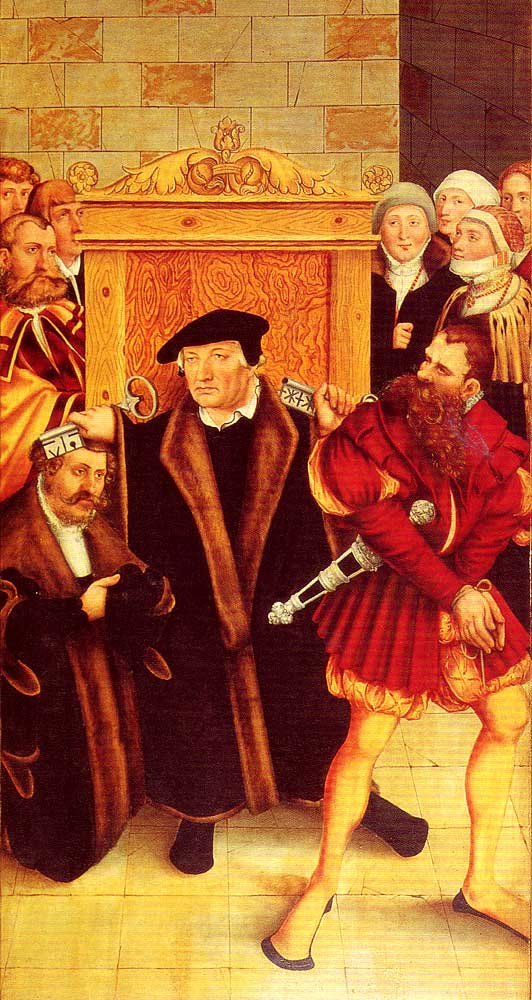
Audio of the sermon is here:
In the Name of the Father and of the Son and of the Holy Spirit. Amen.
Obviously, this is not where the sermon goes normally. When I was a child, I never heard—that I remember—anyone explain why we were doing what we did on a Sunday morning. It seemed random, even though it was regular and predictable. We don’t like the word “rote,” because we should be thinking about what we’re doing. But there are benefits to doing something without thinking about it. That means it’s in your head. It’s part of you. You know this if you’ve ever worked hard at learning an instrument, a skill, a song, a sport: it is only when you know what you’re doing so well that it is almost second-nature, that you can actually move freely. In our culture, we’re used to changing everything all the time. And in order to do that, you have to make it very simple. We don’t think it should take us time to learn how to worship, that anyone ought to be able to do it, no matter if they are Christians or not. But why would we think that? We are not naturally worshipers of the true God. Our hearts are naturally turned away from God and toward our own desires. So even when we become Christians, we still live and learn our way into what that means. We don’t give newborn babies steak immediately. They will choke on it. And yet, even though we all start out with milk, we mature and grow into the faith that is given to us. Paul tells the Corinthians that he could not address them as spiritual people, but as still in the flesh, infants in Christ. “I fed you with milk, not solid food, for you were not ready for it. And even now you are not ready” (3:2).
Do you know the name for this Sunday? Maybe you didn’t know that some Sundays have names! Quasimodogeniti: which comes from the antiphon of the Introit and it means: “Like newborn infants.” Peter says, “like newborn infants, long for the pure spiritual milk, that by it you may grow up into salvation—if indeed you have tasted that the Lord is good.” But the contrast there is between pure and impure milk, not between milk and solid food. There’s a difference between a child-like faith and a childish faith. The first is good because it believes the words that the Lord gives. The second is bad because it doesn’t think it ever needs to go beyond what it learned in Sunday School or in confirmation class. No more Bible studies for me! I graduated from that in eighth grade!
We do need to learn and grow into the worship of the God who has given us His Holy Spirit and faith to believe Christ. And that takes a little time. In fact, we can never get to the bottom of it, because as you can see, each part of the liturgy comes from the Scriptures, and you cannot exhaust the Scriptures. They are endlessly deep and endlessly wide. You can search and read and learn the Word of God, and the only way to do it badly is to think you already know it all.
So we learn both what we do and why we do it, just as human beings, and as Christians. As long as you don’t really know what you’re doing, you are sort of a slave to the thing you’re doing, because you always have to be paying close attention to it. So we’re going to spend the last three weeks of this month, these Sundays of Easter, taking a look both at what we do and why we do it. Both are necessary. Until we know what we’re doing, it’s hard to even ask the question, why? But when we are used to doing something, it is always good to remind ourselves why we do this thing, rather than something else.
Technically, the confession of sins and the forgiving of those sins is not part of the Divine Service itself. You can tell because the first part of the Service of the Word is the Introit. And that means “entrance.” So what we do before the entrance can’t be part of the thing we enter to do. Which is one reason to do the confession and absolution at the entrance of the church. We don’t have to do it there. We could do it by the baptismal font. We could do it in conversation back and forth from the altar. No rule there. But it is preparation, and it sets up everything and puts us into the right context for the Divine Service.
Let’s use the hymnals, since we have them! The Preparation is on page 185. I’m using Setting III for this, not because it’s better than the rest—although I think I could make an argument for its benefits!—but because it is the basic form of the Lutheran Service going back to the Reformation. But the main structure and the main pieces go back to the very first beginnings of the Church’s worship, which developed out of the synagogue and temple in which Jesus and the earliest Christians grew up and lived and learned the Scriptures.
The red print in the hymnal—the “rubric,” from the Latin word for “red”—rubies, right? The red print indicates what to do, while the black print gives you what to say. After the part about a hymn and standing, the first red indicator is that “The sign of the cross may be made by all in remembrance of their Baptism.” It says “may,” which means you also “may not.” There is no law about it. Making the sign of the cross doesn’t save you. If you do make the sign of the cross, you are free to go from your right shoulder to your left shoulder, or from your left shoulder to your right. But whether you make the sign or not, it is there to remind you of a truth: you are a baptized child of God. That is your primary identity. Whatever your job, whatever school or department you’re in, married or single, what you like to do, your particular gifts or talents, your particular temptations; whatever you worry about when you can’t sleep at night; whatever people say about you or know about you; whatever you tell yourself inside your head or when you look in the mirror; whatever—your identity, at core, is none of those things, but what God your Creator has said about you in His Son, Jesus Christ, by the Holy Spirit. Isaiah has the words from God: “Thus says Yahweh, He who created you, O Jacob, He who formed you, O Israel: Fear not, for I have redeemed you; I have called you by name, you are mine. … Because you are precious in My eyes, and honored, and I love you” (Isaiah 43:1, 4). Jesus tells His disciples to make disciples by baptizing them into the Name of the Father and of the Son and of the Holy Spirit and teaching them everything Jesus has said. He gives that command because this is how He gathers His creation and His creatures back to Himself. The flood scattered and killed, and so does baptism: it kills your sinful flesh, which wants to be god. It puts death to death. But the flood also preserved and saved Noah and his family. Baptism for you is like the ark on top of the water, floating over the top of destruction. Or it is like the Red Sea, through which God’s people walk through on dry ground, but those who are not His people are destroyed by water. You are the one He has created, and you are the one He recreates in His own Name, by water and the word.
The Name is everything. But the Name doesn’t just float out there, or stay in heaven. God puts it on you, He gives it, just as He put His Name on Solomon’s temple. Here, He says, is where I choose to be present for life and salvation. And God isn’t afraid of the stuff that He created. It’s His, after all. So water is what He chooses to use with the Word to bring you to Jesus’ death and resurrection for you. It’s not something different from Jesus; it’s just the way He has chosen to get Jesus to you, like a divine postal service—but absolutely reliable. If someone buys you something and it’s been paid for and it has your name on it, it still needs to be delivered or given. What Jesus accomplished and paid for and did on the cross is delivered to you in baptism, by water and the Spirit, by the Word and water.
So when we enter God’s House, we stand here as His dear children. People might confess their sins, and hear God’s forgiveness, even if they’re not baptized. We don’t keep people who aren’t baptized out of the church—in fact, we want them to have the same gift God has given us. But even if confession and absolution come first, it always happens in the context of baptism. The first words we hear are “In the Name…” and the last words of the preparation are “I forgive you all your sins in the Name…” No coincidence there. Jesus has tied His Name to the life that is given in forgiveness. His promise is forgiveness, but that also comes with a command to the apostles in John 20: Forgive sins! Any true forgiveness that is given or received flows from the resurrected Jesus. We always want to create conditions for forgiveness or limits on it, but Jesus does not do that. His forgiveness covers anything and everything. The only sins it cannot cover are those that we refuse to put on Jesus, or, more accurately, that we take back from Him and put them back on our shoulders. Because He took your sin before you ever knew about it, before you had ever committed any sins—that’s how comprehensive His forgiveness is. It is absolute, complete, unlimited. It is not sin, finally, that will separate you from God’s eternal life in Jesus. It can’t be, because Jesus removed that wall separating you from God, and the entirety of sin will not be removed from you until your death. The only thing that prevents that forgiveness from rejoining you to your Creator is not to believe it. Unbelief says, I don’t believe Jesus, I don’t need Jesus, and I don’t believe He took my sin. I’ll keep it. I’ll work on it. I’ll improve myself, be better, get right with God on my own. I’m sure He understands; nobody’s perfect. Well, He absolutely does understand. He was tempted in every way that you are. But without sin. But we mean “understand” as if it meant “excuse,” and that God absolutely does not do. How could He excuse the very thing that drives us from Him into the arms and worship of other gods? That would be like saying that your husband or wife “understands” your adultery—and just excuses or rationalizes it. No. God does not excuse it, or else what is the point of the Son taking on flesh? He could just tell us that it’s all good, because He knows we’re not perfect. We may even be better than some other people. God doesn’t excuse sin; He forgives it—which is, He forgives sinners.
And that’s what we confess ourselves to be. We do that because we’ve been joined to the truth, and if we say we have no sin, we deceive ourselves and the truth is not in us. If Jesus is the Truth about both humans and God and we belong to Him, then we must speak the truth. And the first truth we have to speak is the truth about ourselves. “I, a poor, miserable sinner…” I deserve death now and forever. As I stand before God, I do not stand relative to others, where I might be able to make a case for myself and give reasons for my actions. I stand alone, with what God’s Law reveals about me. Consider your place in life according to the Ten Commandments: Are you a father, mother, son, daughter, husband, wife, child, or worker? Have you been disobedient, unfaithful, or lazy? Have you been hot-tempered, rude, or quarrelsome? Have you hurt someone by your words or deeds? Have you stolen, been negligent, wasted anything, or done any harm? Once you start confessing, you might not stop! A poor, miserable sinner indeed. Sometimes people don’t like to confess that they are “poor, miserable, sinners.” Joyce Meyer, who grew up Lutheran, famously said that she was “neither poor, nor miserable, nor a sinner.” But this isn’t about money, it’s about whether you need Jesus. Because “miserable” really just means “in need of mercy.” If you don’t need mercy, either for your sin or for the living of your life, then you don’t need Jesus, and you don’t need to be here. This place is for sinners who need Jesus.
But remember that we confess only in the context of our baptism. And in that Name there is never confession without forgiveness. The world only likes confession. Out there, they are all too happy to make you confess your faults, your most grievous faults. But there is no forgiveness. The news cycle moves quickly, so people might forget your confession. But that’s not forgiveness. Only here, only from Jesus, only in His mercy for miserable sinners, is there forgiveness. We like to count up the sins of others and give just enough forgiveness to cover those, and no more. But Jesus continually gives all His forgiveness, all the time, over and over. And you and I could never earn that, deserve it, or gain it by getting ourselves right. Forgiveness has to be given from outside us. And Jesus does that by putting pastors in congregations to forgive; He gives mothers and fathers to forgive their children in their homes; He gives children to forgive their parents; He gives people to other people to forgive them, according to each of their vocations.
But how can a man, especially a sinful man, say, “I forgive you”? Of course, it’s not just me as an individual. But “by virtue of my office as a called and ordained servant of the Word,” I do what the Word commands to be done: If you forgive the sins of anyone, they are forgiven; if you retain the sins of anyone they are retained. The pastor—any pastor—has no authority to do anything except what Jesus Himself gives. And Jesus gives that authority to the apostles for the sake of the church. And not just for the church of their time, but for all times, until there is no more need for it. As the pastor, whom God has put here for you, and not as Timothy, I forgive your sins in His stead and by His command. And so, it turns out, we do not stand alone before God. Jesus stands here with us, covering us with His blood, interceding for us with the Father. He stands with sinners and for sinners.
In Christ, we know that God is our merciful Father, in whose name is our help. In one sense, our entire life as Christians is in this preparation for the Divine Service. The Morning and Evening Prayers (you can find them on 327 in the hymnal, or in your Small Catechism) remind us of this: In the morning, when you get up, make the sign of the holy cross and say: In the Name of the Father and of the Son and of the Holy Spirit. Whatever happens today, good or bad, I am baptized and I live always in the forgiveness of my Lord. And you can thank God for keeping you through the night, and ask that He keep you that day from sin and every evil. The baptized children of God died to sin. How can they live in it any longer? Keep me from sin and evil today! But then, when you get to the end of the day, before you go to sleep, make the sign of the holy cross and say, In the Name of the Father and of the Son and of the Holy Spirit. Whatever happened today, good or bad, I am baptized and I live in the forgiveness of my Lord. And you can pray, forgive me all my sins where I have done wrong, and graciously keep me this night. I make the sign of the cross because I’m baptized. Nothing can change that or take it away. I do not want to sin. I want to do what is good for my neighbor, whom God has given me. But I do sin, so I need the mercy and forgiveness of Jesus. And He gives it. Day by day, baptized, under the mercy of God in Christ, doing good works; and sinning, though sin is not my lord, forgiven, and baptized. The whole Christian life, here in the preparation: baptism, new life, confession and forgiveness. Given to you today, and every day, until your baptism is completed in the resurrection—in which there will be, finally, no more sin to confess; only the eternal life in Christ, the forgiver of sins.
In the Name of the Father and of the Son and of the Holy Spirit. Amen.
– Pr. Timothy Winterstein, 4/10/26

