Audio of the sermon is here:
In the Name of the Father and of the Son and of the Holy Spirit. Amen.
I don’t think Jesus is a very good farmer. My first call was to a dual parish in rural Northwest Minnesota. I’m no expert on farming, by any stretch, but I watched and listened to those farmers up there, who were most of the people in my two parishes. They were very careful. They paid attention to the weather, to the seeds, to the fields, to the harvest, to the markets. Most of that was outside of their control. They could decide when to plant, when to spray, when to harvest, when to sell, but they couldn’t control when it got hot or cold, wet or dry, or what the markets did. So they worried, naturally.
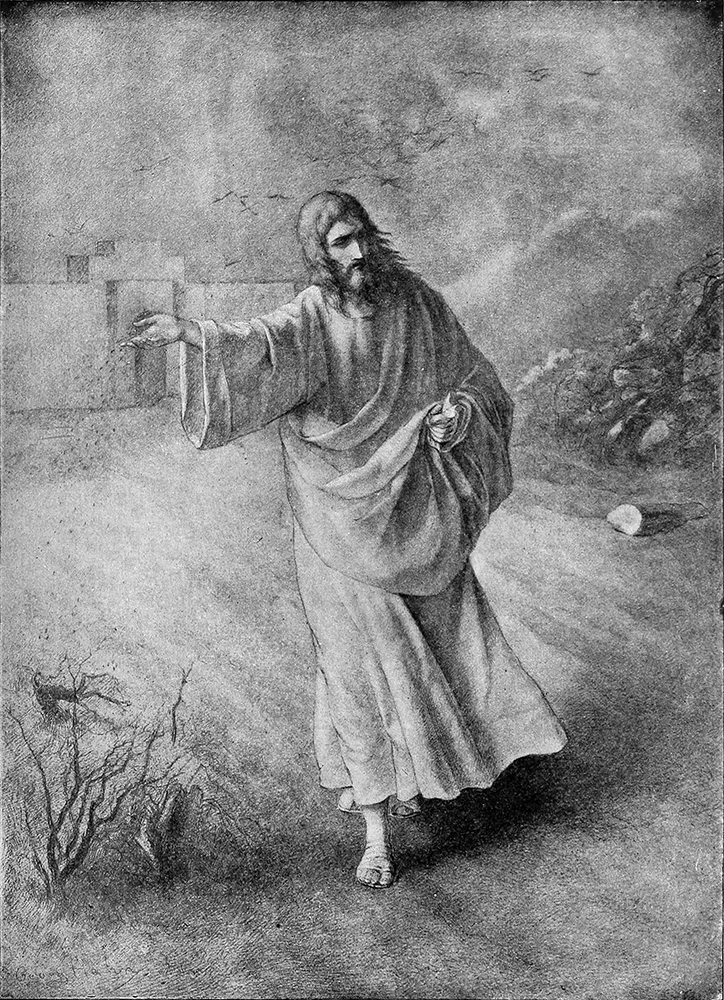
But all of that seems pretty much the opposite of what Jesus does in the parable. And it is Jesus in the parable. Matthew gives us a hint. At the beginning of the chapter, it says, “Jesus went out of the house,” and He got into a boat and the people were on the shore, and He taught them. Jesus went out of the house. And Jesus says, “A sower went out to sow.” That’s what Jesus is doing when He goes out of the house. He sows the seed, which is the word of the kingdom. He tells them a parable that has the kingdom in it. A sower went out to sow—and unlike the Minnesota farmers, seed just goes everywhere. It doesn’t say He threw it on the road, or on shallow soil, or among the weeds. But He’s not being very careful. Seed is falling everywhere. Like if you saw a tractor driving over the road, through the ditch, and into the field, without any rhyme or reason. Some seed falls on the road and the birds gobble it up. Some falls on ground where there isn’t much soil, and the roots don’t have any room to grow. Some falls among weeds, and the weeds grow faster than the plant and choke out the good plants. And then—surprisingly, after all that—some seed manages to get into good soil and bears fruit, 100, 60, 30 times more than the seed.
And that’s all Jesus says to the crowds. He doesn’t explain the parable or interpret it to them. And so when they go back into the house, in the verses that we didn’t hear this morning, the disciples ask Jesus why He speaks to the crowds in parables. We might think the answer is easy: because Jesus is a good teacher, who uses stories to engage His audience! Or because the parables are “earthly stories with a heavenly meaning,” and people respond much more to truths in stories—which is true. But Jesus doesn’t say that. He says that He speaks in parables not so that people will hear and understand, but so that they won’t. So that they will see, but they won’t see; they will hear, but they won’t hear, and they won’t understand, lest they turn and repent and I would heal them. To those who have, more, and more, and more will be given. To those who do not have, even what they have will be taken from them. If someone does not believe Jesus, that person will never understand the parables, let alone the rest of the Scriptures. To the one who does believe Jesus, more and more will be opened up; there is always more. You can never get to the bottom or the end of the Scriptures.
But while believing Jesus is a necessary condition to understand the parables, it is not a sufficient one. Even the disciples, who believe Jesus, do not have magic understanding. Jesus has to give them the interpretation. And He does: the seed is the word of the kingdom; the birds that gobble up the seed are like the devil, who doesn’t want anyone to hear or believe. The seed that grows on shallow soil is someone who receives that word with joy at first, but the roots are not deep enough to withstand what is coming. The sun rises and scorches and dries up that plant of faith, and kills it. Seed falls among the weeds, and it is received, but the cares of this world—where am I going to get what I need? How will I make ends meet? Will I have enough to pay my bills? What job will I get?—and the deceitfulness of riches—if I only have this much, or this much more, I’ll be happy—choke out faith like weeds. But then the divine miracle happens. In and among all of that, somehow, someway, some of the seed takes root in good soil. In the disciples, and in you. You, too, are among those disciples who hears what Jesus says. You heard the interpretation. Blessed are your ears, because they hear! Blessed are your eyes, because they see! You understand, because the seed of the word takes root and grows and is—it’s a present-tense verb—is currently bearing fruit. It’s not because you’ve magically figured it out; it’s not that you’re better or less bad than someone else. A blessing is not something you can get for yourself. It has to be given. And blessed are you.
Jesus tells His disciples what happens to the word of God in this world. He does not tell them why. He does not explain the soils. He simply says what happens. He doesn’t say that these are constant, static states of the soil, that they are always this way. In fact, we might have been each of these at some point: maybe there was a time or times when we could not hear the word at all; maybe there were times when trouble and persecution dried up our shallow roots, or the cares of this world and the deceitfulness of riches choked out faith. But you are here now, and Jesus keeps sowing the seed. The Spirit keeps tilling and cultivating. Blessed are you.
And Jesus will never run out of seed, so the word can be spoken everywhere. You can’t actually waste it. You don’t have to be careful with whom you share it. You can simply spread it and speak it to anyone, and you don’t have to worry. Scatter the Word to your children, to your family, to your friends, co-workers, whomever. Someone comes to you with a terrible diagnosis, or a death in the family, the resurrection hope of Jesus is for them. And you do not have to worry if it doesn’t seem to take root in that moment, or bear fruit. You don’t have to worry, not because it’s not important, and not because it’s not life and death. It is! But you don’t have to worry because you do not control it! God’s word is the seed, but Isaiah also says that God’s word is the rain and snow, that nourish and water that word until it flourishes and bears fruit. It never returns empty; it always does what God sends it to do. It never does nothing. It might bear fruit now, or hearts might be hardened against it now, but it never does nothing. It gives bread for the eater, and seed for the sower. It takes root when and where God chooses, when the Spirit has prepared the exact moment for the seed to grow, for the soil to be good. The sower keeps going out to sow. And blessed are you, who hear and see and understand. There is more for you. Bread for the eater and seed for the sower. You have ears; so hear.
In the Name of the Father and of the Son and of the Holy Spirit. Amen. “And the peace of God, which surpasses all understanding, will guard your hearts and your minds in Christ Jesus” (Philippians 4:7, ESV). Amen.
— Pr. Timothy Winterstein, 7/10/26

