
Author Archives: prwinterstein
Bishop and Christian*, October 2014
How are your feelings related to your worship? That is a question that is behind many of the arguments in the church related to worship. Talk to enough people from various congregations and it will not be long before you come up against a division between those who, on the one hand, know that they have been to church if they feel good, or different, or forgiven and, on the other hand, those who do not seem to care whether they feel anything at all. The division can be seen most clearly when someone leaves a particular (“stale,” “dead,” “boring”) congregation for another (“refreshing,” “alive,” “exciting”) one in which the Spirit seems to be moving more noticeably. What is striking about those conversations is that the descriptive words are completely tied to individual perception: that is, for worship to be good, everything depends on the feelings of the individual who is participating in the worship experience. If someone does not feel (there’s that word again) that he or she “got anything” from the service, and if this experience goes on long enough, such a person may be inclined to seek out a church where something (the “something” is rather ambiguous) is “gotten.” You may recognize a friend or a family member—or yourself—in that description.
A Love Song

By What Authority?

First, Last, and In Between
Forgiveness

Nothing But Love
A Different Christ

[Sorry, voice recorder ran out of batteries, so no audio]
In the Name of the Father and of the Son and of the Holy Spirit. Amen.
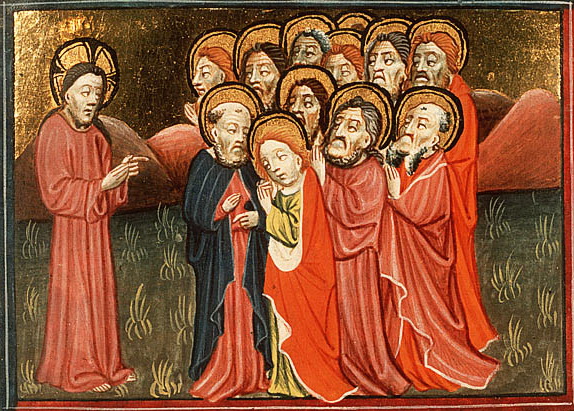
“Wherever God’s Word is preached, accepted, or believed, and bears fruit, there the holy and precious cross will also not be far behind.” So says Luther. But Luther didn’t make that up. He didn’t get it from himself. He got it from the Scriptures. He got it from reading the Old Testament and seeing how the prophets were treated. They preached the Word of God that they had been given, and they were not believed; they were hated, mocked, imprisoned, beaten, and sometimes killed. He got it from reading the Gospels and seeing how Jesus, the Word of God in flesh, was treated. He saw how the Apostles fared when they preached Christ, how they were beaten, imprisoned, and martyred. And this is exactly the order of things here in Matthew 16. Jesus is preached and believed; Peter and the Apostles confess that He is the Christ, the Son of the Living God. And then Jesus says to those same disciples, Don’t tell anyone that I am the Christ. And it becomes clear rather quickly why He says that to them. He begins to show them what it means that He is the Christ, and what kind of Christ He will be. He begins to show them that it is necessary that He go up to Jerusalem, suffer many things from the elders, the chief priests, and the scribes, be killed, and on the third day be raised. And Peter, who has just confessed that Jesus is the Christ, says, “No! You can’t be that kind of Christ. You can’t go up to Jerusalem, the place of God’s mercy, suffer, and be killed. God be merciful to you! That will never happen to you!” No doubt Peter has the best of intentions. He wants to save Jesus’ life and maybe his own, as well. But if these good intentions are carried out; if Jesus follows Peter, instead of Peter following Jesus; then those good intentions would pave the way to hell not only for Peter but for you and me and everyone else. Peter’s good intentions are the intentions of hell and Jesus says so. He turns His back on Peter and says, “Get behind Me, satan! You are a stumbling block to Me. You are not thinking the things of God, but the things of men.” Jesus has told them what kind of Christ He must be, and Peter does not want Him to be that kind of Christ. He tries to get Jesus to be a Christ who does not suffer, who does not die. Just like the devil in chapter four. In those three temptations, the devil is trying to get Jesus to be the Son of God in a different way. He tempts Jesus to turn stones to bread, instead of trusting that His Father will provide. He tempts Jesus to throw Himself down from the Temple, and test God to see if He would do what He said He would do. He tempts Jesus to get the kingdoms of the world not through death and resurrection, but through worshiping the devil. And Jesus says something very similar to what He says to Peter: “Go, Satan! [Not: go behind Me, as He says to Peter.] You will worship Yahweh your God, and Him only you will serve.” Jesus will not be any other Son, any other Christ, than the one whom the Father has sent. And that Christ must go to Jerusalem, suffer, die, and rise again.
 Bishop and Christian