
Audio here.
Video of the Vigil here.
Bulletin here.
It’s no secret that the Scriptures view the resurrection of Jesus—and the eternal life that flows from Him—as of first importance and all-encompassing (1 Corinthians 15). But what does it mean for our lives in this world where death, and not life, seems to reign and rule?
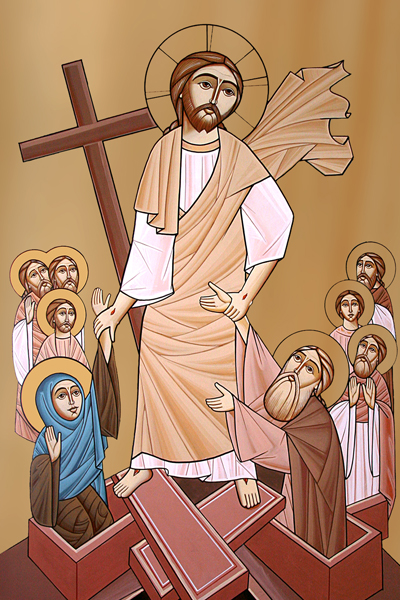
First, it means that if we are joined to Jesus’ death and resurrection (which He says happens in Holy Baptism), then if Jesus is alive, not even death can separate us from Him. He’s already on the far side of death so that, when we die, He will bring us into life.
“This is the feast of victory for our King, alleluia!” Christ is risen! He is risen indeed, alleluia!
This makes—literally—all the difference in the world. Paul says that if Christ is not raised, then our faith is in vain, and we are to be pitied above all people. Because if you believe in getting a good job, or enjoying your family, or getting people to like you, or having fun while you can, then at least you receive a temporal reward. Believing in the resurrection—that it is also your resurrection—may not get you rewards here and now. Jesus says that His Christians will have trouble in the world. We may suffer, be persecuted, not liked. We may lose or not get jobs; our families may hate us. Much of that will not be fun at all. Certainly, the Lord grants us temporal blessings, which we enjoy. But there is no guarantee of that, and those things can disappear in a moment.
Believing in the resurrection means believing in something beyond whatever prosperity or tribulation we experience in our lives. And that means not taking the things of this world more seriously than they deserve to be taken (e.g., trusting in them so that we are driven to despair when they fail). But if Jesus is not raised from the dead, then we had better take the things of this world far more seriously than anything that we might hold in the “future.” A bird in the hand is worth two in the bush, as they say.
Believing in the resurrection and having it turn out false would be far worse than not believing in the resurrection and getting on with your life, getting and doing what you can, while you can get and do it.
Sometimes we experience “church” like we’re putting in our time for God. This is because most of the Christians around us view “going to church” as either something that we do for God (we come to church on Sunday to worship Him for what He’s done throughout the week) or as the place we come to learn about God or to learn how to live a better life. While there are elements of these things in what happens on the Lord’s Day, we miss the point if we make those the only, or even the primary, reasons for why we are in the church building with other Christians. If we view going to church in those terms, we will either satisfy our own self-righteousness when we are glad to be there, or we will feel guilty if we are not glad. And then, when there are “more services,” as in Lent and Easter, the burden will only grow.
However, the fact that we are not always “glad when they said, ‘Let us go up to the House of the Lord’” is only evidence that we need to be there. Because (as you’ve no doubt heard me say before) we do not “go to church” primarily to worship God (as that is commonly understood), nor do we go for any of the reasons that put me first as the subject of the verbs. This is why Lutherans prefer “Divine Service” for what is happening in the Lord’s House on the Lord’s Day. God (“divine”) serves us in Jesus Christ. He is the primary subject of all the verbs; He gives the Gifts; He does the work; He forgives sins and gives life. This is why gathering with the people of God is not optional—not because it is something you have to do to be saved, but because it’s where God delivers to you what He has done for you to be saved. The Divine Service is simply Jesus for you, and you need Him whether you think you do, or not. So do I.





 Bishop and Christian