Video of the Divine Service is here. The sermon begins around the 25:45 mark.
In the Name of the Father and of the Son and of the Holy Spirit. Amen.
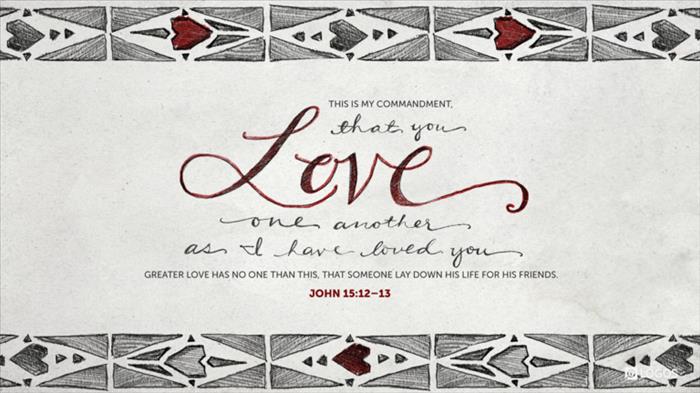
May ten Commandments are too many. Maybe that’s too hard, to keep ten of them. Most people probably couldn’t tell you all ten anyway. Well, Jesus reduces them to two commandments at one point: Love the Lord your God with all your heart, and with all your soul, and with all your strength, and with all your mind; and love your neighbor as yourself. Is that easier? Love God with everything you are and everything you have, and love your neighbor as yourself. I’m not sure that’s much better. Here we have just one commandment from Jesus: love one another as I have loved you. One single commandment, like the single commandment given to Adam and Eve: do not eat from the fruit of the tree of the knowledge of good and evil. That’s it. One command. And we know how that turned out.
But what about love? That seems nicer, easier, better. After all, love is all you need, right? That’s what everyone in the world is convinced is all that’s necessary. They think, along with many Christians, that all Jesus is really after is love. And in one sense that’s true. But before we can talk about how we love each other, we have to know how Jesus has loved us. Love one another as I have loved you. Is love mostly about how we feel? Is it mostly about warm, fuzzy butterflies in our stomach, or good feelings toward another person? If that’s all it is, it seems easy enough. If love is about nice feelings, then you really can love every person equally. Further, our world cannot seem to help associating love with a sexual relationship. Don’t tell me whom I can love. Love wins. Love conquers all.
The world will continue to do what it wants with the remains of a cultural Christianity. But for us, we have to know how Jesus has loved us in order to love one another truthfully and really. In this the love of God was made visible among us, that God sent His only Son into the world, so that we might live through Him. This is how we know love: not that we loved God but that He loved us and sent His Son to be the propitiation for our sins (1 John 4:9, 10). This is how God loved us: He sent His Son into the world so that whoever believes in Him would not perish but have eternal life. None of this is about God feeling good feelings toward us. It is in concrete actions for our sake and for our good. God is love, and we see that love in the flesh of Jesus, crucified and resurrected and ascended for our sake. It is physical, bodily, divine service.
We did not choose Him, but He chose us, to bear fruit that would remain: the fruit of love. And He does not give us generally into the world to have nice feelings about all the people who live here. He puts us in particular places with particular people. He puts us into families that we did not choose, with people we did not choose. Parents do not choose children, and children do not choose parents, or siblings. God puts us there. And it has nothing to do with our feelings toward them, although it’s always better if we love freely, with the only motivation being the true good of that other person. According to the Fourth Commandment and the Sixth Commandment, it is in the husband-wife relationship and the parent-child relationship that we first learn how to love. We learn how to forgive.
And what about congregations? We don’t really choose the people there, either. God puts us into congregations to learn and practice love and forgiveness. In fact, the family of God is more fundamental and basic for eternal life than our natural families. As much as people think they choose congregations, and as much as people “church-shop,” no one is ever going to find a congregation where there are no sinners. And because there are sinners, because every person in this place is a sinner, we must love and we must forgive. There is no excuse for Christians not to love one another. There is no alternative. Our Lord commands it.
So when there’s a little spark of offense, when someone says something or does something against you, it is easy to allow that to grow into a raging fire that threatens to consume everything. Sinners will blow on that spark; the devil will blow on that spark, because the devil wants to burn up relationships. He wants to burn up families. He wants to burn up congregations. He wants to burn up everything. He comes only to steal, kill, and destroy. And he often succeeds, with our collaboration. But love covers over a multitude of sins. Luther says, when there is a spark of offense, spit on it! Put it out. Do not let it get out of control.
But as we heard from Jesus last week, our love will not be perfect in this life. You are clean already because of the word I have spoken to you, Jesus says. We are clean in Christ, clean before God. You cannot be more righteous than Jesus. We are clean in Christ, but we are not clean in our lives. So love is necessary. And we learn what love looks like in this world by the Ten Commandments. We learn how we ought to love one another, though it takes different forms depending on our vocations at a given time. We are still being pruned by the Father to bear the fruit that remains, so that people will know that we are Christians by our love. But our love often fails. We are often loveless, faithless, selfish. We often do all the things that 1 Corinthians 13 says love does not do; and we often do not do all the things 1 Corinthians 13 says love does do.
Our love fails, and that is why we are here. That is why we confess our sins. That is why we are here before this altar: because our love is not perfect or complete or total. But God’s love for you in Jesus Christ is. The perfect love of the Father and the Son has come into this creation in the body that the eternal Son took to live and die and rise from the dead. And in that resurrection life, the love of the Father and the Son incorporates loveless people into that perfect love. There is no greater love than for someone to lay down his life for his friends, and that is what Jesus did. Although it is not because we were already His friends. We were slaves of sin; we were still sinners; we were the enemies of God. And He loved His enemies and did good to those who hated Him. He has called us His friends because of what He has done for us. Slaves do not know what their master is doing, but you are His friends and you know what He is doing. You know His love.
So we gather here, as imperfect and failing lovers, around the perfect love of God in Christ, which the Holy Spirit brings to us, and works for others through us. Here we, week by week, are loved and served by God in physical, concrete ways, in holy words and holy actions. He not only speaks, but His words do what they say. He doesn’t just talk about it, He actually delivers forgiveness. He actually uses water and words to join you to Himself. He actually uses bread and wine to give you Jesus’ body and blood. This is His divine service, and it is here alone where we learn what true love is and so how we love one another. It is here that His love strengthens our faith to believe Him more and more; and it is here that His love strengthens our love for one another. We practice love, and our love fails. But the perfect love of God never fails, and it is that love that will bring our love to perfection on that final day.
In the Name of the Father and of the Son and of the Holy Spirit. Amen. “And the peace of God, which surpasses all understanding, will guard your hearts and your minds in Christ Jesus” (Philippians 4:7, ESV). Amen.
— Pr. Timothy Winterstein, 5/4/24

