
Audio here.
Video of the Divine Service here.
This year, November 27 is the First Sunday in Advent. That means that we begin a new church year, and enter again into the life of Jesus, from prophecy through the giving of the Holy Spirit on Pentecost. Here’s the challenge for you: to participate in the entire church year. Yes. I’m asking you to be in the Lord’s House every Lord’s Day and on festivals, too. And that should include corporate Bible study, particularly on Sunday morning. [If you’re reading this and you’re not a member of Faith, then take up the challenge in your own congregation.] To let the rhythm of the church year, and the weekly rhythm of Word and Sacrament, order your days and your months and your year. To refuse to let the world order your life. To refuse to be conformed to this world, with its priorities and schedules and what it considers important; and, instead, to be transformed in the renewing of your mind as the Holy Spirit brings you the Word of God each and every week.
What Do We Do and Why Do We Do It?
Starting on September 18, I began a series of sermons preaching from the liturgy, and how the pieces fit together to make a unified whole. (You can find all the parts on bishopandchristian.wordpress.com as they are completed.) The reason I’m doing this is partly out of my own experience, as I mentioned in week one’s sermon. That is, it took me a very long time to understand what I’ve come to understand about the Divine Service and how the pieces fit together. I certainly do not understand it all, and even as I’m writing each week’s sermon, new avenues of thought are being opened up, even since I first did this eight years ago.
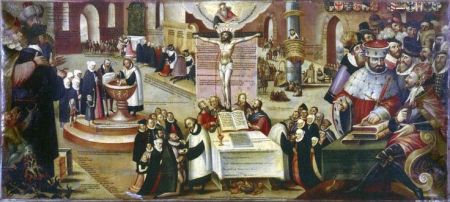
On the liturgy, Preparation through Gloria in Excelsis.
[meant to have video; no power cord. meant to press record; forgot.]
In the Name of the Father and of the Son and of the Holy Spirit. Amen.
I think it was Jaroslav Pelikan who said something to the effect that traditionalism is the dead faith of the living, while tradition is the living faith of the dead. Traditionalism is doing something simply because it was always done; tradition is doing what has been handed down to us, because it has become ours. Traditionalism very often leads to the opposite error: doing things simply because they aren’t what we’ve always done, always doing what is new and contemporary. But the fact that something is “contemporary” is not a reason to do anything. All it means is that it is being done now, at the same time that we are alive. What matters is not when something was produced, or when it was made, but what it is and what it does. A high school history teacher of mine once asked a class of sophomores, “What makes something a classic?” I don’t remember all the answers that were given, but I remember one answer: Something that stands the test of time. There are lots of things that are made and done and written and heard, but most are forgotten, most are forgettable, most are not able to stand the brutal test of history as it shifts, changes, and moves through place and time. One thing that has stood the test of time, even as it has developed and moved through very different languages, cultures, and places, is the liturgy of the Church. Granted, the Church has not had only one liturgy in her history, but it is astounding to consider how much the liturgies of the Church have in common across time and space. For the next few weeks, I’m going “preach through the liturgy” as we dig deeper and hear better this great gift as it has been handed down to us for hundreds, even thousands, of years.

 Bishop and Christian