Audio of the sermon is here:
In the Name of the Father and of the Son and of the Holy Spirit. Amen.
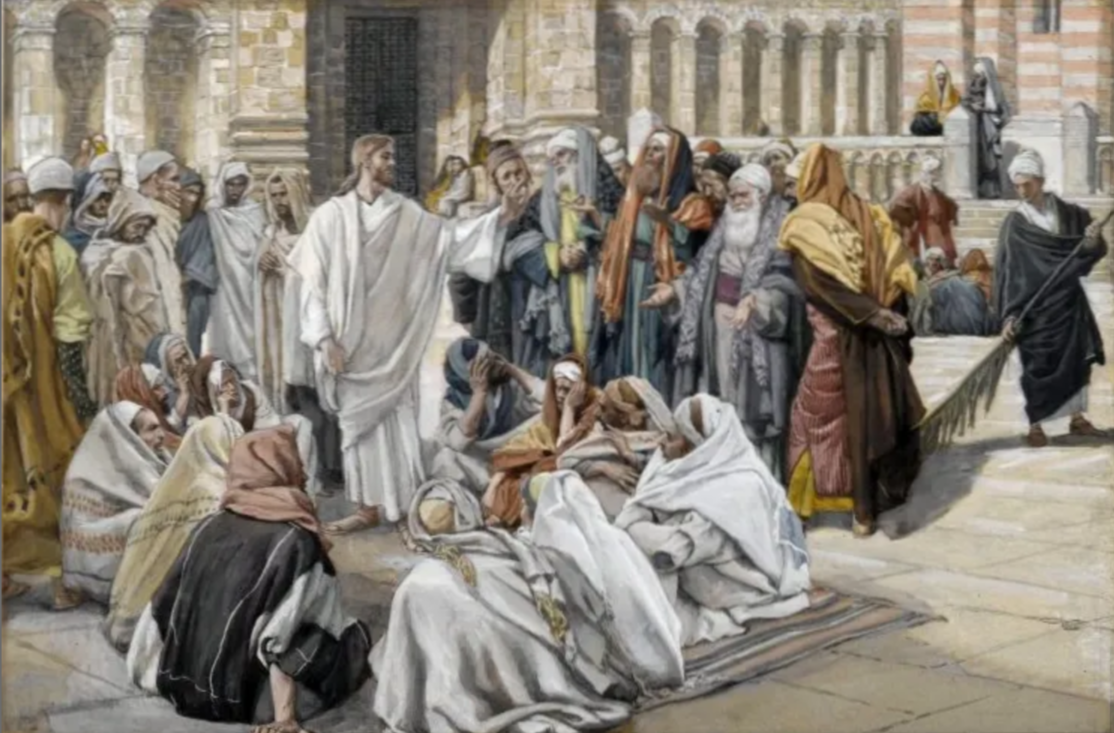
I know we’ve been trained to think of the scribes and the chief priests as the bad guys in this story, but their question is not unreasonable. Jesus is teaching in the temple after He entered the city on a donkey, and they come up to Him and say, “By what authority do you do these things, and who gave you this authority?” It’s not an unreasonable question. In fact, it’s probably a question we should ask more often these days. The public square used to be literal, and people had to gather there either to speak or to listen. Now the public square is in our pocket or purse at all times. Anyone and everyone can speak about whatever they want. We still like people to have expertise; but now we assume anyone can be an expert. At the very same time that we have very little trust in the authority of institutions and prominent experts, we will listen to anyone who has a phone and a ring light.
But maybe we should ask this question of more people: where do you get the authority to say these things? Obviously, it was not a person who gave them any authority (which we don’t trust anyway). It is a technological ability that allows them to present themselves as an authority. And every person on the internet speaks with absolute, unshakeable certainty. Maybe it’s a prerequisite of putting up videos online, but very rarely do you find anyone who humbly presents an opinion. Everyone acts as if what they are saying is the rock-solid truth of reality and only stupid people would disagree. But when you go looking for where that certainty comes from—some past, long experience in the area, or expertise, or education—there is more often than not none. Zero. Obviously, there are a lot of political commentators, but the worst for me are the people who act like they’ve discovered some new, ground-breaking piece of information about the Bible, which they’re reading for the first time. “Guys, did you know…?” and they go on to say something that people have known for centuries, and is very commonly discussed among Christians. It’s not new, it’s not ground-breaking, and people have been wrestling with these things for thousands of years. But go on, random person on the internet. No trusted authority breeds authorities who know nothing of what they speak.
All of that to say, the question the scribes and chief priests ask is a good and valid question. By what authority do You do these things? What things is Jesus doing? He rode into Jerusalem on a donkey, like Zechariah 9 says, and people were praising Him with the word “hosanna,” which means “save [us] now”! Then He clears the temple and throws out the money-changers and the animal-sellers. Then He heals the sick and the diseased and children praise Him: out of the mouths of little children You have ordained praise. Then He curses a fig tree and it withers. And finally, He teaches in the temple, all in this very short period of time. By what authority do You do these things? Valid question because the chief priests and scribes do have some authority. They have been put in some positions of authority among and for the people, in the temple. Humanly speaking, they have a right to ask Jesus.
So Jesus says, “I will also ask you one question. John’s baptism, was it from heaven or from people?” The thing that John did, by what authority did he do that? Was it from heaven—from God—or was it from people? And notice, they reveal that they are not at all trying to find the answer to these questions. They do not really want to know whether Jesus has authority to do what He’s doing. They reveal it because they discuss among themselves how they should answer: if we say, from heaven, then He will say, why didn’t you believe him? (Which is, in fact, what Jesus says anyway in verse 32.) If we say, from people, then we fear the crowds because they hold that John was a prophet. This is not about the truth; this is simply calculation about the effects of saying one thing or another. And of course we are not strangers to this way of thinking about things. What will happen if I say this or that? What will people think? What will the consequences or the implications? We calculate and calculate, rather than simply speaking the truth in love. We don’t seek the truth; we think about what will happen if we believe the truth and act according to it, or do not.
So they say, We don’t know. And Jesus says, Neither, then, will I tell you by what authority I do these things. Because the answer is the same! The answer to the question about John’s baptism is the same as the answer to the question about Jesus’ authority: they have the same source. God sent John to baptize people confessing their sins, and God sent Jesus as the forgiveness of those sins. John points to Jesus and He was sent to identify Him by means of his baptism. The question is the same as what Jesus asks His disciples: who do you say that I am? If He is the Christ, the Son of the living God, then He has the authority of God in the flesh to say and do what He says and does.
What about His authority? Let’s examine the record of the Gospel according to St. Matthew. In chapter 7, Jesus is teaching as one who has authority, and not as their scribes. The scribes can only describe what various teachers have said about religious questions. Jesus speaks as if He has authority to interpret the words finally and absolutely. He speaks as if He is the source of the words, which He is. In chapter 9, Jesus heals a paralyzed man, but before He does, He says to the man, Son, your sins are forgiven. But scribes say that He is blaspheming. In response, Jesus says, which is easier to say: your sins are forgiven? or Rise and walk? But that you may know that the Son of Man has authority on earth to forgive sins—He says to the man, rise, take your mat, and go home. And he does. And the people are astounded that God has given such authority to man.
Then in chapter 10, Jesus gives His disciples authority over unclean spirits, to cast them out, and over sickness and death, to heal. And they do, in His authority. And finally, in chapter 28, after Jesus’ resurrection, He meets His disciples on a mountain in Galilee and He says to them, All authority in heaven and on earth has been given to Me; therefore, because of that authority, Jesus sends them out: go, and wherever you go, make disciples by baptizing them into the Name of the Father and of the Son and of the Holy Spirit, and teaching them to observe everything I have commanded you. And, look, I am with you all the days until the completion of this age.
I cannot prove to you that Jesus has this authority. Either He is risen from the dead and He has the authority to do all things; or He is not, and He does not. But only the Holy Spirit can give you the faith to believe that. If those who saw Jesus in the flesh could still calculate, rather than believe, it certainly won’t be different today. But I haven’t been put here to prove Jesus’ authority. I’ve been put here to act according to that authority, which He has given to the Church through His apostles. I have no authority of my own, except to do what Jesus does by His authority. The Church has no authority except that of the Jesus who is with and among us all the days until this old, evil age is complete and the new, resurrection age begins.
So it is that I baptize into the Name of the Father and of the Son and of the Holy Spirit, as Jesus commanded. This is how you are a disciple: you are baptized and you continually learn everything Jesus said. And in that Name, under His authority, in His stead and by His command, I forgive you all your sins. Because He said, Whatever sins you forgive, they are forgiven; whatever sins you bind, they are bound. As it is in heaven, it is on earth. It is His authority by which I say the words by which He makes His body and blood present with bread and wine. He is the one who says, “This is My body; this is My blood.” And He says, “Do this in remembrance of Me.” So we do. All of this is not so that authority can be exercised over or against you, but for you. For your sake, your sins are forgiven. For your sake, you are baptized into the one who has all authority on earth and in heaven. For your sake, you eat and drink the body and blood of the one who has authority on earth to forgive sins and heal bodies. So the God who exalted Jesus, in His flesh, to the place of all honor and authority enlightens us by His Holy Spirit, so that we will confess Jesus as Lord and be led into all the truth.
In the Name of the Father and of the Son and of the Holy Spirit. Amen. “And the peace of God, which surpasses all understanding, will guard your hearts and your minds in Christ Jesus” (Philippians 4:7, ESV). Amen.
— Pr. Timothy Winterstein, 9/25/26

