Audio of the sermon is here:
In the Name of the Father and of the Son and of the Holy Spirit. Amen.
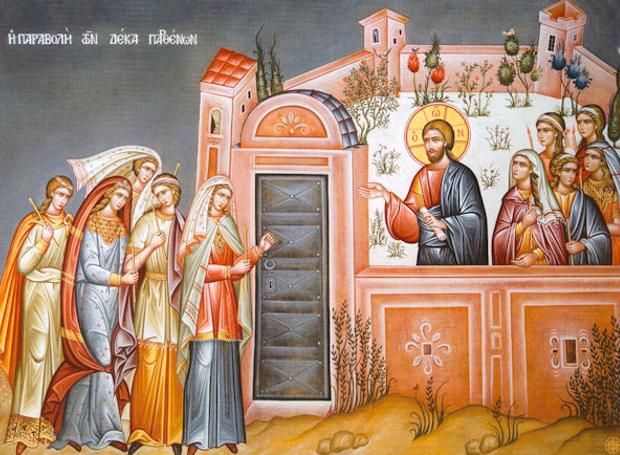
I am confident you are familiar with this parable. You’ve probably heard it several times, or you know the basic vocabulary. If nothing else, maybe you’ve heard or sung the song that goes, “Give me oil for my lamp, keep me burning. Give me oil for my lamp, I pray. Keep me burning, burning, burning, until the break of day.” Do people still sing that, maybe at camp? Anyway, you’re probably familiar with this parable. If you’re not, the basic story is about ten virgins—ten unmarried women—who are meant to meet and welcome the bridegroom, who is going to begin the wedding feast. Where is the bride? I don’t know. That’s led some people to suggest that this bridegroom is a polygamist, and these ten virgins are all going to be his brides. But the parable doesn’t even hint at anything like that. The simplest explanation is that these ten young women are friends of the bride’s or groom’s family and they are part of the procession of the wedding party, with their lamps.
Five of the virgins are foolish, and five are wise. What makes them wise? They have brought extra oil with them, in case the bridegroom takes longer than expected. And He does. So long, in fact, that they all get tired and fall asleep, and their lamps go out. Then, in the middle of the night, the cry comes: “Look! The bridegroom!” So they all wake up, and they get ready, including trimming the wicks of their lamps and lighting them again. But the lamps of the foolish virgins go out again immediately. So they ask the wise ones for some of their oil. But the wise say, no, because there might not be enough for both of them. So the wise tell the foolish to go buy some oil from the merchants, from the sellers. But while they’re gone, the bridegroom does actually show up, and the prepared ones go in with the bridegroom, into the wedding feast, and the door is shut. Then when the foolish come back, whether they found oil or not, they knock on the door and say, Lord, Lord, open to us! But He says, Truly I say to you, I do not know you.
People have all sorts of questions about this parable, because there are all sorts of gaps. We know very little about wedding customs of the first century, so people love to speculate, as some do about polygamy. What do the oil and the lamps signify? We are not told. Why can’t the wise ones share? Are they just being mean and selfish? Why won’t the Lord open the door to the wedding feast when they knock? We are not given the answers to any of those questions. So it’s probably better to take the answers we are given and learn how to ask the right questions. We can start with the point of the parable, which Jesus gives us: So then, keep watching, because you do not know the day nor the hour.
In other words, we know the wise virgins were ready, so they went into the wedding feast with the bridegroom. The foolish virgins were not ready, and the door was shut against them. The clear point is: the bridegroom will come; you must be ready. But it’s hard to be ready, it’s hard to keep watching, when it has been so long. Not just our own lifetimes, but many, many lifetimes have passed since Jesus spoke these words. We keep talking about it, but it is hard even to think about what it looks like to be ready for the coming of Jesus. But the parable just before this shows us what it looks like not to be ready. The master of a house leaves and puts a servant in charge of the house. But when the master of the house delays—the same word as in this parable—that evil servant stops doing what he was given to do and begins to eat, to drink, getting drunk, and to beat his fellow servants. And then the master of the house, the master of that servant, shows up on a day he does not expect and at an hour he does not know, and cuts that servant into pieces and puts him with the hypocrites, where there is weeping and gnashing of teeth. And then, at that time, the kingdom of heaven will be like this parable: just as that evil servant gave up his appropriate responsibilities to do what he wanted because his master—his Lord—delayed longer than expected, so the foolish virgins are not prepared for how long the delay might be.
But Peter reminds us that God is not slow to keep His promises as some count or understand slowness. He is faithful, He will do what He promised. We confess it every week: the one who is ascended to the right hand of the Father will come again in glory to judge the living and the dead. We keep praying the table prayer of the church: Come, Lord Jesus. However long it takes, whether we are on the earth when it happens, Jesus will appear in all His glory and every knee will bow before Him, and every tongue will confess that He is Lord.
How then can you be ready? How can you be sure? Are you sure that you will never get tired of waiting? Do you have enough of whatever is burning in their lamps to last until the bridegroom comes? I don’t know any way to answer that question definitively, except to say it is always uncertain and doubtful when we try to examine ourselves. I certainly wouldn’t want to trust my entrance into the wedding feast to my own preparations. I do not think I will fall away, but how can I be sure?
But the cry will not only go out on the last day. It goes out now. There is, even in the parable, a gap between the middle of the night when the virgins are awakened by the cry, and when the bridegroom actually shows up to go into the house. And that cry has reached your ears. Look! The bridegroom! He appeared in this world before He will appear again. He was born into this world in order to find His bride. Look, the bridegroom who is Christ, the one who sees bruised reeds and faintly burning wicks and He does not break or extinguish them. The inexhaustible and unquenchable fire of His love for you burns undimmed. He has appeared already in time to prepare you for the day of His revelation in glory. He sent His apostles to proclaim repentance and the forgiveness of sins to every nation, and He commands them: make disciples everywhere by baptizing them into the Name and teaching them to keep everything I’ve spoken to you. He commands, forgive their sins. He commands, do this in remembrance of Me. He called you by His Spirit, and He joins you to His own death and resurrection. He names you with His own holy name as one of His dear and beloved children. He delivers to you His forgiveness of your sins entire and whole. There is nothing His suffering and blood and death do not cover. All your guilt at what you’ve done, even the things that you think you’ve successfully buried in time and memory. All your shame at what others have done to you. All of it and the death it brings. He took it as His own so it does not belong to you anymore.
Look! The bridegroom! He is both the host and the food at the feast of love and life. Take and eat, take and drink. Look! The bridegroom! You will know His voice on that day, because you know it and hear it now. And you, dear, wise ones, you desire to hear it all the more. And then, on that day, you will hear the cry of the archangel and the trumpet of God, and everyone will be awakened, whether from sleep or from death, and both the living and the dead in Christ will go out to meet Him, and then He will bring you in to the wedding feast begun in fullness in the new creation, and so you will always be with the Lord.
In the Name of the Father and of the Son and of the Holy Spirit. Amen. “And the peace of God, which surpasses all understanding, will guard your hearts and your minds in Christ Jesus” (Philippians 4:7, ESV). Amen.
– Pr. Timothy Winterstein, 11/6/26

