Audio of the sermon is here:
In the Name of the Father and of the Son and of the Holy Spirit. Amen.
There are two kinds of people. There are three slaves in this parable, but only two kinds of slaves. Before we get hung up on the slavery language, think of it not in terms of slavery in the American south, with kidnapping, buying, and selling of people, but of working off your debt, like we do with credit cards. You may not be working for the credit card company, but… you are working for them, to pay off what you owe. Or, think of Paul, who calls himself a “slave of Christ.” That is, as Bob Dylan put it, “You gotta serve somebody. It may be the devil or it may be the Lord, but you gotta serve somebody.”
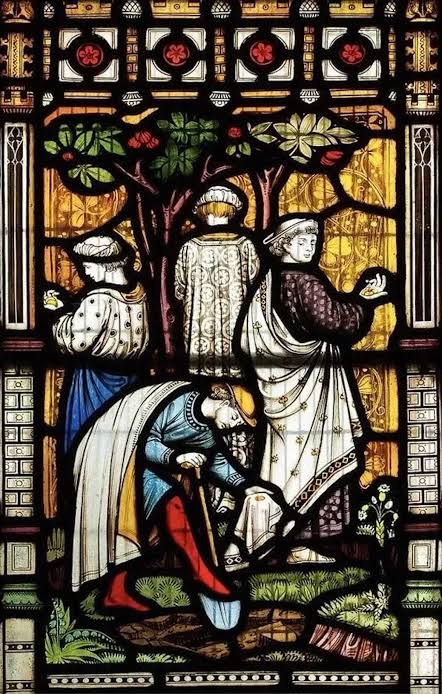
At any rate, these slaves have this master; another translation is “Lord.” And this Lord is gracious. He goes away on a long journey and He gives gifts to His slaves: to one five talents, to another two, to another one, each according to his ability, or capability, or power. These are not talents, like in a talent show. They are measurements of money; in this case, as we find out later, measurements of silver. This is not a small amount. If a talent represents 15-20 years of average wages, well, you can do the math. And as far as we know from the parable, there are no restrictions on what the slaves do with this silver. They are free to do what they would like. So immediately the first slave takes his five talents, works with them, and gains five more. What is this work? It doesn’t say. He just goes and works with what he’s been given, and he gains more from it. And the second slave does the same. The third slave, however, does not “work” and “gain.” He “digs” and “hides.” He digs up the ground and hides the silver of his Lord.
When the Lord comes back, after a long time, He settles with the slaves over what they’ve done with His money. The first one says, here are five more talents. The second one says, here are two more talents. The third says, I knew You were a hard man, reaping where You did not sow, and gathering where You did not scatter seed. So I buried it in the ground and here, You have what is Yours. There are three slaves here, but there are only two kinds of slaves. The first two are in the same category: Well done, good and faithful slave. You have been faithful over a little, over a few things. I will appoint you over much, over a lot. Enter into, come in to, the joy of your Lord. Exact same words for both the first and second slave.
But the third doesn’t get “good and faithful;” he gets “evil and lazy.” You knew that about Me, did you? You should have thrown My money in the bank and I could have had a little interest on what is Mine. Take that talent from him and give it to the one who has ten, because the one who has will have much, even an abundance. But the one who does not have, even what he has will be taken from him. And take that profit-less slave and throw him into the outside darkness, where there is weeping and gnashing of teeth.
Two kinds of slaves: those who have and those who do not. Those who do something with what the Lord has given and those who bury and hide what the Lord gives. Notice that this is not like the parable of the workers in the vineyard, where some are mad that others get relatively more for relatively less. Here, there is no comparison. No one is mad about how much he gets compared to someone else. Also, this is not quantitative, where the amount itself is the point. The Lord simply decides and gives how He will, and no one seems upset that the first slave gets five talents. That’s simply how the Lord wants it. The problem is not comparison or quantity; it’s doing or not doing. It’s using or neglecting. It’s working with or hiding. The words to the first two slaves are exactly the same, though they do not start with the same amount and they do not end with the same amount. They work with different amounts, they earn different amounts; but they get the same words from their Lord.
Two kinds of slaves, and the difference is found in the third slave’s words: I knew You were a hard man. Basically, You take what You didn’t earn, and you demand what isn’t Yours. The first two clearly have a different view of the Lord. They know that everything they have is a gift and they’re working with what belongs to the Lord, not to themselves. It’s a free gift that they use freely, as they are able. The third slave somehow thinks that the Lord is taking advantage of him. And isn’t that close to how people still think of God? That He’s demanding something—you—to which He is not entitled? And all the gifts He’s given are now yours, and what you do in the world has nothing to do with what He has given or what He commands? The third slave thinks the Lord is a task-master, counting, keeping track, demanding, observing closely, and taking from His slaves what He does not deserve to have. How far that is from the picture of the Lord given in the parable, let alone in the Scriptures! This is a Lord who gives freely of what is His, far more than the slaves deserve, and He lets them go work, freely, according to their gifts. The first two trust this Lord, while the third does not. You get the sort of God you believe. Not that God changes. He is the way the first two believe. But the third gets a different, alien God, who acts exactly how the slave expects Him to. He even repeats the same words back to him. Trust in this Lord separates the slaves into these two categories.
We, who have believed in this gracious Lord, who gives us everything we have and still takes care of us, might fall into two different mistakes. We might, as so many sermon series, so many books, so many podcasts could lead us to believe, think that salvation is a past issue, and now all that’s left is to learn what we should do as Christians and do it. How we should live, how we should parent, how we should work, how we should use our money. All of those things are helpful in their place. We should use wisely what we have been given, and there’s always more to learn. But if that’s all we learn, all we hear, all we study, I guarantee you will get worn out; you will be exhausted by all the demands on you, because there is no end of things you should and must do. If grace is primarily in the past, getting you into salvation and heaven, how will you possibly hold up under all the demands, which essentially transform Christianity into a new and “better” law?
On the other hand, sometimes we take grace to mean that we don’t have to do anything at all, or that we can’t do anything at all. And when it comes to salvation, that’s certainly true. There is nothing to be done to contribute to your salvation, because you can’t help Jesus out. He doesn’t need it. And if there is something to be done, how could you ever be sure that you had done your part? But that doesn’t mean there’s nothing to be done here in this world, for those around you. God hasn’t given you gifts and abilities to bury and hide them. They are all gift and they are all grace, but work in them. Earn with them. You’re free to take what God has given you and use it, because you know what kind of Lord you have, and you know He is gracious.
You’re under grace, and that means the words you will hear are the same whether you have a little or a lot, whatever you use and earn: well done, good and faithful slave of Christ! You have been faithful over a little; I will set you over much. Enter in to the joy of your Lord! Your Lord is both author and perfecter of your faith. And for the joy set before Him, He endured the cross, despising the shame, to sit down at the right hand of God (Hebrews 12:2). Come in to His joy, now in the working and earning, and then in the welcome and celebration.
In the Name of the Father and of the Son and of the Holy Spirit. Amen. “And the peace of God, which surpasses all understanding, will guard your hearts and your minds in Christ Jesus” (Philippians 4:7, ESV). Amen.
– Pr. Timothy Winterstein, 11/14/26

