Audio of the sermon is here:
In the Name of the Father and of the Son and of the Holy Spirit. Amen.
Last spring and summer, one of the last classes I took for my PhD was an ethics class. I decided to write my paper on the ethics of forgiveness. That was a mistake. Not because it’s a bad topic, but because I found out just how much had been written about forgiveness. I think I checked out maybe eight books from the IU library, and maybe eight or ten from the seminary library. I had probably 25 articles or essays. And that wasn’t even most of it! There is an incredible number of things written about forgiveness.
It started to really pick up after World War II, for reasons which might be obvious. The Twentieth Century produced some of the greatest evil ever seen, at a scale that no one could have predicted. With two world wars, the Holocaust, the gulags, and just the vast amount of death that should have put an end to any idea of progressively getting better and better. So people started to wonder, what is forgiveness? What does it do? When should I forgive? Do I have to forgive everyone all the time? Are there limits or conditions to forgiveness? Maybe there are people or evils I shouldn’t forgive, because it will let them off the hook, or they might take it as permission to continue their sins? Maybe forgiveness is even evil because it keeps people from getting what they deserve, and that undermines a good and just human society.
With all that thinking and writing about forgiveness, rationally, sociologically, philosophically, it’s kind of refreshing to hear Jesus just cut through all the confusion and simply tell us that those who follow Him forgive. He forgives; we must forgive. It is simple. That doesn’t erase all the questions, but it clarifies the central point. It doesn’t make it easier to forgive, but it focuses our attention.
It begins with Peter’s question: Lord, how many times will my brother sin against me and I forgive him? Seven times? Peter gets the initial point. When Jesus talks about his brother, another follower of Jesus, sinning against him, and he should show him his sin so that he might gain his brother, Peter understands that forgiveness is the answer. And although seven is not a large number, consider it in terms of sin. Someone sins against you, maybe steals some money from you, and you tell them and they say, yes, I took it. Here it is. Please forgive me. And you say, of course, I forgive you. And then the same thing happens the next day. And you say, yes, I forgive you. And then the person does the same thing five more times. You might not let that person into your house anymore. You might start hiding your money. Not a large number, but it can start to seem pretty large if the same thing happens seven times! And of course, people often sin against us more seriously than that. They often harm us more grievously and more horribly than that theft. Seven times starts to grow larger and larger.
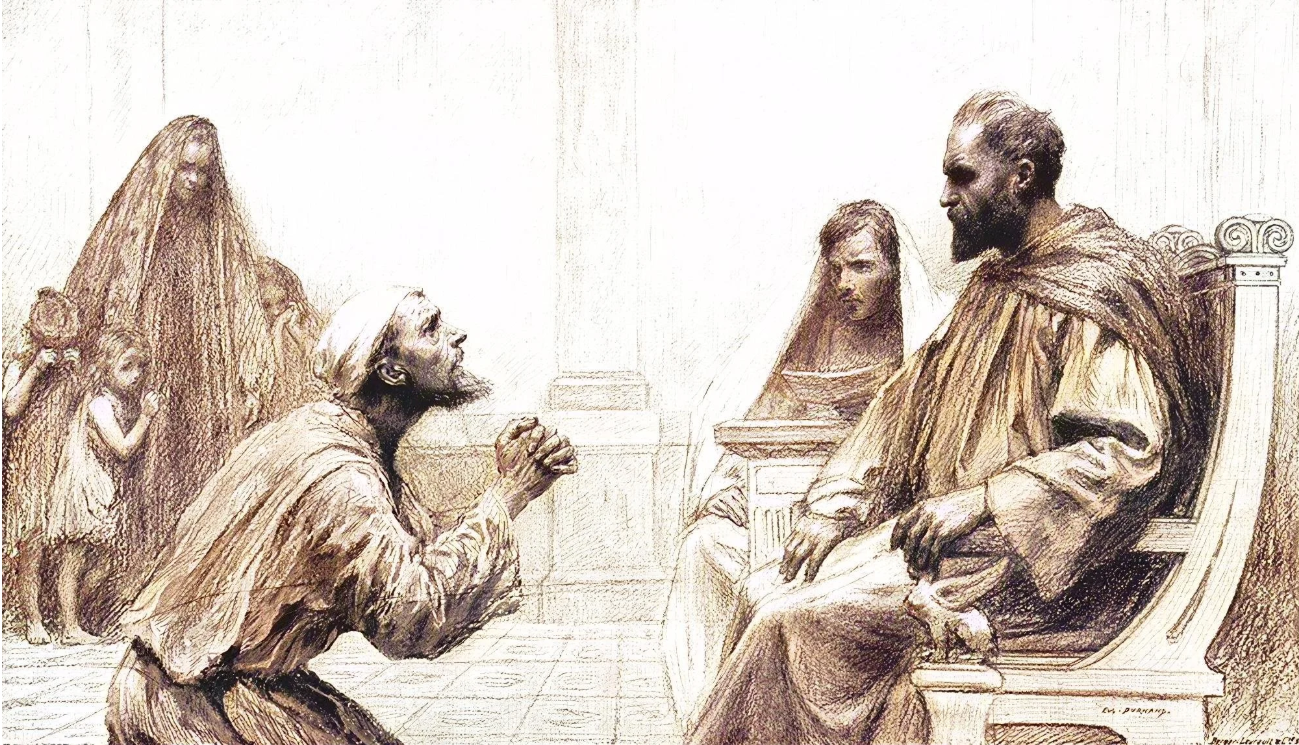
But Jesus says, no, not seven times, but seventy-seven times. It’s not 70 x 7, as in 490. It’s just the King James way of saying 77. But obviously the literal number is not the point. It’s the exponential increase of Peter’s number. The number, even if it were 490, is not the point, and Jesus tells a parable in order to demonstrate it. There was a slave who owed his master, the king, 10,000 talents. And when the slave cannot pay back his debt, the master orders him sold with his wife and children until they pay the debt. Seems harsh, but is it very different from today? Our masters are just faceless credit card and mortgage companies, instead of kings!
At any rate, the slave falls down on his face and begs, Be patient with me and I will pay you everything. This is obviously ridiculous. One talent was roughly 6,000 denarii. And we know that a denarius was about how much a day-laborer would be paid for one day’s of work. So even though the point is not the literal number, if we take it on its face, that would mean 60,000,000 days of wages that the guy owed. This is really as if Jesus said something like, he owed a zillion dollars. I don’t know how many a zillion is, but I know the guy is never paying it back. For him to claim that if he just has a little more patience from the master, a little more time, then he will pay it back is absurd. It not only won’t happen; it couldn’t happen. So with those who think they have time to get right with God. This isn’t about time, it’s about impossibility.
But the master is not a credit card company or a mortgage lender. He does nothing that the slave asks him. He doesn’t give more time, or say, reset the clock. He doesn’t refinance or start the 30 years over. He has compassion, a word that is used of Jesus at least twice in the Gospel, and He forgives the entire debt. He releases the man entirely. He looses him from the burden completely. No more time, no more excuses, no more patience; just forgiveness.
And then that slave goes out and he finds another slave of the same king, and he demands that that slave pay him what he owes, which is 100 denarii. If we remember that one denarius was about one day’s wage, we see that this is a little more than three months’ pay. Is that a small amount? No. Think of three months of your paycheck. Not a small amount. Translate that into terms of sin, and it’s not a small thing, not just a little mistake, not something where you say, no problem. It’s serious. So both things are true here: people sin against you in serious and terrible ways; and their sin against you is not anything like your rebellion and unbelief and despising of God’s word and command, both in love toward Him and in love toward your neighbor. However seriously someone sins against you, it is only part of their sin, and maybe not even the greatest part. That does not mean we should minimize sin, or that it doesn’t really matter. It does. Three months’ wages is a lot. But relative to what the first slave owed, it is hardly anything. And, because the first slave owed far more, what the second slave owes is really just part of what the first slave owes the master.
The second slave gets down on his face and says almost word-for-word what the first slave had said: have patience with me and I will pay you everything. And in this case, it’s actually possible for him to repay. But the servant not only does not forgive, he doesn’t even give him time to repay. He has him thrown into prison until he can pay. And the fellow slaves are disturbed and they tell the master, who has the first slave thrown to the torturers, literally, until he pays back the last cent. And so will your Father in heaven do to each one of you unless you forgive your brother from your heart. “The Gospel of the Lord.”
The overwhelming immensity of the master’s forgiveness is matched only by the unconditional severity of the judgment. That is, there is simply no question how the followers of Jesus are to act. You are the first slave; do not act like him toward your fellow slave, your brother. All of our reasons, all of our excuses, all of our limitations and conditions on forgiveness—all cut down with the single blow of Jesus’ words. Forgive as you have been forgiven. Does that mean that God puts a condition on His forgiveness of you? No, if that were the case, then the master would have said, go out and forgive all your fellow-servants their debt, and then I will forgive yours. Instead, the first slave simply takes the master’s forgiveness for granted and it changes nothing for him and how he treats other people. But if God’s forgiveness is not enough for other people, then it is not enough for you. By the measure you judge, you will also be judged. No mercy for others means no mercy for you. And that is because your forgiveness is nothing but God’s forgiveness in Jesus. You do not have forgiveness for others, unless you have God’s forgiveness. Forgiveness is not something you drum up out of the depths of your heart and give out of your goodness. It is simply relaying the fullness of what has been already given to you.
At least one of the reasons why we come up with limits and conditions on our forgiveness of others is that we are afraid of losing something. We are afraid our forgiveness will be abused. We are afraid that we might be harmed. We are afraid that the person we forgive will take advantage of us. And all I can say is that they very well might. That’s what this world is like. That’s why every good gift God has ever given has been abused and taken for granted and misused. Why would it be different for us when we give out God’s gifts to other sinners? You may lose something. If a man asks you to go a mile with him, go two. If a man asks for your coat, give him your cloak too. If a man strikes you on one cheek, turn the other to be struck. But all of that fear is because we think of forgiveness only in this world, only in this life, only before death. And you only have one life, so you can’t lose anything, because this is all you get. But Jesus’ forgiveness doesn’t come from a dying world. It comes from His resurrection. It comes from a new world that has been begun in Him. And you have already died. Your life is hidden with Christ in God. You cannot lose anything you already can’t keep. Your forgiveness of others comes from the resurrection life of God, where everything is already made new and made whole. No one can take any of that from you. You cannot lose it because it is in Christ. So you are free to forgive as you have been forgiven. You are free to love as you have been loved. It is absolute, unconditional, overwhelming, and contrary to every reason, philosophy, and understanding in this world. It is, very literally, counter-every-culture that humans build. It covers every sin, because it is not yours, but Christ’s. And because you are Christ’s. He covers even all your unwillingness to forgive, and explodes all our limits and conditions. His forgiveness covers you, and it covers everyone who sins against you, now and forever.
In the Name of the Father and of the Son and of the Holy Spirit. Amen. “And the peace of God, which surpasses all understanding, will guard your hearts and your minds in Christ Jesus” (Philippians 4:7, ESV). Amen.
— Pr. Timothy Winterstein, 9/11/26

