Audio of the sermon is here:
In the Name of the Father and of the Son and of the Holy Spirit. Amen.
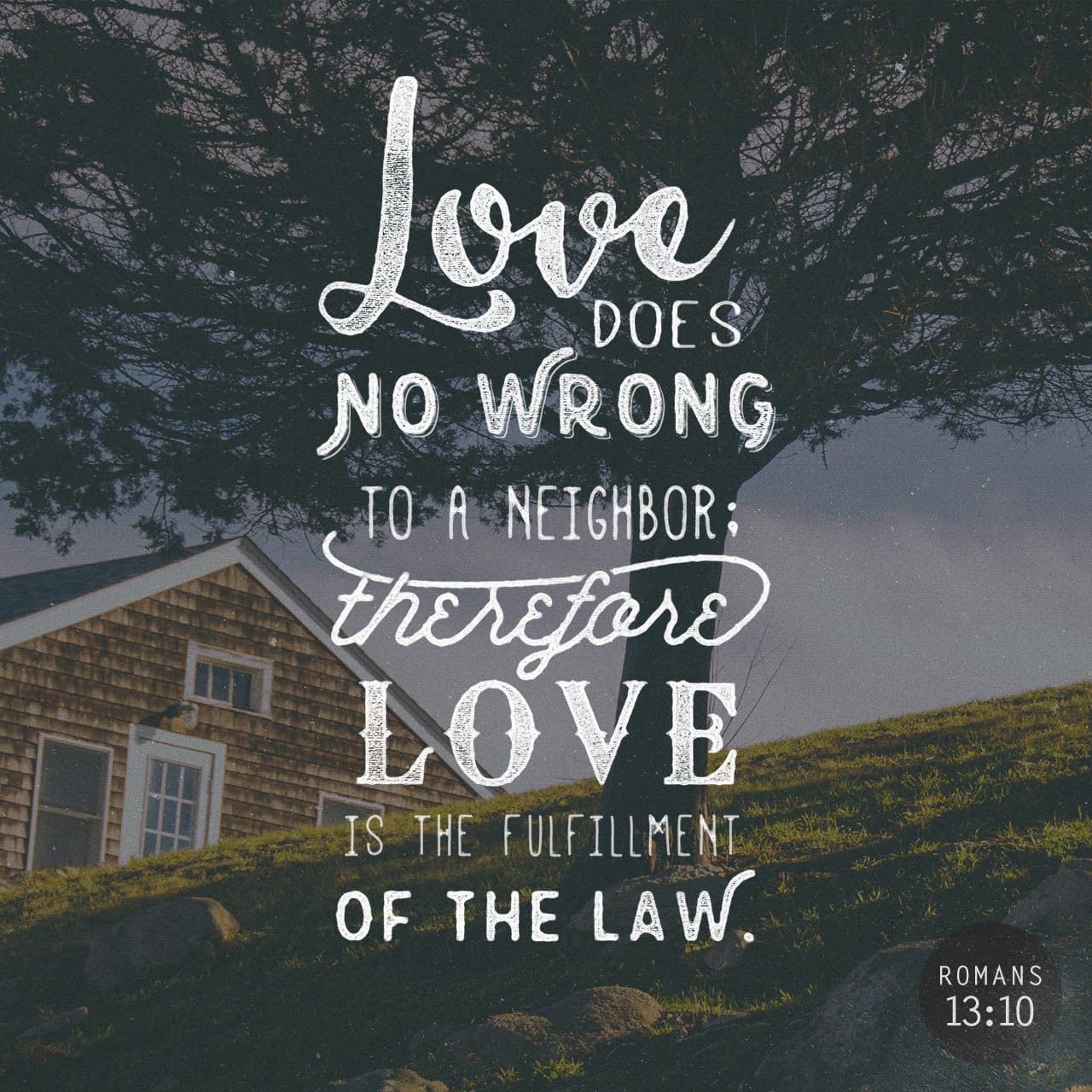
Last week, we heard St. Paul’s words to the church in Rome—and to the church of all times and places—to “let love be genuine.” Today we hear Paul’s words, “Owe no one anything except to love one another. The one who loves another is fulfilling the law. All the commandments, you shall not commit adultery, you shall not murder, you shall not steal, you shall not covet, and whatever other commands there are, are summed up in this word: love your neighbor as yourself. Love works no evil against a neighbor; therefore, love is the fulfillment of the law.”
Those are not two words we often hear next to each other: love and law. We might even think they’re opposites, that love has nothing to do with the law and vice-versa. But that is evidence that our definition of love has slipped. Even more surprising, in the beginning of this passage, Paul says that paying taxes is loving your neighbor, which is certainly something that I don’t appreciate! He says that we are to pay what is owed: if taxes or revenue or honor or respect is owed, we are to give it. And then he immediately says that we are to owe no one anything except to love one another. So if we are to pay what we owe to whomever we owe it, and if we are to owe nothing but to love, then when we pay what we owe, we are loving our neighbor. Loving your neighbor is just doing what various relationships require: citizens and those in authority, children and parents, husbands and wives, etc.
But it’s hard when our definition of love has slipped so far. In English we can use the word “love” for all sorts of things: I love coffee, I love my dog (sometimes), I love my wife, I love my children, I love my classes, I love my job, I love to travel, I love this band, I love that movie. But clearly those things are not on the same level—at least I hope they’re not. And my wife does, too. If I love coffee in the same way or on the same level that I love my wife and children, I have a serious problem.
But the problem is really with the way we use the word “love.” For most of us, when we use that word, it doesn’t mean I do the things that my relationships require, even when I don’t want to do them. It means I feel a certain way about a thing or a person. I enjoy something or someone. And so it’s easy, then, to “fall out of love,” or to stop “loving” the things we “loved” when we were younger. Of course, it’s worse than that, because it becomes very easy for us to let the word slip a little bit more, so that “God loves someone” or “I love God” run along the same lines as “I love coffee” or even “I love my family.” Then we just put it all on a scale of how much we feel good toward something or someone, up to and including God.
But let’s work it the other way around. Instead of moving from the way we use the word and then applying that to God, what if we moved from the way that God defines the word and then, at least, the Church can use it correctly. I don’t mean a dictionary definition, defining a word by using other words. I mean what the Latin means: to set limits or boundaries on something. But God doesn’t do that only with His Word, as when He sets limits between earth and sea and sky. He does it more definitively, pun intended, when He acts in certain ways. God means everything He says, but there is no gap between what He says and what He does, as there is between what we say and do. And what is praise, everywhere in the Scriptures? It is, first of all, the glory due to God for what He does. You have thrown the horse and his rider into the sea. You have brought us through the wilderness. You have brought us into the land of promise. You have kept your promises to Abraham, Isaac, and Jacob. The Psalms, for example, do not start with what God is like, His characteristics, and then proceed to what He does. It is exactly the other way around: what has God done? That’s how we know what God is like.
And what God has done is love. This is how God loved the world: He sent His only-begotten Son into the world so that whoever believes in Him will never perish but have eternal life. This is how we know what love is, not that we loved God, but that He loved us and gave His Son as an atoning sacrifice. Love is defined—bounded, limited—in and by Jesus. He chose to love the world this way, for His Love to be conceived and born, to live and die and rise from the dead, so that we wouldn’t have to figure out what love is, but we would see and hear it. It is not only that God loves, or that God is loving. God is Love itself. So then anything that is done against or apart from Him cannot, by definition, be love. The definition of love is Jesus, expressed in the limits, in the boundaries, of His flesh and blood, His body, crucified and resurrected. But not confined there for His own sake. In His incarnation, death, resurrection, and ascension, that love that is defined by Jesus opens up to you and to all people, so that you might share this love of God. Everything else is less. Everything else is reduced to a cliché or a tautology: love is love, which means nothing at all.
God’s love in Jesus finds its limits in Christ, in this creation, so that we know it is concrete and specific and located; but it also opens up without limits for every single person who has ever lived and will ever live, so is our love. It is bounded by the commandments of God. That is, whatever else it is, it is not love to dishonor our parents. Whatever else it is, it cannot be love to commit adultery or to treat people to whom we’re not married as if we were married. Whatever else it is, it cannot be love to take our own or other people’s lives, life that God has given to them. It cannot be love to take the things that God has given to other people. We do not get to define love as we wish; that is, we do not get to make up our own good works. Love is the fulfillment of the law, and the commands God gives describe concrete ways in which we love our neighbor as ourselves. The law keeps our sinful flesh in check, and puts to death our sin continually until we die, so that sin will have no hold on our resurrection bodies in Christ.
But there’s more. Because the love of God in Jesus is not just measured up to the letter of the limit of the law. It explodes the measuring, limiting, counting way that sinners use and try to keep the law. God’s grace and mercy are not counted out bit by bit according to our sin against the law of God. They are given completely, fully, far beyond and not according to the law. And so it goes for our love for one another. Even though we have commands that bound love so that we do not make up our own ideas and definitions of love, the command to love opens up in a thousand ways, it breaks out in infinite ways.
How many ways are there to care for your neighbor according to the life and body God has given to him? More than we can count. How many ways are there to be chaste and protect and respect the marriage bed? As many ways as there are Christians. How many ways are there to honor and love our parents? As many ways as there are children and parents. What we think of limiting us, contrary to love, when we are under the law is unlimited and free and open for those who are in Christ. You will never run out of opportunities to love your neighbor as Christ has loved you. You will never run out of times to forgive those who confess to you, as Christ’s forgiveness is infinite. You will never cease to have responsibilities to care for other people with the gifts God continually gives. Even in the new creation, in perfect, restored, resurrection bodies, love will continue. Now we do it imperfectly. Now we practice love. Now we continually act in loveless ways. Now we must constantly walk by faith and in hope. But then we will love perfectly, both God and other people. What will it look like? I am not sure. But it will be exactly as God always meant His creation to function, in the perfect harmony of all creatures together before their Creator. This is why faith, hope, and love remain, but love is the greatest. Because faith and hope will both be swallowed up by sight and having what we hope for. But love continues forever in the one who is Love.
In the Name of the Father and of the Son and of the Holy Spirit. Amen. “And the peace of God, which surpasses all understanding, will guard your hearts and your minds in Christ Jesus” (Philippians 4:7, ESV). Amen.
— Pr. Timothy Winterstein, 9/4/26

