Audio of the sermon is here:
In the Name of the Father and of the Son and of the Holy Spirit. Amen.
There were lots of answers back then, and there are lots of answers now. When Jesus asked His disciples, “Who do people say that I am?” He got the answers that were going around then: some say John the Baptist, some say Elijah, and some say Jeremiah or one of the prophets. Herod thought Jesus was John come back from the dead. There’s a prophecy in Malachi that Elijah would appear before the “great and awesome day of the Lord.” And Jesus speaks like a prophet. He doesn’t seem to care what people think about His words, or what they might do to Him. He simply speaks and lets the words stand as they are.
If you were to ask someone on the street, or in one of your classes, or in your dorm or apartment, or at work: who do you think Jesus is? I suspect you would get a lot of different answers. People generally seem to have a pretty good opinion of Jesus. He seems like a nice guy. He talks a lot about love. In fact, people often sum up Jesus’ words in “Love one another,” or “love your neighbor as yourself,” which is actually from Leviticus. You would think that’s the only thing He said. But He says a lot of things in the Gospels, a lot of which people might be surprised to hear! Most people think He just wants people to be nice. Some people think Jesus is a teacher, like other religious teachers, of a good way of living in the world. Others may say that Jesus is the highest embodiment of what human beings could be, and if you follow His way, you too could activate and achieve your full humanity.
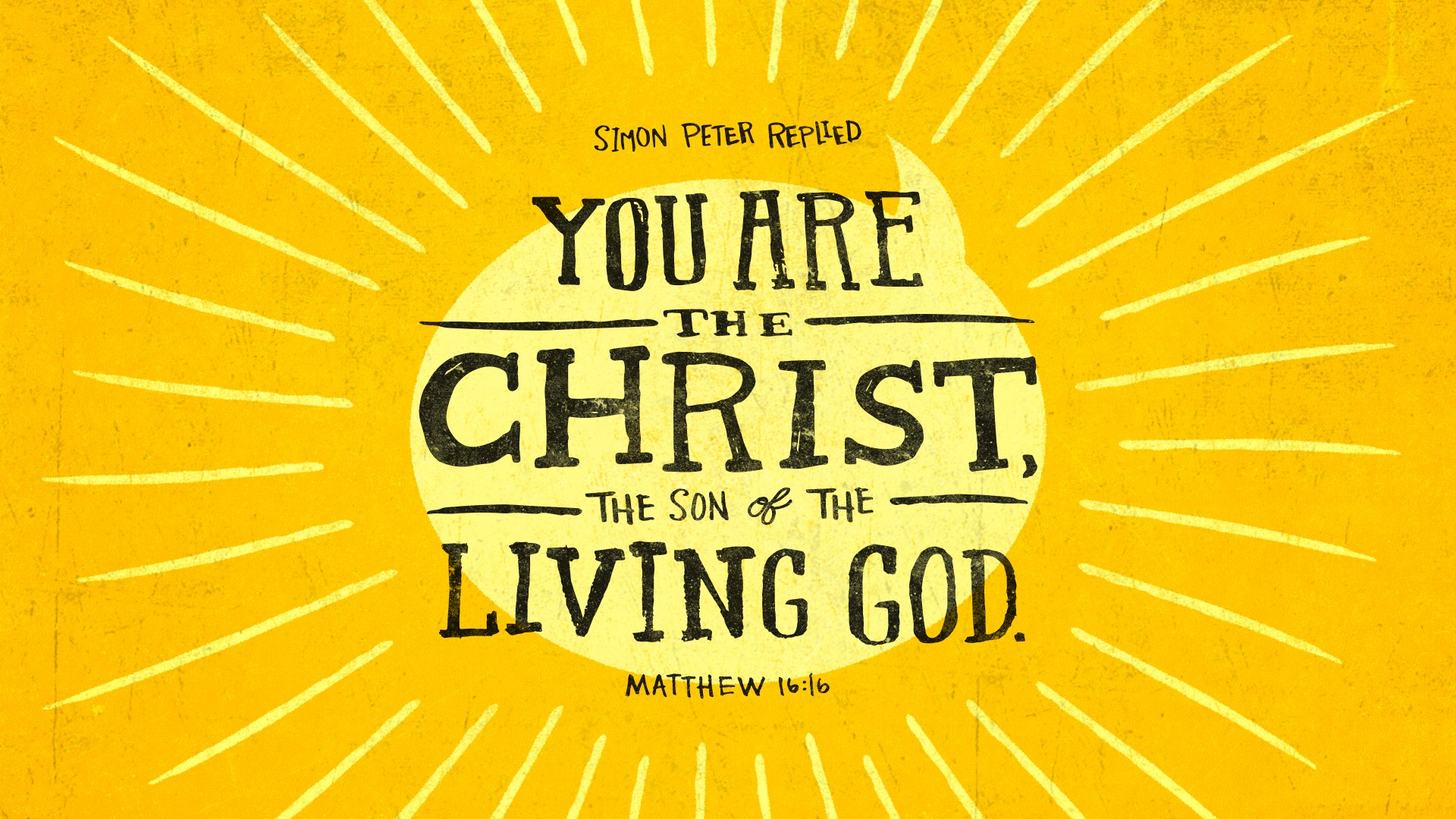
But whatever people may say, whatever the answer to the question, What do people say about Jesus, the Son of Man?, that’s not the most important question. People say all sorts of things, some more informed than others. And you don’t have to worry about all of those things. You don’t have to be afraid of it. People and their opinions come and go. The far more important question, the basic and fundamental question, is what Jesus says after: But you—who do you say that I am? In other words, this isn’t really about them; it’s about you. Who do you say that Jesus is? Peter answers for the twelve: You are the Christ, the Son of the Living God. You are Christ, which is not Jesus’ last name. It’s actually a title: christos. It’s a Greek word that means, “anointed.” It’s the Greek version of meshiach, or messiah.
When people are anointed, usually with oil, in the Old Testament, it identifies them as people who have been set apart for a specific role or office or job. So kings were anointed; this is the king. You could accept it or not, but if someone was publicly anointed as king, especially if God had sent the person to do the anointing, then that person was king. Prophets were sometimes anointed, identifying them as the ones whom God had sent to speak His word. Priests were anointed, identifying them as the ones who were to offer the sacrifices and take care of the tabernacle and the temple. And Jesus is anointed, when He is baptized by John in the Jordan. He is anointed publicly and visibly by the Holy Spirit, descending in the form of a dove. He is the one who has and brings and gives the Holy Spirit. And God the Father speaks from heaven, “This is My beloved Son, with whom I am well-pleased.” He affirms it on the mountain of Transfiguration, and says, “Listen to Him.” And He confirms everything that Jesus says and does when He raises Him from the dead.
This is My Son, the Son of the living God—not of dead gods. All the other gods are dead, because they have no life and they cannot give life. Whether they have a statue or an image, they cannot do anything. When the ark of Yahweh’s covenant is brought into the temple of Dagon, the fish god of the Philistines, the Philistines find Dagon’s statue fallen over, its head and hands broken off. Dagon is like the rest of the gods: he cannot hear, he cannot see, he cannot speak, and he cannot act. But the Father of Jesus is the living God, who has made all things through the Son, the Word who was made flesh. He has the life of God and He brings that life on the earth and gives life to His creatures.
This is the confession of Peter: You are the Christ, the Son of the living God. But confession means to say the same thing. You cannot confess only with yourself. So Jesus says to Peter, “Blessed are you, Simon, son of John! Flesh and blood—no other person, no matter what they say about Jesus, and Peter’s own flesh and blood—flesh and blood did not reveal this to you, but My Father in heaven revealed it to you.” In other words, Peter did not put all the pieces together, follow the logic of the situation, and conclude that Jesus was the Christ. In fact, the disciples very often do the opposite and mistake who Jesus is. But the Father gave this word to Peter, so Peter confesses with the Father what is true of Jesus.
And you confess. You either say the same thing as whatever ideas are out there about Jesus, or you say the same thing as Peter, which was given to Him by God. No one ever says anything new about Jesus. They think they do. They think they’ve come up with some new idea, but all you have to do is be a little familiar with the history of the world after Jesus and the controversies in the Church, and you will realize that no one says anything new. They just repeat old, false ideas. And we don’t say anything new about Him either. We just confess what has been given to us by God in Jesus, through His apostles and prophets.
Who do you say that I am, Jesus asks. This is the most important question. How do I know it’s the most important? Because Jesus says to Peter, “I tell you, you are Petros, Peter, and—He makes a pun on Peter’s name—on this petra, rock, I will build My Church, and the gates of hell will not be victorious over it.” Peter’s confession, given to him by the Father, is the very foundation of the Church. If what He says is false, then we are wasting our time here. But if what He says is true, nothing can ever defeat or destroy or remove the Church. Jesus builds the Church, and He builds it on the foundation of the apostles and prophets, with Himself as the chief cornerstone, in which the whole thing holds together. Because the words of the apostles are His words and the words of the prophets are His words. And He puts you, as living stones, into this massive house of God. Congregations and denominations may go away, but “built on the Rock the Church must stand.”
Who, then, do you say He is? You are making a confession by being in this place. Because you are here, you are giving your answer to that question. You are here because you know that Jesus is here—not was here, as if we were just here to remember a dead man’s words. Jesus is here as the crucified and resurrected Son of the living God, to deliver to you His gifts. This is His divine service of you. You know that no matter what happens tomorrow, or this semester, or this year, the one thing that cannot change is that you are a baptized child of God. He put His Name on you, joined you to Christ, and that identity can never be shaken, because it depends on the promise of God, who never lies. Before you ever said anything about who Jesus is, God said something about who you are: this one is My beloved child, whom I made, whom I redeemed, whom I am make holy.
By being here, you are saying that Jesus is your Lord, who has purchased and won you, who were lost and condemned, with His own precious blood to be His own and to live under Him in His kingdom, because He lives and reigns forever. You are saying that you know where Jesus has promised to be found, where you can take refuge when the weight of living in this world is pressing down on you. But even more, when the weight of your own sin, pressing you down into death, is weighing on you: the things you’ve done and left undone; the things you’ve hidden from everyone else, and the things you’ve forgotten. Here is where you confess your sins and Jesus lifts and removes that burden, as He continually forgives your sins. By being here, you say that Jesus is the one who meets you here and gives you the life of God in His body and blood, according to His word. By being here, you are answering the question of Jesus, who do you say that I am?
But not only here. This is not the only place where Jesus is Lord and Christ, although sometimes it seems like it. But Jesus is Lord of all things, Lord of this whole creation and all its creatures, even the ones who do not believe it. So when you go out there to your classes and the places where you live and work, you also give the answer to that question. When people ask you why you come here, or why you’re a Christian, or how you deal with everything, you confess that Jesus has made you His own and gives you forgiveness and life and healing and resurrection and hope. He says, Come to Me all who labor and heavy-laden, and I will give you rest.
And you go about your lives out there because of what you have heard here. God has given you various relationships, to care for other people, to love them, to do everything to the best of the ability that God has given to you. You know that your status and identity before God depends on nothing except what Jesus has done, so you are free to give everything for others in the many ways, and according to the various gifts God has given to each one of you. And He has established little outposts, little embassies in this world, where He declares that He is Lord of all things.
Who is Jesus? He is Lord and Christ and the Son of the living God, for you here in this place, and because of that certain promise and word, everywhere you go. And nothing can knock Him off His throne, now or ever. Thanks be to God!
In the Name of the Father and of the Son and of the Holy Spirit. Amen. “And the peace of God, which surpasses all understanding, will guard your hearts and your minds in Christ Jesus” (Philippians 4:7, ESV). Amen.
— Pr. Timothy Winterstein, 8/21/26


Jesus said: For flesh and blood has not revealed this to you, but my Father who is in heaven.” Is there any particular reason for Jesus to say that his Father revealed this to Peter, rather than the Holy Spirit? Wouldn’t this type of revelation be more commonly a function of the Holy Spirit rather than God the Father?