Audio of the sermon is here:
In the Name of the Father and of the Son and of the Holy Spirit. Amen.
Peter makes a confession: You are the Christ, the Son of the living God. And Jesus says, “Blessed are you, because no person revealed this to you; My Father in heaven revealed it to you.” And on the confession, Jesus promised to build His Church. The blessed one makes a good confession, but he has no idea what it will mean, either for Jesus or for him. His confession is good and right, but he doesn’t know that it means the cross for Jesus, and then for him. It is clear that he doesn’t know what it means when Jesus begins to tell the disciples what it will mean: He began to tell them how it was necessary for Him to go to Jerusalem and suffer many things and die and rise on the third day. And Peter rebukes Jesus: God forbid! This shall never happen to You! This is probably why Jesus told them not to tell anyone that He is the Christ, because of things like this. Peter has the right confession, but he has the meaning wrong.
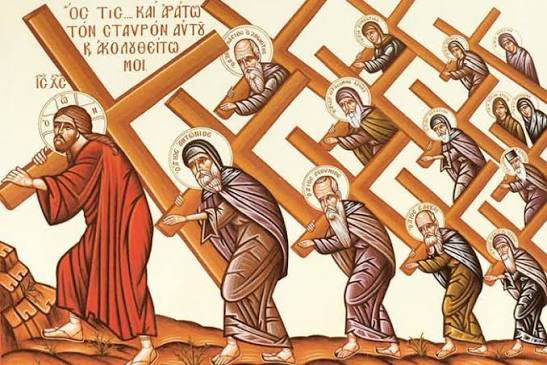
We said last week that we also make confessions of who Jesus is, both in here and wherever we go, because Jesus is Lord in every place. And the fact is that we cannot know exactly what our confessions will mean either. Peter does not want his confession of Jesus as Christ and Son to mean suffering, death, and resurrection. He wants Jesus to be a different kind of Christ than the one He says He will be, just like Satan in the wilderness. So Jesus tells him to go back behind Him, following Jesus, where he belongs. And for those who go behind Jesus, following Him, it will mean the same thing it means for Jesus: deny yourself, take up your cross, and follow Me. This is the greatest heresy of our time! Everyone says that the goal is to fulfill yourself, complete yourself, do what you think will make you happy above everything else. But Jesus says, no, deny yourself.
Does Jesus mean that you—your self—should be erased? That you should disappear? That you should be someone other than who you are? Well, yes and no. He certainly means that you should cease to be the person who satisfies your sinful flesh, indulging yourself, getting what you can and ignoring everyone else, except as they can assist you in your success. He certainly means that you should hate evil and hold fast to what is good. He means that you should leave vengeance to Him, and not take it on yourself to avenge when people harm you. He means that you should do good to your enemies. But He does not mean that you, the person whom He created and for whom He died, should be erased. This is the irony of Jesus versus us: we think that we know better than He does who we are. We think that when He commands us to be fully human, fully the creatures created by God the Creator, that when we disagree with His commands or they go against what we think is right, that to do what we want is to fulfill ourselves. As if the creature knows better than the Creator what He meant for His creatures. But, in fact, when God gives commands, it is all aimed at what human beings should be to be fully human. So Jesus says, What good would it do you to expend all your effort and invest in gaining everything you can in this world, only to lose it all in the end? Jesus says that you can go out and do everything within your power, everything you think will make you happy and successful and fulfilled, and what will it get you in the end? Nothing. You will lose it all. But the one who loses his life for My sake, Jesus says, will find his life. He will find it, right in the place where he thinks it is gone and lost forever, right in the middle of death: there you, who die in Jesus, who lose your life for His sake, will find life beyond the threshold of death.
I can’t tell you what the cross will look like that comes with your confession of Jesus. Crosses are unique. Peter’s, at least according to tradition, was an upside-down cross, because he said that he was not worthy to die in the same way as His Lord had died. But this confession is a choice. And we never know where our choices will lead us. You may have a lot of choices now: what classes, what major, what job, what spouse, etc. Some of us have fewer choices in a lot of those areas. And the older you get and the more choices you make, the fewer choices you will have. In fact, we think we are completely free to choose, but we should realize as quickly as possible that the idea that you can be anything you want is a lie. No matter what I wanted, or how hard I worked, I was never going to play in the NFL. You and I are all limited by our genealogy, our location, etc. Every one of us. And, in fact, if you were baptized as an infant, you did not get a choice. You can believe the promise God made there or deny it, but you can’t undo it. Even so, is there a sense in which your confession now is a choice? As much as Peter’s was, and as much as his denial was.
But here you are, making your confession, and that confession comes with a cross. You don’t get to choose your crosses. You make your confession as one who belongs to Jesus, and the cross will come, in some form or another. It may come as persecution, although the American church has been remarkably free of real persecution relative to the rest of the world and the rest of Christians throughout history. It may come when you don’t get a job. Or you may have to quit pursuing something you thought you wanted because you can’t live like a Christian in that environment or context. You may not end up marrying someone you thought you were going to, because that person does not confess Christ. Your choice of Christ, because of the Holy Spirit’s work, may mean you lose friends or you lose opportunities or some other thing. It may mean that you doubt the God whom you’ve believed. You may not be able to hear Him or see Him and you may have to endure for a while in the darkness of uncertainty or suffering or unanswered prayers.
You don’t get to choose your crosses, but you choose whether to take them up and endure them or whether to throw them off. But understand what it means to throw off the cross God lays upon you. It doesn’t mean you won’t physically die. None of us gets a choice in that matter. But the difference is whose death you will die: Jesus’ death, which has already over and done and finished in resurrection; or your own, which only ends in death, with no resurrection? Taking up the cross that is laid upon you, denying your sinful flesh, will mean that you will end up where Jesus has already gone, into the resurrection. Throwing it off may mean you are outwardly more fulfilled, but what good is it to gain even the entire world and still lose your present and eternal life? Instead, under Jesus’ cross, there is life now and life forever, because He is already raised from the dead. And His body must go and be where He is.
And for those who bear the crosses of living by faith in a world of sights and sounds, you have a promise. It is a promise that is here for you, that none of your sins will come between you and God because Jesus already bore them. It is a promise that He will give you refuge and sustain you as you endure the crosses, by feeding you with His own body and blood. And you have a community that was chosen for you by Jesus, to which you were joined. A community in which love is genuine, a community in which we rejoice with those who rejoice and weep with those who weep; where we bear one another’s burdens as we live under the cross. A community in which you will always hear the promises of Jesus and know the hope of the resurrection. Where your confession of Christ will find its fulfillment in Him, in whom you will never be put to shame.
In the Name of the Father and of the Son and of the Holy Spirit. Amen. “And the peace of God, which surpasses all understanding, will guard your hearts and your minds in Christ Jesus” (Philippians 4:7, ESV). Amen.
— Pr. Timothy Winterstein, 8/29/26

